Credit-Based Trial Experiments and Paid Conversion Outcomes in AI Products
How credit allocation shapes trial-to-paid conversion in AI products.

Credit-based trials work differently than time-based trials, and the difference matters more than most product teams realize. A time-based trial gives every user the same fourteen days regardless of what they do with them. A credit-based trial hands control of the clock to the user: burn through the allocation fast and the trial ends fast, use it sparingly and it might never end at all, or never deliver the moment that makes someone pay. That inversion, usage instead of the calendar setting the pace, is what makes credit trials a precision tool rather than a blunt one. Every parameter in that structure, from how many credits a new signup gets to what happens the instant the balance hits zero, is a variable with a measurable effect on conversion.
Credit-based trials shift the pacing mechanism from calendar time to consumption, and that structural difference produces measurably distinct conversion dynamics. A time-based trial treats every signup identically regardless of engagement; a credit-based trial ends when the balance hits zero, which means the trial can conclude in hours for a heavy user or linger indefinitely for someone who barely engages. Activation rate accounts for 60% to 75% of conversion variation under either model, but in a credit trial the allocation itself is the primary lever controlling whether a user reaches the value moment at all. ChartMogul's January 2026 benchmarks put a "good" AI-native conversion rate at 6% to 8% and a "great" one at 15% to 20%, with the gap between bottom-quartile and top-quartile outcomes driven by structure and activation, not product quality.
AI products push this dynamic harder than most software categories, because compute cost per task doesn't scale in a straight line. A single multi-step agent run or a long-context inference call can burn through what a dozen simple queries would cost. That nonlinearity is also why AI teams reach for credits over time gates in the first place: free users on AI products are expensive to host, and credits help constrain that cost exposure. Credits also let a company hide GPU minutes and token counts, numbers a typical buyer can't reason about, behind a unit anyone can count. Finance likes this because it maps cleanly to what's being spent on infrastructure. Customers often like it less, because they frequently have no real sense of what a credit buys them until they've spent a few.
How do credit-based trial conversion rates compare to time-based trials in AI products?
The spread in outcomes is the first thing worth sitting with. Available B2B SaaS benchmarks put the gap between the best and worst-performing trial structures at four to six times, and the driver isn't product quality. It's structure.
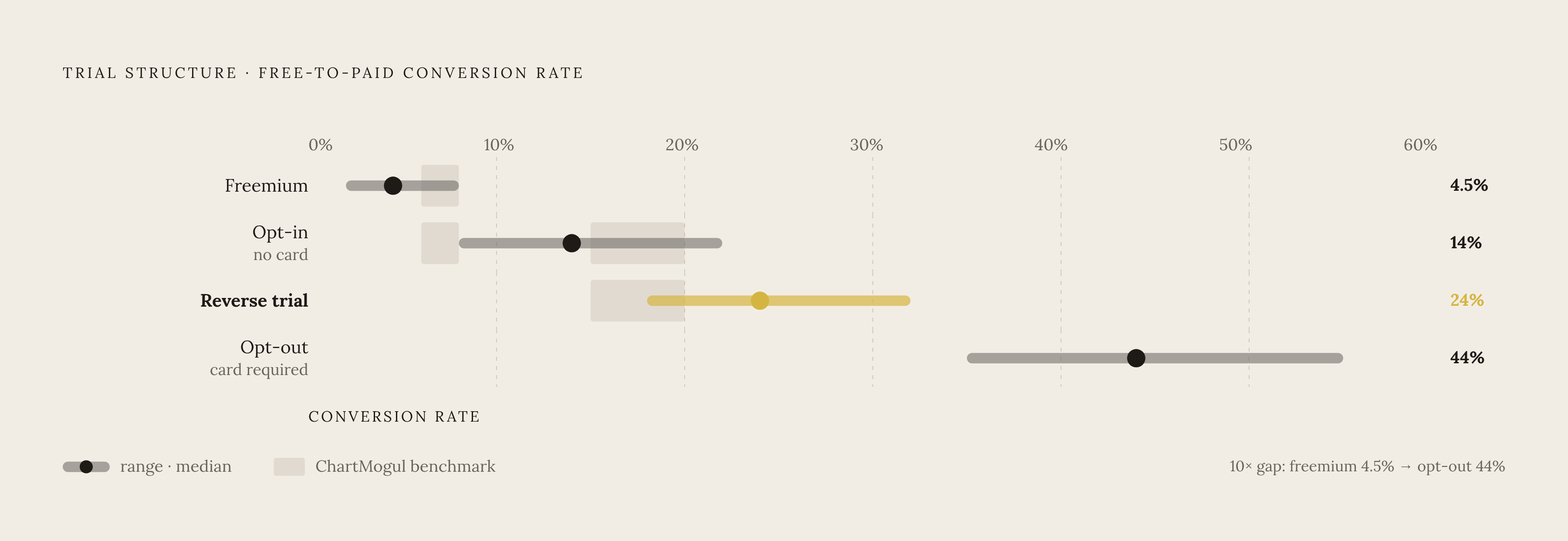
Broken down by model, opt-in trials that don't ask for a credit card land between 8% and 22%, with a median around 14%, according to available benchmark data. Opt-out trials, the ones requiring a card up front, run 35% to 55%, median 44%. Freemium sits far lower, 2% to 8%, median 4.5%. Reverse trials, where a user gets full access first and drops down to a limited tier later, land between 18% and 32%, median 24%.
Credit-based trials don't sit neatly inside any one of those buckets. They can be run opt-in or opt-out, and whichever card requirement a team chooses gets layered on top of a consumption constraint that neither of the other models has. ChartMogul's January 2026 report benchmarks AI-native products separately: a "good" conversion rate is 6% to 8%, a "great" one is 15% to 20%. That's a touch better than traditional SaaS overall, which is notable given how often AI products default to freemium, a structure that converts at the bottom of the range.
The number that should anchor any design decision here: activation rate inside the trial accounts for 60% to 75% of the variation in trial conversion, according to GrowthSpree's 2026 data, and that holds regardless of trial length or whether a card was required at signup. Credit allocation isn't a pricing lever dressed up as a growth tactic. It's the primary lever for activation itself. A trial that gets someone to the "aha" moment converts. A trial that doesn't misses the window no matter how many credits sat unused in the account.
One calibration note worth flagging: the widely cited 18.2% opt-in benchmark from First Page Sage's study of 86 companies gets misapplied constantly, because that sample skews B2B in a way that inflates the number for broader use. ChartMogul's 8.9% figure, pulled from 200 products, is the more conservative and more defensible baseline. The gap between bottom-quartile and top-quartile trial performance is enormous, and activation is where that gap gets decided.
How credit allocation volume shapes the probability of reaching a value moment
Set the allocation too low and the user never gets far enough into the product to see what it's for. Set it too high and there's no pressure to ever come back and pay. Both failure modes cost money, just on different ends of the funnel.
The right way to think about allocation isn't generosity. It's a probability calculation: how many credits does it take to finish the one workflow that produces the value moment, the task that makes someone go "oh, that's what this is for"? That number is the floor for the trial allocation, not a target to trim toward.
One approach worth considering is running trials generously, and sometimes extendably, specifically so a customer can get a feel for real usage patterns before committing to a plan, which cuts down on the anxiety of guessing wrong. But over-allocate too far past that value-moment threshold and something else breaks: if a user can't plausibly run out of credits inside the trial window, the urgency that's supposed to trigger the upgrade decision just isn't there. At that point the trial has quietly turned into freemium, whatever it's labeled as internally.
Allocation also shouldn't be one number for every signup. A document-processing pipeline chews through credits at a completely different rate than someone running single-query lookups now and then. Apply one flat allocation across both use cases and one segment gets shortchanged while the other never feels the pinch that's supposed to drive conversion.
Once the allocation number is set, the next question is how fast it burns, and whether the user can actually see that happening in real time.
Consumption pacing and the visibility problem that kills conversion
The demand-side data on this is blunt. Unexpected charges from consumption-based and AI pricing models hit a large majority of IT leaders, and cost forecasting for AI deployment ranks as the top challenge for the vast majority of CIOs. That's not a billing footnote. It's a trial-design problem, because a user who runs out of credits before ever reaching the value moment doesn't convert. They churn, and they usually churn annoyed.
Part of the issue is that AI tasks don't cost the same. A single-turn query is cheap. A multi-step agent workflow, a fine-tuning run, or a long-context inference call is not. If a trial doesn't tell users which actions cost more up front, they'll burn their allocation exploring low-value tasks and never get to the workflow that would have sold them. Showing the credit cost of an action before someone executes it, a cost preview, directly closes that gap and is already treated as standard practice in well-run consumption products.
None of that works without a metering layer fast enough to keep up. A usage dashboard that updates hours after the fact is close to useless when the credit balance is the thing gating access to the product. AI consumption happens at the speed of an API call, so the system tracking that balance has to move at the same speed or the whole guardrail concept falls apart. That's the reason OpenAI ships soft and hard usage limits, and why Hugging Face built out usage cap tooling: users can't manage what they can't see.
A visibility-first credit trial needs a few concrete things in place. A real-time balance shown prominently inside the product, not buried in a settings page. Pre-action cost estimates before someone commits to an expensive operation. Low-balance alerts that fire before the account hits zero, not a notification after the fact. Rollover and overage policy spelled out clearly at signup, so nobody discovers the rules by hitting them.
Get that visibility right, and the moment of exhaustion stops being an accident. It becomes something a product team can actually design around.
Engineering the exhaustion moment as a conversion trigger
Running out of credits isn't a failure state. If activation already happened by the time the balance hits zero, it's the single highest-leverage moment in the entire trial.
Timing backs this up. Benchmark data on B2B trials shows most conversions cluster near expiration, and conversion rates drop off sharply past day fourteen. Credit trials follow the same logic, just measured in balance instead of days: the deadline that matters isn't a date on the calendar, it's a threshold on the meter.
What a product does at zero balance decides the outcome. A hard stop with no obvious next step just pushes the user out the door. A hard stop paired with an immediate, low-friction upgrade path catches them at the exact moment they're most motivated to pay. A soft warning at, say, a low-balance threshold delivers the pitch before frustration has a chance to build. A credit extension buys more runway for someone who hasn't gotten anywhere yet, but for someone who's already activated, that same extension just removes the urgency that would have converted them.
That's the catch: none of this works unless activation happened first. Since activation drives 60% to 75% of conversion variation, a user who hits zero before ever completing the core workflow is a churn event dressed up as an exhaustion event. A user who hits zero after activating is sitting at the highest-intent moment the trial has to offer.
Designing for that means finding the minimum credit consumption that correlates with activation, which takes metering at the task level, not just a total spent per account. The conversion message should fire once a user has crossed that activation line and dropped below a defined credit buffer, a behavioral trigger rather than a calendar one, and it can't run without usage data arriving in something close to real time.
The financial case for getting this precise is straightforward. A one-percentage-point lift in conversion produces roughly 15% more new revenue per trial cohort, according to Pulseahead's analysis. That's not a marginal tweak. It's the kind of number that justifies engineering time even for teams running modest trial volumes.
The parameters worth treating as testable variables in a credit trial experiment
Because a credit trial is built out of parameters, each one is a hypothesis waiting to be tested against a conversion outcome, not a setting to configure once and forget.
Initial allocation is the first: test it by segment and by expected use case, since the number that gets a power user to activation is going to over-serve someone doing lightweight lookups. Credit-to-task mapping, meaning how many credits a given action costs, controls burn rate directly, and adjusting it changes the effective length of the trial without touching the headline credit number at all. The low-balance alert threshold decides when the conversion pitch lands relative to exhaustion, worth testing at various low-balance thresholds to see which produces the cleanest handoff. Exhaustion behavior itself, hard stop versus soft gate versus overage cap versus extension offer, produces a distinct conversion curve for each option. Extension eligibility cuts both ways: offering more runway to users who haven't activated yet can lift activation, but offering the same extension to users who have already activated can flatten the urgency that would have converted them. And a hybrid model that adds a calendar expiry on top of the credit pool introduces pressure for slow starters that pure consumption-based exhaustion doesn't create.
None of that testing happens if the tooling isn't there. nearly half of SaaS pricing leaders report making critical pricing decisions on intuition alone, which is as much a tooling gap as an organizational one. When pricing logic is buried in application code and finance only sees results once a month in a report, every single test requires an engineering ticket before it can run.
Running this well takes real-time metering at the task level so activation milestones are actually visible, the ability to adjust credit pricing without a code deploy, cohort-level tracking that ties consumption behavior directly to paid outcomes, and product, finance, and growth all looking at the same live data instead of three separate versions of the truth.
That infrastructure question is exactly where the next constraint shows up: how fast a team can actually iterate depends on what's running underneath the trial.
Why the billing infrastructure underneath a credit trial determines how quickly a team can iterate
The scale problem here is easy to underestimate. A single LLM API call throws off at least two billable events, one for input tokens and one for output tokens. A platform processing hundreds of thousands of API calls an hour is generating hundreds of thousands of billing events in that same hour, which adds up to an enormous volume of events a month at any real scale. And it's not just token counts: the metering layer has to track compute time, image analysis, and whatever other task types a product supports, routing each one to the correct pricing logic, all for the same customer, often concurrently.
The rating engine underneath a credit trial has to support pricing expressed as something like (input tokens × rate in) plus (output tokens × rate out), with both rates configurable without anyone touching code. That configurability isn't a nice-to-have. It's the entire mechanism that makes pricing experiments possible in the first place.
Real-time isn't optional here either. Enforcing a credit limit means knowing the balance before a task runs, not after the fact. A system that lags by even a couple of hours can't stop a user from overspending and can't fire a low-balance message at the moment it would actually change behavior.
Building metering infrastructure that performs at this level is a serious engineering investment on its own, long before factoring in the maintenance, compliance work, and ongoing iteration that pile up after launch. Whatever a team ends up using, a few things are worth checking for: usage enforcement fast enough (sub-50ms range) that credit checks don't add noticeable lag to the product itself, support for multiple aggregation types (sum, count, unique count, latest, custom) since different AI tasks need different metering logic, no-code or low-code configuration so product teams can adjust trial parameters without waiting on an engineering sprint, real-time dashboards that product, finance, and growth can all pull from at once, flexible integration options including native SDKs and streaming pipelines like Kafka or ClickHouse for high-volume ingestion, and an on-premises deployment path for enterprise customers where data residency isn't negotiable.
Teams that can turn a trial parameter around in days, rather than waiting weeks for an engineering cycle, run more experiments in the same stretch of time. And since activation drives most of the variation in conversion, and testing is the only way to find the allocation and pacing that actually gets users there, the speed of iteration isn't a side benefit of good billing infrastructure. It's the whole point.