Seat to Usage Pricing Transition at a B2B SaaS Company
AI workloads shatter per-seat pricing, forcing SaaS companies to measure usage instead.

Per-seat pricing still runs most of B2B SaaS, and it's the wrong model for what's happening in the product right now. Every model call, every token, every GPU-minute costs the vendor money the second an AI agent fires it off, and a seat count has no way to see that cost coming. The companies still pricing purely by headcount aren't being cautious. They're pricing the wrong unit, and the invoice eventually says so.
SaaStr told the story with one data point that ought to unsettle anyone still selling by the seat. A company cut its Salesforce footprint from more than ten human seats down to two humans and one API seat, an 80% reduction in headcount using the platform. Its Salesforce bill went up 83% anyway. Agents hit the platform roughly 100 times harder than a human clicking through screens, and pure per-seat pricing can't record that. Fewer humans means fewer seats and less revenue, with none of the consumption upside ever showing up on the invoice. Industry forecasts project at least 40% of enterprise SaaS spend will shift to usage-, agent-, or outcome-based models by 2030, which isn't a marginal correction. It's a rewrite of the model that defined the category for twenty years.
None of this is a eulogy for seats, and it isn't a call to rip them out overnight either. The conditions make the transition rational, arguably overdue, and the real fight left is execution. Almost every company that has tried this so far has gotten some part of it wrong.
What actually breaks when you treat this as a rate-card swap
Teams announce a new pricing page, change the numbers on the site, and assume the hard part is done. That assumption is the mistake. Billing runs at the end of the month and the gaps show up all at once: no usage data to invoice against, contracts that never anticipated variable charges, finance models with no baseline, customers asking why nobody explained any of this before the email went out.
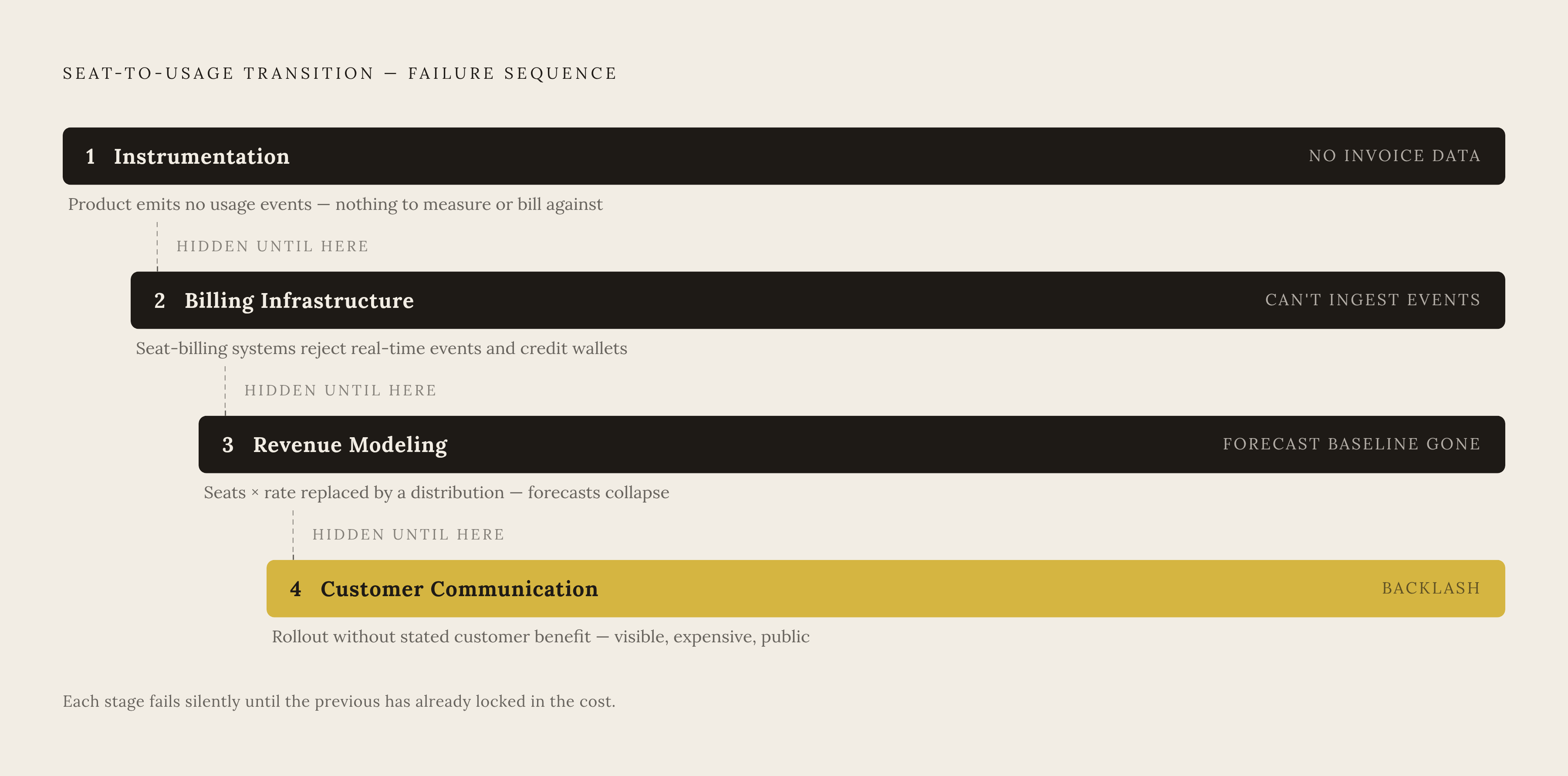
Four things break, in a fixed order, and the order matters because each failure hides the next one until it's too late to fix cheaply. Instrumentation breaks first: a company cannot charge for a unit of consumption its own product doesn't already emit as data. Billing infrastructure breaks next, since most seat-billing systems were built to count logins and run renewals on a calendar, not to ingest events in real time or manage a credit wallet. Revenue modeling breaks because seat revenue is a multiplication problem (seats times rate) while usage revenue is a distribution, and finance teams lose the forecasting baseline they've leaned on for years. Customer communication breaks last, but loudest: companies that rolled out credit or usage systems without explaining why triggered real backlash, because the message described a billing mechanism instead of giving customers a reason to trust it.
Bain & Company's analysis of more than 30 established SaaS vendors found 65% had already layered AI usage charges on top of their base seat structure. Most of the market isn't debating whether to make this change. It's mid-transition, adjusting in public, and getting it wrong in view of its own customers.
Choosing a usage metric that customers will accept and the product can actually measure
The metric has to do two jobs at once: correlate with the value the customer actually receives, and register in the product as something engineering can measure without ambiguity. Miss either one and the pricing model collapses, either because customers won't accept the logic or because billing can't produce a correct invoice.
Three primitives sit alongside seats now, and picking among them is not a style choice. Raw consumption (API calls, tokens, compute minutes, GB stored) tracks closest to actual infrastructure cost but is often too granular for a buyer to hold in their head. Credits sit as an abstraction layer between raw usage and the bill, useful for smoothing out AI workloads that spike and dip unpredictably. Outcomes are the frontier: payment tied to a verified result, which requires both sides to agree, contractually, on what "resolved" or "completed" actually means before anyone signs anything.
Developer tools got here first, for a clean reason: API calls and compute hours already sit in the product's own exhaust. Nobody had to invent a way to measure them. If a company's value metric isn't already trackable in real time, the fix comes before the pricing announcement, not after. Metering something engineering can't reliably emit isn't a product roadmap item. It's a billing correctness problem, and it surfaces as a wrong invoice, not as a strategy debate.
Outcome-based pricing works, but it's a second move, not a first one. Zendesk charges $1.50 per committed automated resolution and $2.00 pay-as-you-go. Intercom's Fin charges $0.99 per resolution and grew at 393% annualized. Both required "resolved" locked down in the contract before launch, because a dispute over what counts as resolved is a dispute over the invoice itself.
Credits are the practical bridge most companies are reaching for right now, and the timing is telling. GitHub moved Copilot to AI Credits on June 1, 2026, with one credit equal to a cent and completions still free. OpenAI ended the free preview of Workspace Agents on July 6, 2026, and now meters every agent run in credits on top of seats. Anthropic switched Fable 5 to metered usage credits on July 20, 2026. Three major AI platforms landed on the same billing object within seven weeks of each other, which is worth noting even as credits get described, fairly, as a workaround rather than a permanent answer.
Whatever the metric, run it through a simple test. Can the product emit it as a discrete event the moment it happens? Can the customer independently check their own consumption against the bill? Does the bill go up specifically when the customer is getting more value, not just clicking more?
Designing the hybrid model that carries existing customers through the transition
Pure usage pricing on day one is the wrong first move for an existing customer base, full stop. Those customers signed contracts under seat economics; they budgeted around a number that didn't move month to month. Switching them straight to variable consumption strips away the predictability they planned around, and predictability was half of what they were paying for in the first place.
Hybrid pricing is the transition state most of the market has already settled into, and the data backs the instinct: companies using hybrid pricing reported a 21% median growth rate, ahead of both pure subscription and pure usage-based peers, according to the 2025 SaaS Pricing Trends Report. There's more than one way to build the structure. Seats can carry a usage cap with overage billed above it. Credits can be bundled per user or per tenant and pooled across a team. Or a company can drop the base fee lower and stack variable charges on top of it.
The live examples are worth studying because they scaled without breaking trust. Datadog prices core monitoring per host, log management per gigabyte ingested, and application performance monitoring per traced request, three separate usage vectors that expand as a customer's footprint grows, and posted $3.43 billion in revenue for 2025, up 28%. Snowflake has no per-seat metric at all: storage by the terabyte, compute by the second per warehouse size, credit-per-hour rates doubling at each tier. Its net revenue retention sits at 158%, among the highest in public SaaS. Intercom combined seat-based pricing with usage elements once Fin AI became part of the product.
What's not defensible is the pattern known as the AI tax: a 20% to 37% price increase at renewal from bundling AI features into an existing SKU. Customers read that as a penalty, not an upgrade, no matter how the renewal email is worded. The honest version charges customers less for what they don't use, rather than more for whatever got added whether they asked for it or not.
Small design choices carry real weight here. Credit rollover policies have emerged as a meaningful design lever, reducing customer anxiety about credits expiring unused. Rollover isn't a cosmetic feature. It's a fairness signal, and customers read it as one.
Anthropic's move in 2026 is probably the clearest structural precedent so far. It lowered the Enterprise seat price to roughly $20 and priced usage separately on top, making it the default for new Enterprise agreements by February 2026. ChatGPT Enterprise, as of mid-2026, hadn't followed suit and remained a negotiated flat-seat contract at a premium per-user rate per month. Two paths, both live in the market at once. But "lower seat floor plus usage on top" is the one gaining validation, and betting against it looks like the wrong side of the trade.
What the metering and billing infrastructure actually needs to handle
Metering splits into two architectural patterns, and picking the wrong one for the product creates problems that surface months later, usually in finance, not engineering. Event-based metering records a timestamped entry every time something discrete happens, a message sent, an API call, a report generated, and suits high-velocity transactional products where pricing wants to sit close to the marginal unit. Resource-based metering instead samples a continuous state, storage in gigabytes, compute hours, concurrent capacity, and fits infrastructure products where consumption isn't a series of actions but an ongoing condition.
Production-grade metering has a floor, and it isn't aspirational: the system must handle high-volume event throughput, near-real-time ingestion latency, complete financial correctness, and effectively continuous uptime. Fall short on any of those and the invoice is wrong, which is a different and worse kind of failure than a slow dashboard. A slow dashboard annoys someone. A wrong invoice becomes a support ticket, then a credit note, then a renewal conversation nobody wanted to have.
Most seat-billing platforms were never built for any of this. They count users and run renewals on a monthly or annual clock. They have no event ingestion pipeline, no sub-second metering, no credit wallet, and no way to run prepaid and postpaid billing on the same account at once. These are architecturally different problems, not variations on the same one. The standard market answer, pairing a metering tool with a separate billing tool and integrating the two, creates a permanent engineering obligation, because reconciliation errors pool at the seam between the two systems, and somebody has to own that seam indefinitely. Flexprice, a metered billing infrastructure platform built for AI and SaaS companies that charge by consumption, treats metering and billing as a single engine rather than two products wired together.
Finance teams feel this first. A finance team spending the first week of every month correcting billing errors is really describing a metering system that can't produce an accurate invoice on its own. Enterprise buyers in regulated industries may also require the billing infrastructure to run on their own infrastructure, a requirement that rules out most cloud-only billing platforms before they're even evaluated. International deals raise a related issue: a billing system priced and floored in US dollars only is disqualified from global enterprise contracts, so hybrid pricing at scale needs currency-aware metering from the start, not bolted on after the first international deal falls through.
One more requirement shows up specifically in AI products. Prepaid credit wallets, where a customer buys a block of credits upfront, have to sit on the same engine as postpaid invoicing for usage beyond that block. These aren't sequential stages a customer moves through one after another. They run concurrently on the same account, and the billing engine has to handle both without the two ledgers drifting apart.
Running the revenue model before and during the transition
Seat revenue is arithmetic: seats times rate, done. Usage revenue is a distribution, and finance teams need historical consumption data to model what that distribution looks like. That data usually doesn't exist yet, because the product wasn't tracking it under seat pricing.
The fix is sequencing, not more forecasting horsepower. Instrument first and price later: turn on usage tracking in shadow mode, emit the events, record the consumption, and let the distribution build before pricing goes live on top of it. Run cohort analysis against behavioral proxies to identify who the power users, median users, and low-usage accounts are likely to be once usage billing turns on. Then model both ends of the range explicitly: what happens to revenue if median consumption comes in at half the expected level, and what happens if the top accounts consume five times more than modeled.
The upside case is real, and it's the strongest argument for making the change at all. Usage pricing expands wallet share inside existing accounts as customers grow, and Snowflake's reported 158% net revenue retention is among the clearest evidence of what that expansion looks like when every additional second of compute is a separate billing event.
The downside deserves the same honesty finance teams give the upside. Organizations with variable or seasonal software needs can cut their costs by 20% to 40% compared to seat-based pricing, and that savings comes directly out of vendor revenue, not out of thin air. Model which accounts are most likely to shrink their spend before the transition is announced, not after the first quarterly numbers come in lower than expected. Margin pressure sits underneath all of this too: AI-native product gross margins are projected to average around 52% in 2026, up from 41% in 2024, still well short of the 80%-plus margins traditional SaaS has run for years. If the pricing model doesn't recover the cost of inference, the margin erosion happens quietly, one usage event at a time, until the quarter closes and nobody can explain the gap.
Pricing needs to become a continuous function, not a one-time launch decision. Teams that treat every rate adjustment or credit exchange rate change as a new engineering ticket will fall behind teams that built the flexibility to adjust in place. Finance, product, and engineering all need shared visibility into the same billing data, because routing requests between departments defeats the entire purpose of metering in real time.
Migrating existing customers without triggering churn
The backlash pattern is consistent enough to name precisely. Companies that rolled out credit or usage systems without explaining the customer benefit got pushback, because the announcement read as a new billing mechanism rather than a reason the customer should feel good about it.
The message needs four things in place before the pricing page changes. What the new metric is, and why it tracks value better than a seat count did. What the customer's own current usage translates to under the new unit, calculated for them rather than left as homework. What last month's bill would have looked like under the new model, ideally landing lower for the median account, because that's the number that actually earns trust. And what protections exist: rollover credits, spend caps, alerts before an account crosses into overage.
Sequencing matters as much as the message. New customers and new contracts should move first, since there's no legacy agreement to reconcile against. High-usage accounts come next, especially the ones whose bills are likely to hold flat or drop under the new structure, since they become the internal proof point everyone else watches. Low-usage accounts should move last and get the most hands-on support, because they face the largest relative shift in how their bill gets calculated, even when the dollar amount barely moves.
Set a firm sunset date for seat-only pricing rather than running both models side by side indefinitely. Parallel pricing structures don't stay simple. They turn into a standing reconciliation exercise for finance and engineering, month after month, with no clean end in sight, and the longer that exercise runs, the harder it gets to shut down.
Sources
- Usage-Based SaaS Pricing Models: Complete Transition Guide
- SaaS Pricing Is Shifting from Per-Seat to Usage and Outcome — What Changes at Your Next Renewal - SoftwareSeni
- The Death of Per-Seat Pricing: What It Means for Your SaaS P&L - The SaaS CFO
- SaaS Pricing Strategy Guide 2026: Per-Seat, Usage-Based,… | NxCode