Annual Commitment Switch Effects on SaaS Expansion Revenue
Annual plans cut expansion windows from twelve to two, reshaping when revenue grows before renewal.

Switching a customer from monthly to annual billing doesn't just change how often an invoice lands. It changes when expansion revenue gets captured, how visible that revenue is before renewal, and how high net revenue retention can climb before the contract structure itself puts a ceiling on it. Most SaaS teams treat the switch as a retention decision, full stop. That's a mistake: it's a revenue-architecture decision too, and the two goals pull against each other more than the standard playbook admits.
Monthly billing is simple. Revenue gets recognized and collected every month, the customer faces a churn decision every month, and expansion (more seats, a higher tier) can happen at any one of those twelve annual touchpoints. Annual billing collapses that cadence. Revenue typically gets collected upfront or invoiced once a year and recognized ratably over the term, and expansion gets squeezed into two narrow windows: a mid-term amendment, if the contract allows one, or the renewal itself.
The retention math behind this trade is well established. Annual plans run churn in the 5 to 10% range, versus 30 to 50% for monthly plans, a gap wide enough to reset the entire denominator NRR gets calculated against. Predictability follows the same pattern, which is why finance teams push so hard for annual conversion in the first place: higher floor, steadier hiring plans, cleaner board decks.
But the mechanism that produces that stability is the same one that narrows expansion. Mid-contract upgrades generate expansion revenue the month they happen. Renewal-time expansions generate it in month one of the new term. An annual plan doesn't eliminate expansion opportunity, it just compresses most of it into those two moments. There's a cash-flow wrinkle too: upfront annual collection front-loads cash into a period that has nothing to do with when the customer actually uses the product, and that becomes a real problem the moment a usage-based component sits on top of the annual base.
Annual plans stabilize revenue that already exists. They do nothing to protect the revenue that doesn't exist yet, the expansion that would have happened at month four under a monthly structure but now has to wait.
When customers actually switch to annual plans, and why timing within the customer lifecycle is decisive
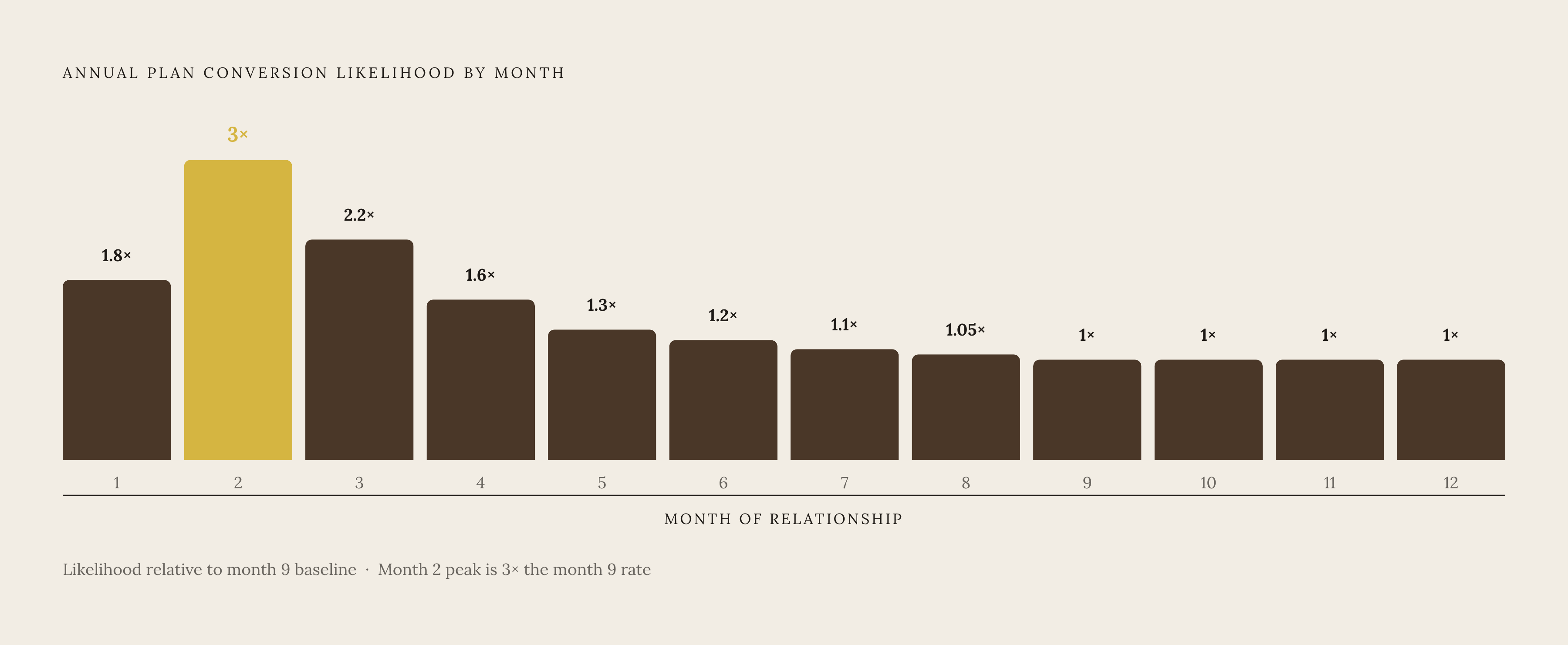
ChartMogul's 2025 SaaS Billing Report, drawing on more than 2,500 companies, found something that ought to reshape how teams think about the upgrade prompt: conversions to annual plans peak in month two of the customer relationship. New customers signed in January 2024 were three times more likely to switch to annual in month two than in month nine. The enthusiasm curve is short, and it decays fast.
That narrow window has an obvious behavioral explanation. A customer two months in hasn't hit a support ticket that soured them, hasn't found the competitor's feature comparison page, hasn't sat through a budget review that puts the whole subscription in question. Call it the first flush of enthusiasm. It isn't a clever insight so much as a plain fact about how people make decisions, one that pricing teams can build a motion around or ignore at their own cost.
Most SaaS companies already sense this, even if they don't formalize it. The common go-to-market pattern is monthly-first: cut friction at signup, let the customer feel the product, then prompt the annual upgrade once value has landed. Most SaaS companies offer both billing options and let the customer self-select, and at $1,000+ ARPA, 76% run a deliberate mix of monthly and annual, per ChartMogul. The initial monthly purchase is usually a beachhead, not a failed close.
The stage where this gets pursued hardest is instructive. For companies in the $3 million to $8 million ARR range, annual billing makes up roughly 47% of ARR among those offering a mix, the largest share across any ARR band in ChartMogul's data. That's the stage where teams are actively converting customers to annual, and it's also the stage where the month-two window matters most: a customer who upgrades to annual in month two starts a twelve-month clock that shapes every expansion conversation until the next renewal. Miss that window, and the expansion architecture for the whole year gets built on whatever mechanism the team bothered to put in the contract, if any.
How annual discount design affects the expansion ceiling before the contract even starts
The discount that wins an annual commitment is a recurring structural cost, not a one-time concession. It's a pricing decision that follows the customer for the rest of the term. Across 50 self-service SaaS products surveyed in 2025, the median yearly-to-monthly price ratio was 125%, which works out to a 20% discount for committing annually. That discount has grown fast: the average was 15% in 2022 and has risen to 28% in 2025, a jump driven partly by subscription fatigue among buyers and partly by more flexible commitment options crowding the market.
The ceiling problem starts here, before a single invoice goes out. If a customer locks in a deep annual discount and then expands mid-contract, adding seats or usage, someone has to decide whether that expansion gets priced at the discounted annual rate or the full monthly list rate. Most teams never settle this in contract language, and that's the wrong call to leave open. Inconsistency here is exactly what damages trust at renewal, when the customer discovers their expansion cost more per unit than their base commitment did.
ARPA changes the calculus. Per ChartMogul, once a deal moves past roughly $500 ARPA, custom pricing narrows the gap between monthly and annual rates, and the discount stops functioning as a reward for annual commitment specifically. At that point it's just a flexible sales lever, applied across both billing models depending on deal size and negotiation leverage.
There's a real growth signal behind annual adoption. Per ProfitWell data, SaaS businesses with more than 40% of customers on annual contracts grow 9% faster than companies leaning primarily on monthly billing. But that growth premium comes from churn reduction, not from expansion acceleration. Treating the two as the same thing leads teams to overweight annual conversion as an expansion strategy when it's really a retention strategy wearing an expansion label. The discount that wins the annual deal functions, in practice, as the price floor for every upsell conversation that follows. Set it too deep without a plan for mid-contract pricing, and the ceiling on expansion gets built in at signature.
The mid-contract expansion problem, and the three mechanisms that partially solve it
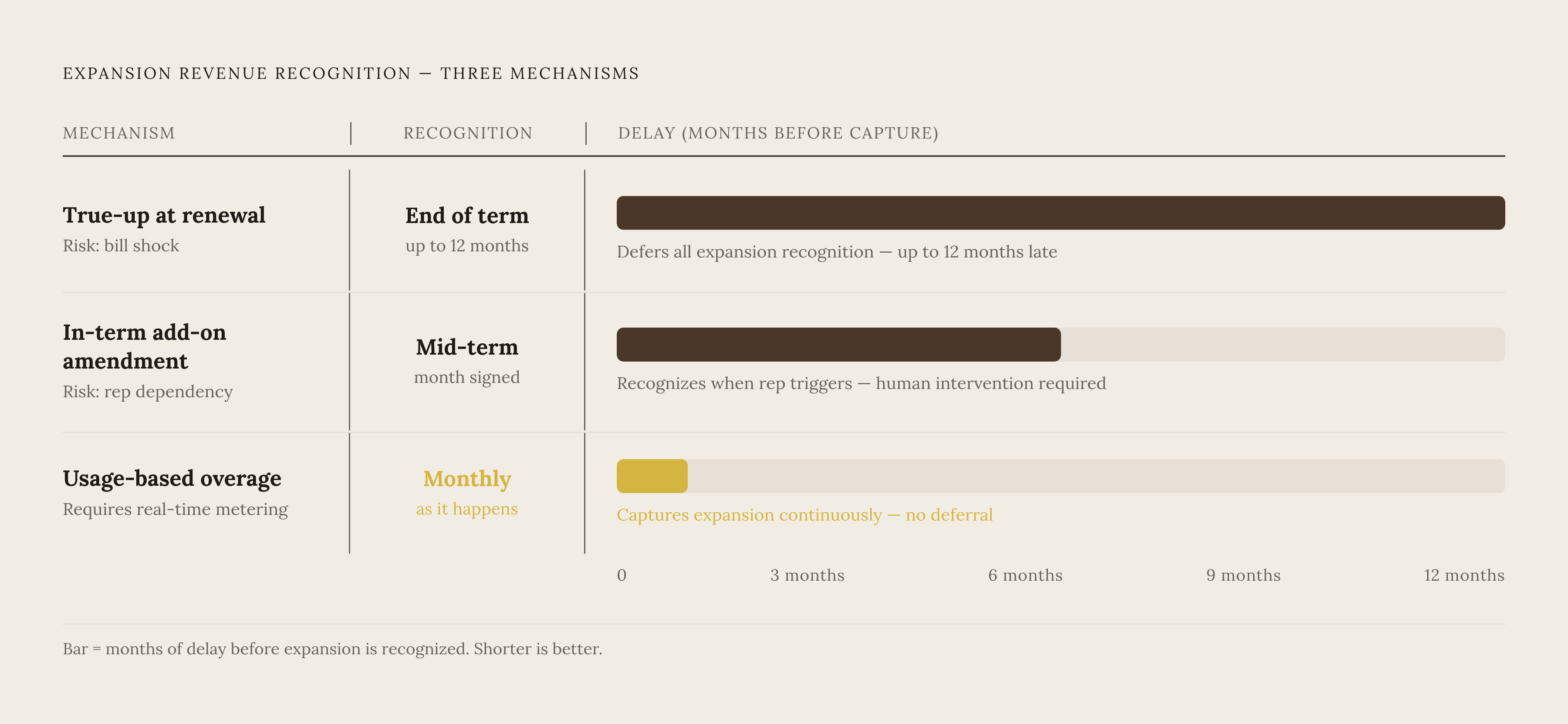
A customer on a twelve-month annual plan has exactly one natural expansion moment, and it's twelve months away. Anything that happens before then requires deliberate mechanism design. Without one, expansion revenue doesn't disappear, it just gets deferred to renewal, sitting invisible on the books the entire time.
Three mechanisms cover most of what teams actually build, and they are not interchangeable. Of the three, only one is worth betting the roadmap on.
True-up at renewal. The customer commits to a minimum at signature, actual usage gets measured across the term, and any overage gets billed at renewal as a lump sum. It's simple to administer, which is its whole appeal, but it defers expansion revenue recognition for up to a year and creates a reconciliation bill that can genuinely shock a customer who wasn't tracking their own consumption.
In-term add-on amendment. The customer buys more seats, modules, or capacity mid-contract through a formal amendment, and the expansion ARR gets recognized the month the amendment is signed. This needs a sales or customer success motion to trigger it, though. It doesn't happen on its own; someone has to notice the need and start the conversation.
Usage-based overage on top of the annual commit. The customer commits to a base (seats, API calls, tokens, whatever the product's unit is) annually, and consumption above that base gets metered and billed monthly or quarterly. This is the hybrid model, and it's the only one of the three that captures expansion as it happens rather than parking it until renewal or waiting on a rep to notice. If a team can only build one mechanism well, this is the one worth the engineering investment. The other two are patches on a structure that wasn't designed to expand in the first place.
That third mechanism has an infrastructure precondition: real-time metering. A billing system that can't count consumption continuously can't support mid-contract expansion from overages, full stop. Billing architecture, at that point, becomes a direct constraint on which expansion strategy is even available to the revenue team.
Fit still matters more than preference. True-ups suit stable, predictable usage patterns. In-term amendments suit seat-driven products with clear expansion triggers, like a department onboarding new hires. Usage overages suit consumption-driven products where growth is continuous and irregular, the kind of product where a customer's usage might jump 40% in one month and flatten the next.
How usage-based components change expansion revenue visibility under annual commitments
Pure annual billing has a visibility problem that doesn't get discussed enough. Revenue from an annual contract is known in full at signature. Absent an amendment, there's nothing new to observe until renewal, which means finance sees a flat line for eleven months and then a single data point. Expansion forecasting under that structure is almost entirely backward-looking, built from what happened last year rather than what's happening now.
A hybrid model changes that. Consumption telemetry, tracked continuously against the committed base, shows which customers are approaching or exceeding their commitment weeks or months before a renewal conversation ever starts. That's a leading indicator, not a lagging one, and it changes what a customer success team can actually do with the data: prompt an upgrade conversation while the usage trend is still building, instead of finding out about it during a renewal negotiation.
The stakes here are rising because of what's happening in one adjacent spending category. Global AI spending is forecast at close to $1.5 trillion in 2025, and average monthly corporate AI budgets are projected to reach substantial five-figure sums. Customers spending at that scale can see their own consumption grow 20 to 30% annually, which turns mid-contract usage signals into a commercial issue, not an operational footnote buried in a systems team's dashboard.
The risk runs both directions. A customer who can't see their own consumption in flight is a customer walking toward bill shock at renewal, and bill shock doesn't produce expansion. It produces a contraction negotiation right when expansion should be on the table. Real-time usage dashboards, shared with the customer rather than kept internal, work as a retention tool as much as a billing one.
This changes what NRR even measures. Under a pure annual model, NRR has limited visibility between renewals, with expansion largely undetectable until the contract period closes. Under a hybrid model with monthly overage billing, expansion can show up in NRR every single month. The billing structure isn't just shaping the revenue anymore, it's shaping the cadence at which that revenue becomes visible and reportable, and a metering layer that only processes usage in end-of-month batches can't deliver that signal in time for anyone to act on it.
What annual commitment structure does to NRR at renewal: the ceiling effect and how to avoid it
Here's the ceiling effect in its plainest form. A customer signs an annual contract at a steep discount, uses the product heavily all year with no usage billing layer in place, and arrives at renewal having generated zero documented expansion. That customer's NRR contribution is capped at 100%, no matter how much value they pulled out of the product along the way. The commitment structure set the ceiling, not the customer's actual usage. That's the part most teams get backwards: they blame the customer relationship for flat expansion when the contract never gave expansion anywhere to register.
Compare that to a customer on a hybrid annual-plus-usage structure who crossed their committed base three separate times over the year. That customer has already contributed expansion ARR before renewal conversations even start, so the negotiation opens from above 100% NRR, not at it. The difference between these two customers lies elsewhere, beyond usage. It's whether the contract had a mechanism built in to capture that value as revenue.
Seat-based renewal expansion still matters: a customer growing from 50 to 100 seats generates legitimate expansion ARR in month one of the new contract. But it depends entirely on a successful renewal conversation and a customer success motion negotiating that growth. Nothing about it is automatic, and teams that rely on seat growth alone are betting the whole year's expansion on a single conversation.
Pricing discipline compounds all of this. Companies that regularly review and adjust pricing tend to see meaningfully higher growth rates than those that don't, yet a significant share of SaaS companies go extended periods without revisiting their pricing structure. Annual renewal is a natural forcing function for a pricing review. It only works as one if the team treats it that way instead of letting the contract auto-renew on autopilot.
None of this is happening in a tailwind. Expansion rates have been compressing across the market, which means the mechanisms built into a contract matter more each year, not less. Market growth used to paper over weak expansion design. That's no longer available as a crutch, and teams still leaning on it are the ones watching NRR slide first. The gap between enterprise and SMB NRR, 8 to 10 percentage points in enterprise's favor, comes down to contract sophistication more than anything else: enterprise deals routinely carry true-ups, usage layers, and multi-year commits, while SMB contracts rarely bother.
Designing annual commitment structures that build expansion in rather than hoping for it at renewal
Five principles fall directly out of the mechanics above, and none of them require guesswork.
Set the committed base below expected usage, not at it or above it. A customer committed to a base they'll reliably exceed produces automatic overage expansion without anyone lifting a finger. A customer committed above their actual usage has no expansion path at all, and worse, a solid argument for downsell the moment renewal talks start. Teams that set the base at "expected usage" to look conservative on paper are the ones most often stuck with a downsell conversation instead of an upsell one.
Treat the annual discount as a price-setting decision, not just a signup incentive. The rate offered at annual signature becomes the baseline every mid-contract expansion gets measured against. A team that gives away a deep discount at signup and then prices overages at full list rate has built an internal contradiction that customers will notice, and remember, at renewal.
Build the upgrade prompt around month two, not around renewal. Given that upgrade likelihood runs three times higher in month two than month nine, the entire expansion architecture should assume conversion happens early and get built to capture growth from that point onward, not from month eleven.
Surface usage data to customers before they have to ask for it. A customer who can watch their own consumption climb toward the committed base is already halfway through an expansion conversation. The alternative, a surprise invoice at renewal, doesn't open an expansion conversation. It opens a contraction one.
Choose the mid-contract mechanism, true-up, in-term amendment, or usage overage, before the contract gets signed, not after. Retrofitting a mechanism mid-term means going back to the customer for consent, and that friction alone kills a fair number of expansion opportunities that would have closed cleanly if the mechanism had been specified from day one.
Cadence matters as much as mechanism. Teams that review pricing quarterly grow 23% faster than those reviewing it annually, which means annual renewal is too infrequent to be the only trigger for a pricing conversation. Usage signals, tracked continuously, should prompt pricing reviews on a shorter cycle than the contract term itself.
None of this works without billing infrastructure that can keep up. The most carefully designed commitment structure sits inert if the billing layer can't meter consumption in real time, apply it against committed minimums, and generate an accurate mid-term overage invoice without a human reconciling spreadsheets by hand. Finance teams that spend the first week of every month reconciling usage against annual commits aren't dealing with a staffing problem. They're paying, in labor hours, for the gap between their billing architecture and their pricing strategy. A single engine that handles the annual commitment and the usage layer together closes that gap, and it turns expansion revenue into something visible in real time, rather than something discovered months later during a renewal that should have been a formality.
Sources
- Easy guide to SaaS benchmarks | 2025
- SaaS Pricing Benchmarks 2025: How Do Your Monetization Metrics Stack Up?
- chartmogul.com
- The Great SaaS Price Surge of 2025: A Comprehensive Breakdown of Pricing Increases. And The Issues They Have Created for All Of Us.
- guybarner.medium.com
- getmonetizely.com
- saasfactor.co