Freemium to Paid Conversion Experiments in PLG SaaS Products
Model choice and activation tracking set your conversion ceiling before any experiment runs.
Median free-to-paid conversion across B2B software products sits at 8%. Almost no product actually converts at that rate. A January 2026 study from ChartMogul, ProductLed, and Growth Unhinged, covering 200 B2B software products, found a bimodal distribution: roughly one in five products converts below 2.5%, while about one in four clears 25%. That's a tenfold gap between the top and bottom quintiles of self-serve products, and it means the "average" describes almost nothing real.
Freemium specifically splits the same way. A meaningful share of freemium products sits below 2.5% conversion. Another quarter lands between 10% and 15%. Rates above 15% are uncommon, and above 25% they're rare enough to be exceptional. So a team converting at 4% and benchmarking against an 8% median concludes it's underperforming by half, when in fact it may be sitting closer to the middle of a distribution that has no meaningful center. For freemium, 3-5% conversion is a reasonable outcome. 8-12% is genuinely strong. But those labels only mean anything once a team knows its model type, its traffic source, and its ACV bracket, because those three variables set the ceiling before a single experiment runs.
How trial model choice sets your conversion ceiling before any experiment runs
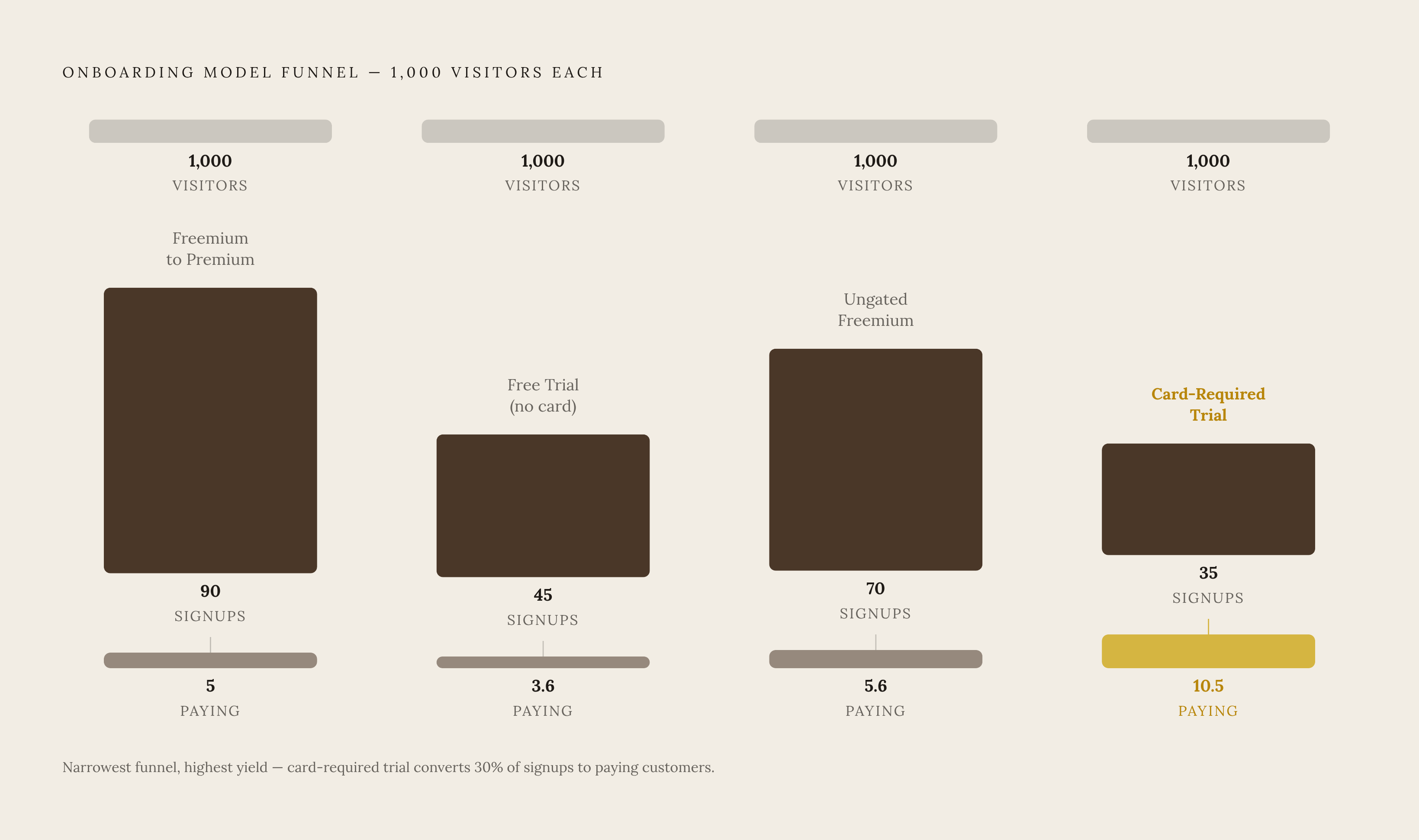
The Growth Unhinged 2026 report, produced with ChartMogul and ProductLed, ran a thought experiment that makes the model comparison concrete: take 1,000 visitors and route them through four different onboarding models, then count what comes out the other end.
Freemium-to-premium produces about 90 free signups and roughly 5 paying customers. A standard free trial with no credit card required produces 45 signups and about 3.6 paying customers, fewer absolute customers than freemium despite a higher conversion rate per signup. Ungated freemium, the "try before you make an account" pattern associated with products like Perplexity, produces about 70 signups and 5.6 paying customers. A credit-card-required trial produces only 35 signups but 10.5 paying customers, the highest absolute yield of the four, from the smallest top of funnel.
The implication is that conversion rate per signup and revenue yield per visitor are two different questions, and optimizing for one can quietly lose the other. A team fixated on lifting its per-signup number might reject a model that actually produces more paying customers per unit of traffic.
Despite this, most teams aren't running the model with the best yield. 57% of products lead with a free trial, more than double the 26% that lead with freemium, and only 7% use a reverse trial. Most teams, in other words, are running the model with the narrowest top of funnel. AI-native products break from this pattern: only 43% lead with a free trial, compared to 61% of SaaS products, a gap that tracks directly to token-cost economics. Giving away unlimited free usage of a model that costs money per inference is a different bet than giving away unlimited free usage of a database record.
Freemium products that allow ungated, try-before-account access are running a structural experiment worth studying on its own terms: they're trading signup friction for a higher-quality intent signal, since only visitors with real interest bother to engage before an account even exists.
ACV bracket sets its own ceiling, independent of model choice. Products priced between $1,000 and $5,000 in annual contract value show the highest median conversion, at 10%. Sub-$1,000 ACV products can reach 24% at the top quartile. Same model, same gating logic, wildly different realistic upside, because the buyer psychology and purchase friction differ by price point.
Once a team has picked, or at least validated, its model, the next lever is activation. And here's where most experimentation breaks down before it starts: 34% of PLG companies don't track activation at all, which means most experiments are running blind on the very thing that should define the test population.
Why most PLG teams run conversion experiments on users who were never going to convert
ProductLed's survey of more than 600 B2B SaaS companies found that only 34% track activation in any structured way. Two out of three teams, then, are measuring conversion without knowing which of their users ever experienced the product's core value in the first place.
This is the measurement gap sitting underneath most conversion benchmarks. Reported conversion is almost always free signups divided into paying customers, a calculation that lumps activated and unactivated users into the same denominator. A user who created an account and never opened the product again counts the same, in that denominator, as a user who ran the core workflow five times in a week. Averaging across both tells a team almost nothing about what to fix.
Activation tracking exists to solve exactly this problem: it lets a team define a "monetizable active user," not just anyone who registered, but someone who completed the sequence of actions that correlates with actual willingness to pay. Research cited in product-led growth analyses puts a number on what that redefinition is worth: users who reach the core value moment convert at 12–18%, a rate three to six times the freemium median.
Product Qualified Lead, or PQL, adoption is the structural proxy for whether a team is actually doing this work. Only about 24-25% of companies use PQLs to segment their funnel, yet PQL-identified users convert at roughly three times the rate of unqualified free users. For products in the $1,000-$5,000 ACV range, PQL-driven conversion reaches meaningfully higher rates, which is effectively the empirical ceiling separating top-quartile performers from the median.
So before any gate experiment, any trigger test, any pricing tweak, the first question has to be whether "activated" has been defined at all. Skip that step and every A/B test that follows is underpowered, because the test and control groups both contain users who were never going to convert regardless of what changes.
Feature gating versus usage limiting: which constraint actually triggers upgrades
Products that limit usage, seats, API calls, storage, convert 1.5 to 2 times higher than products that limit features. Legibility explains it: a usage cap creates an immediate, unambiguous upgrade trigger at the exact moment it's hit. Feature gating doesn't work that way.
A user on a feature-limited free plan can linger indefinitely if the features available to them happen to cover what they need. There's no clock, no counter, nothing forcing a decision. The urgency signal simply never fires, and the product bleeds free users who never feel a reason to leave. Usage limits, by contrast, convert at 4-7% on average within freemium, above the general freemium median, because the constraint shows up mid-task. A user hits the cap while actively trying to finish something, not while comparing a static features table on a pricing page.
The placement of the gate matters as much as its type. Gate after value is realized. A gate placed ahead of the core workflow kills activation before it can ever produce conversion intent, since the user never gets far enough to want more.
One useful test structure: move a high-value feature behind an upgrade prompt that only appears once a user completes a defined activation milestone, then compare conversion among users who hit that milestone against a control group that sees the same prompt on a fixed schedule instead. The milestone-aligned version should outperform, because it's tied to demonstrated engagement rather than elapsed time.
Reverse trial, temporary access to premium features while nominally on a free plan, remains underused. A small share of products run it this way, and it remains worth tracking as more products experiment with it.
None of this works on users who never activated in the first place. Gate experiments should be scoped strictly to the activated segment defined earlier, because testing gate placement on the full free-user population just reintroduces the measurement gap from the previous step.
Behavioral triggers at the upgrade moment: what fires conversion and what fires resentment
Product-led growth data shows that behavioral triggers, prompts fired based on what a user actually does inside the product, convert at 3.4 times the rate of time-based prompts. This is arguably the single most important number in the entire conversion stack, because it tells a team where to spend design effort.
A behavioral trigger fires when a user hits a usage cap, completes a value milestone, invites a teammate, or exports a result. A time-based trigger fires because seven or fourteen days have passed, regardless of whether the user has done anything meaningful in that window. The difference in outcome makes sense: one prompt shows up because the user just proved they need the product, the other shows up because a calendar rolled over.
Pairing an in-app prompt at the moment of usage-limit hit with a first-month upgrade offer typically lifts free-to-paid conversion by 2-5 percentage points, a meaningful jump on a base that may already be starting around 3-5%. Sequencing matters too. Conversion data shows that automated workflows combining in-app triggers with email sequences convert 2.1 times more users than either channel run alone.
A Reforge and MKT1 meta-analysis of 190 PLG companies tested something more structural: routing paid traffic to a landing page that required completion of a core product action before the upgrade CTA ever appeared. That single change lifted conversion from 2.8% to 4.9%, cut early drop-off by 41%, and improved 30-day retention among paid converters by 33%. Retention lift alongside conversion lift is the tell here, since it means the change wasn't just moving the upgrade decision earlier, it was producing better-qualified converters.
Timing has a hard edge to it. Most B2B conversions happen either when a trial expires or the moment a usage constraint is first felt, and after day 14, trial conversion rates fall off sharply. Prompt design should front-load urgency into the first week of active engagement rather than assuming a slow build toward day 30.
The failure mode on the other side is resentment. A prompt that interrupts an active workflow before the user has established any sense of value doesn't produce an upgrade signal, it produces a churn signal. Timing an upgrade prompt is a design decision that has to account for where the user is in their own arc with the product, not a volume decision solved by firing more prompts more often.
Why discounting at the conversion moment costs more than it earns
Pricing research has found that discounts offered specifically to drive free-to-paid conversion reduce lifetime value by 18–30%. The mechanism is straightforward once named: a discount anchors the customer at a lower price and signals, implicitly, that the sticker price was inflated from the start.
A customer who converts at 30% off carries a different renewal expectation than one who converts at full price, and that gap doesn't close on its own. It compounds across the length of the relationship, showing up again at every renewal conversation as a negotiating position the customer now believes they're entitled to.
There are alternatives that don't touch the price anchor at all. Extended trial periods buy more time for value realization without ever suggesting the price itself is negotiable. Feature unlocks, surfacing a premium capability for a limited window, let the product make the case for itself instead of asking the price to do it. Team plan bonuses, extra seats or collaborator access, raise switching cost and product stickiness while leaving unit price untouched.
There's a signal worth sitting with here: enterprise deals that originated from grassroots free adoption have been observed to convert at meaningfully higher rates than deals run through traditional sales-led motions. That suggests the most valuable conversions are often already self-selecting before any offer gets extended, which means a discount handed to that segment is pure margin given away on a deal that would have closed regardless.
Some AI products have started experimenting with adaptive monetization instead of flat discounting, offering longer free usage windows to early-stage startups while pushing enterprise teams with high engagement toward faster transitions. That's a use-case-sensitive paywall, not a blanket price cut, and it treats different segments as genuinely different rather than applying one discount rule to all of them.
The design implication for experimentation is blunt: test value-add offers against discount offers with lifetime value as the primary metric, not conversion rate in isolation. A 2-percentage-point conversion lift that destroys 20% of LTV is not a win. It's a loss with a flattering headline number attached.
How usage-based and credit-based pricing mechanics change the freemium conversion equation for AI products
AI-native products convert at 6-8% at the 50th percentile and 15-20% at the 75th percentile, outperforming standard freemium benchmarks at both marks. Part of the explanation is structural: usage-based pricing creates graduated upgrade pressure that builds naturally as consumption grows, instead of relying on a single gate or a single expiration date to do all the work.
Credit-based freemium is the clearest version of this. Instead of limiting a feature or setting a countdown clock, the product hands a new user a fixed allocation of credits at signup and lets them use the full product immediately. The upgrade trigger fires when credits run low, which happens to be the exact moment the user has demonstrated the most value from the product. There's no arbitrary timer involved.
The reason this converts differently comes down to how personal and visible the constraint is. "You have 40 credits remaining" is a concrete, individualized signal. "Your trial ends in 6 days" or "this feature is locked" isn't tied to anything the user has actually done, so it reads as arbitrary by comparison.
Running this model requires billing infrastructure that most subscription platforms weren't built to handle: real-time metering, wallet balances enforced without lag, and upgrade prompts that fire the instant a threshold is crossed rather than on the next batch job. That's a genuinely different technical problem than tracking a monthly subscription renewal date.
Get the metering wrong and the same mechanic that should drive conversion turns into a churn event instead. In July 2025, a developer received a $7,225 invoice traced to uncapped usage on a monthly Pro plan, a case where usage ran past any visible limit and the customer had no warning before the bill arrived. That's the conversion moment turned inside out: instead of a user seeing their usage climb and deciding to upgrade, the user found out after the fact that no one had told them the meter was running.
Spend visibility is the fix, and it's worth treating as part of the conversion funnel rather than just a retention feature bolted on afterward. A customer who can watch consumption in real time is less likely to get blindsided by a bill and more likely to upgrade proactively, before hitting a hard wall they didn't see coming.
Outcome-based pricing sits at the far edge of this trend. Zendesk charges only when a ticket is fully resolved by AI. some AI support products charge per resolved customer interaction. Both models reframe the upgrade decision as return-on-investment-positive by design, since the customer is only ever paying for a result they already received, which removes price sensitivity as a conversion barrier almost entirely.
None of this holds together if pricing itself can't move without an engineering deployment. Continuous experimentation on price and packaging requires infrastructure that lets product and finance adjust the lever directly, not a process that routes every pricing change through a sprint backlog.
Building a repeatable experimentation system rather than a one-time conversion fix
Ownership is where a lot of this breaks down structurally, before any single experiment gets designed. Sales owns free-to-paid conversion at only 23% of companies, while Product leads PLG strategy at 49% and Marketing at 42%. The team standing closest to the actual upgrade moment, the one hearing directly why a deal didn't close, frequently doesn't control the product signals, the gates, or the triggers that drive that moment in the first place.
A structured system has to close that gap, and it follows the order laid out across this piece. Define the activated user first, and baseline conversion only against that segment, not the full signup pool. Validate model architecture, freemium against trial against ungated, using per-visitor yield rather than per-signup conversion, since those two metrics can point in opposite directions. Choose the gate type based on the usage-versus-feature evidence, and place it after the value moment, not before it. Build behavioral triggers instead of time-based ones, and sequence them across channels rather than relying on a single prompt. Test value-add offers against discounts using lifetime value as the deciding metric. And where the product is usage-based or credit-based, treat the metering and spend-visibility layer as core funnel infrastructure, not a back-office billing detail.
Run in that order, each layer sets up the one after it, and a team can trace a conversion lift back to a specific mechanism instead of a vague sense that something worked. Run out of order, or skip the activation step entirely, and the numbers coming out the other end describe nothing real, the same phantom average that made an 8% median so misleading in the first place.
Sources
- The SaaS Conversion Report: A new look at free-to-paid conversion | ChartMogul
- Product-Led Growth Benchmarks: Key SaaS Findings and Trends | ProductLed
- PLG SaaS Free-to-Paid Conversion Rate Benchmark 2026 | acceleroi
- TOP 20 FREE TRIAL CONVERSION STATISTICS 2026 THAT EXPOSE SAAS TRIAL REALITY
- ustechautomations.com