Flat Rate to Credit-Based Pricing Conversion in an AI API Product
The credit unit's design shape matters far more than the metering tooling you pick first.

Flat-rate pricing charges the same amount whether a customer runs ten API calls or ten thousand. AI products can't sustain that model because their underlying costs, tokens processed, GPU-minutes consumed, model calls made, scale directly with usage. Converting to credit-based pricing is a defined engineering and pricing problem: define the credit unit, map every consumption event to a cost, migrate existing customers without leaking revenue, and build a metering layer that can count what the pricing promises. Most teams get the sequence backwards. They pick a metering vendor first and let the tooling dictate the credit unit, when the unit should be settled on paper before anyone touches an API, and that single ordering mistake predicts more failed conversions than any technical shortfall does.
What credit-based pricing actually is and what it is not
Credit-based pricing works like this: a customer buys a bundle of credits upfront, and the product deducts credits from that balance as the customer takes actions. Each action gets deducted at a rate that reflects its relative cost and complexity. A one-line text completion might cost 1 credit. A high-resolution image render might cost 50.
Credits sit as an abstraction layer over the infrastructure metrics that actually drive cost: tokens, GPU-seconds, API calls. The customer sees a balance and a deduction rate. They never see the raw token count or the compute bill, and that's by design.
Credits are not tokens, and treating them as interchangeable is the first conceptual error most teams make. Tokens are a model-level unit of measurement, while credits are a product-level unit that might translate into many tokens, a single API call, or a completed outcome, depending on how the product defines the action. Credits are not seats either, since they get consumed rather than assigned to a person or a login. And they are not a loyalty perk sitting on top of a real pricing model. Credits are the primary billing currency itself, full stop. Treating them as a marketing layer produces a second, shadow pricing model that nobody agreed to, and that shadow model is usually what breaks first.
Three billing mechanics can coexist under a credit model, and most mature AI products run some combination of all three. Prepaid billing has the customer purchase credits upfront, deducted as they use the product, the same shape OpenAI uses for its API today, where customers fund a balance starting at a $5 minimum and draw it down with each request. Pay-as-you-go flips the order: consumption happens first, and the invoice follows. Committed volume contracts set a usage floor a customer commits to, drawn down against actual use. Any of these can run alongside a subscription base fee, and most enterprise AI contracts do exactly that.
The distinction that actually matters, and the one most conversions miss, is between consumption credits and outcome credits. Some credits map to consumption: a certain number of tokens processed, a certain amount of compute burned, regardless of whether the output was useful. Those need a metering layer that counts raw usage. Other credits map to outcomes: a support ticket actually resolved, a workflow actually completed. Those need a classification layer that judges success before the deduction fires. Plenty of AI products need both running at once, and building one pipeline to handle both as if they were the same problem is where conversions go sideways early.
Defining the credit unit before touching any code
Nothing else in this conversion matters more than the shape of the credit unit itself. It decides what the customer sees on their dashboard, what the metering layer has to count, and how much margin protection the vendor keeps when the cost of a model call changes six months from now.
There are two ways to design it, and one of them ages badly. Resource-mapped credits tie 1 credit to a fixed amount of underlying resource, say N tokens or N GPU-seconds. It's simple to meter and easy to audit, but it exposes infrastructure units directly to the customer, who now has to think in tokens rather than in tasks. Action-mapped credits instead tie 1 credit to a standard unit of work: one document summarized, one image generated. The customer sees the cost of the task, not the cost of the compute behind it. That version takes more upfront work to define, and it's the one worth building toward. Resource-mapped credits are the shortcut, and the shortcut gets expensive fast, usually right around the first time a model gets swapped for a cheaper one and the pricing page has to explain why nothing changed for the customer.
Action-mapped credits carry a real strategic advantage. The vendor controls the internal ratio between a credit and its true infrastructure cost, and can adjust that ratio whenever model costs shift without ever touching the public pricing page. That flexibility matters more than it sounds. GPT-3.5-level inference dropped roughly 280-fold between November 2022 and October 2024. A credit unit rigidly pegged to one model's token price becomes a liability the moment that model gets swapped out, and in AI infrastructure, that moment arrives faster than most pricing teams plan for.
Pricing the credit unit itself starts with the fully-loaded cost of a single action: model inference cost, plus infrastructure overhead, plus the margin the business needs to hold. Check that baseline against live API pricing rather than guessing at it. As of late 2024 and into 2025, Azure OpenAI prices GPT-4o at $5 per million input tokens and $15 per million output tokens. Claude Haiku 4.5 runs $0.50 per million input tokens and $2.50 per million output. DeepSeek V4 Flash comes in lower still, at $0.22 per million input tokens off-peak ($0.44 peak) and $0.66 per million output tokens off-peak ($1.32 peak). Set the credit price to cover cost at average usage, not at the lightest customer's usage, or the model quietly bleeds margin on every heavy user it attracts.
A single flat credit rate for every action type is almost always wrong, because not every action costs the same to run. Define a credit multiplier per action before any of this reaches a pricing page: a basic text completion might run 1 credit, a high-resolution image generation might run 50. And decide, before implementation starts rather than after, whether credits expire, whether they're transferable between accounts, and whether they can be gifted. These read like marketing decisions. Each one carries billing infrastructure implications that are expensive to retrofit later.
Mapping consumption events to credit costs
Every billable action in the product needs to exist as a named event with a defined credit deduction attached to it. That map, event by event, is the actual contract between the pricing model on paper and the metering layer that has to enforce it in production.
Each entry in that map needs five things: a unique event name, the trigger condition that fires it, the properties captured (model used, input size, output size, tier, customer ID, timestamp), the deduction rule itself, and an idempotency key. Skip any one of those and the event map has a hole in it somewhere a customer will eventually find.
Fixed deductions only work for fixed-cost actions. Anything with variable cost needs a formula: deduction equals the ceiling of input tokens divided by 1,000, times the input rate, plus the ceiling of output tokens divided by 1,000, times the output rate, all converted to credits at the internal ratio set earlier. A flat number here just breaks the moment usage varies.
The metering pipeline runs in three stages, and collapsing them into one is the shortcut that causes the most damage later. Ingestion collects raw telemetry at the point of action. Metering normalizes and aggregates those raw events into billable metrics. Rating applies the deduction rules to actually move the credit balance. These are three distinct jobs, and doing all three inside one script because it's faster to ship is how teams end up debugging a black box six months later.
Scale is the part that catches teams off guard. AI agent workflows can throw off thousands of events per minute across a single multi-step process. If the pipeline falls behind, enforcement ends up reading a stale credit balance, customers blow past limits nobody caught in real time, and the overage surfaces after the fact instead of during it, which is exactly backwards from what a credit system is supposed to prevent.
Idempotency isn't optional here, either. At-least-once delivery guarantees and network retries mean the same event can and will arrive twice. The metering layer has to catch duplicates by idempotency key before any deduction happens, not after, and definitely not by having someone reconcile it manually at month-end.
Two aggregation paths need to run side by side. A fast path serves latency-sensitive needs like customer-facing displays and enforcement decisions, while a slow path handles exact aggregation for final invoicing and reconciliation, where accuracy matters more than speed. Building only the fast path produces invoice errors. Building only the slow path produces enforcement failures, since nobody's balance updates fast enough to matter. Both have to exist, and treating one as optional is how teams end up rebuilding the other under pressure.
Outcome-based credits need one more layer on top of all this. An action that only deducts credits on success, a resolved ticket, a completed generation, needs a classification signal in addition to the usage event. The event still fires the moment the action happens, but the deduction itself waits on a downstream result before it's confirmed.
Migrating existing customers without revenue leakage
Migration is where a well-designed credit model either holds up or quietly starts losing money. Flat-rate customers carry implicit usage expectations built up over months or years of billing that never asked what they actually consumed. Convert them onto credits without care, and heavy users get under-credited and start churning, while light users get over-credited and margin compresses. Both failures happen at once if the allocation work is sloppy.
Before setting a single credit allocation, pull at least 90 days of usage data per customer, segmented by actual usage band rather than by plan tier. Two customers on the same "Pro" plan can have wildly different consumption profiles, and averaging across the plan instead of the customer is how the allocation ends up wrong for most of them.
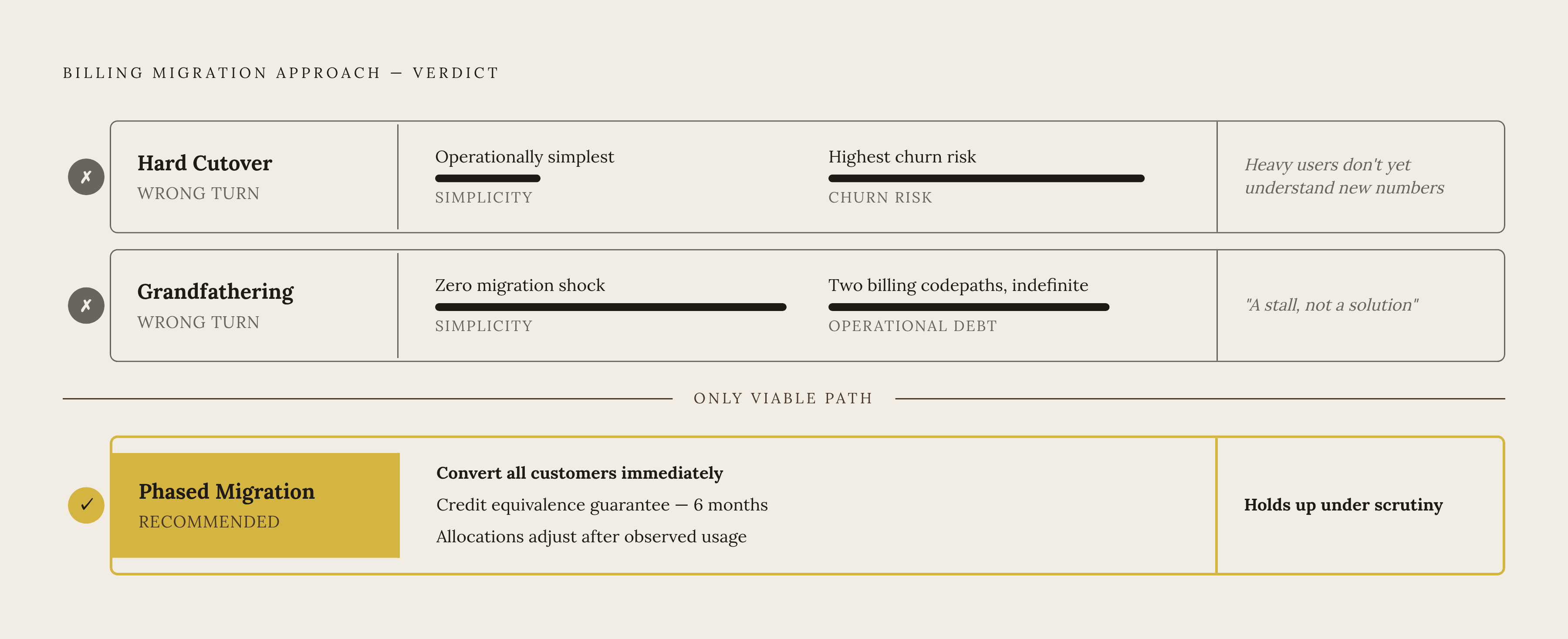
Three migration paths exist, and only one of them holds up under scrutiny. A hard cutover moves every customer to credits on one fixed date. It's operationally the simplest option, but it carries the highest churn risk, particularly among heavy users who don't yet understand what the new numbers mean for them. Grandfathering keeps existing customers on flat rate while only new customers enter the credit model. It avoids the migration shock entirely, but it leaves two permanent billing codepaths running in parallel indefinitely, which is the exact structural problem the conversion was supposed to eliminate. Grandfathering is a stall, not a solution, and teams that pick it usually end up doing the real migration a year later anyway, with twice the customers to convert.
Phased migration with a credit equivalence guarantee is the one that actually works, and it should be the default choice, not one option weighed evenly against the other two. Convert everyone to credits immediately, but guarantee each customer an equivalent to their current flat-rate value for a defined window, say six months, and use that window to adjust allocations based on what actually gets observed before the guarantee lifts.
The equivalence calculation itself is straightforward in principle: take each customer's average monthly usage, translate it into credit terms, and set their starting allocation to match that usage at the same dollar value they were already paying. Neither a discount nor a surcharge at the moment of migration, just a like-for-like conversion the customer can verify against their own history.
Three leakage vectors need closing before go-live, and all three get missed more often than they should. Unmetered paths that were free under flat rate, some internal API route nobody billed for because it didn't matter under the old model, need instrumentation and a credit cost assigned before the switch, or they become permanently free under the new one too. Failed requests and retry storms need an explicit policy: most products shouldn't charge credits for a failed call, but "most products" isn't a policy, and the event map needs to say so directly rather than leaving it as an assumption. Batch jobs need the metering layer to count each item in the batch as its own event, not the batch as a single event, or the pricing collapses for anyone running bulk operations.
Communication has to run in sequence and in order: a migration notice, an explanation of the credit model, a personalized statement of each customer's specific allocation, an FAQ addressing bill shock protection directly, the go-live itself, then a first-cycle review once real usage data comes in. Skipping steps to move faster tends to just move the support tickets earlier instead of eliminating them.
Spend visibility matters as much on the vendor's side of this as it does on the customer's. Reporting on unexpected SaaS charges tied to consumption-based pricing shows up often enough in surveys of IT leaders that it should be treated as the default risk, not the edge case. Customers moving off flat rate need real-time balance visibility and threshold alerts from day one, not a promise that alerts are coming in a future release.
A rollback path also needs to exist before launch, not after the first angry account escalates. Define the condition plainly: if a customer's first credit bill comes in above a defined threshold over their flat-rate equivalent, they get a temporary reversion while the allocation gets corrected. Having that path available, even if few customers ever use it, is what keeps the migration window from turning into a churn event.
What the metering layer must handle that most billing stacks cannot
Everything above is a design exercise until it runs on infrastructure that can actually execute it. A credit model that cannot be metered accurately isn't a pricing model. It's a promise the product can't keep.
Metering for AI usage has requirements that most billing infrastructure was never asked to handle. Ingestion has to hold up under real throughput: AI agent workflows can generate vast numbers of events per second at scale, and if ingestion becomes the bottleneck, everything downstream inherits the delay. Balance reads have to happen in real time, since enforcement decisions, block, throttle, warn, all depend on the current balance being current, and a stale read means an overage charge that should never have happened in the first place. Duplicate events have to get caught at the infrastructure layer through idempotency, not patched over manually in application code after the fact. Prepaid and postpaid mechanics have to run on the same engine, since a customer with a prepaid wallet and a postpaid invoice for overages needs both handled together, not split across two systems that then need reconciling against each other every billing cycle. And conditional deductions, the outcome-based credits described earlier, need the platform to hold a pending deduction open and confirm or void it once the downstream classification signal arrives.
The common answer to this problem, bolting a separate metering tool onto a separate billing tool, is the wrong answer, not just a costly one. That integration is something someone has to maintain forever, and it's usually where the reconciliation errors show up at month-end. Forecasting variable revenue is already a widely reported challenge among usage-based SaaS companies, and a fragile metering-to-billing handoff makes that problem worse, not better.
Subscription-era billing platforms weren't built for any of this. Their event ingestion architecture was designed around periodic, pre-aggregated usage reports, monthly totals, not millisecond-speed event streams from an agent running a hundred steps in sixty seconds. Adapting that architecture after the fact is possible, but it's a retrofit bolted onto a foundation that was never meant to carry the load.
A few things are worth checking directly before selecting a platform for this. Does it offer a native event ingestion API with real idempotency key support, not a webhook workaround bolted on later? Does it manage real-time credit balances with configurable alert thresholds? Are pricing rules programmable in a way that a product manager can update without waiting on an engineering deployment? Does it handle prepaid wallet mechanics and postpaid invoicing on the same customer account, in the same system? And for enterprise customers whose security requirements rule out cloud-only vendors, does it offer on-premises or sovereign cloud deployment at all?
Building this in-house is a real option, but it's an honest one only if the cost gets counted correctly. Months of engineering time get spent building it, and then a team has to own it, upgrade it, and debug it indefinitely afterward, which is the real cost of "free" open-source infrastructure. The actual decision in front of most teams isn't whether to build or buy. It's which platform was designed from the ground up for usage-at-scale metering, versus which one was adapted from subscription billing after the fact, and the second category will always cost more once the retrofit work gets counted honestly.
Designing the customer-facing credit experience
A credit model can be perfectly engineered and still fail if the customer can't see what's happening to their balance. Opacity here produces bill shock, and bill shock produces support tickets and churn, regardless of how accurate the underlying metering actually is.
A minimum viable credit dashboard needs four things visible at all times: the current balance, in both credits and dollar-equivalent terms; credits consumed in the current period broken down by action type; a projected end-of-period balance based on the current consumption rate; and configurable alert thresholds, say notifications as balances run low and a block or throttle at exhaustion.
Transparency isn't a nice-to-have layered on top of the pricing model. It's part of the pricing model. Customers need clear documentation of what each action costs in credits, how those credits convert to dollars, and exactly what happens the moment their balance hits zero. Leave any one of those ambiguous and the pricing model turns into a support burden almost immediately, because customers will fill the ambiguity with the worst-case assumption every time.
The policy for what happens at zero needs to be set before launch, not improvised during it, and the three options aren't interchangeable. A hard cutoff at zero access prevents runaway spend, but it's also the highest-friction option for a customer mid-workflow who suddenly can't finish what they started. A soft limit lets in-flight work complete before enforcement kicks in, at the cost of needing that overage rate spelled out clearly enough that it doesn't feel like a surprise charge later. Automatic top-up, where the customer pre-authorizes a refill when their balance runs low, removes the interruption entirely, but only works if the opt-in and confirmation flow are explicit enough that the customer knows exactly what they agreed to.
Automatic top-up is one option worth considering, not a peer option sitting alongside the other two. It's the only one of the three that doesn't force a customer to choose between finishing their work and controlling their spend at the exact moment they're least equipped to make that decision. A hard cutoff protects the vendor's margin at the customer's expense, and a soft limit just delays the same argument to the invoice. Picking a policy isn't where products get this wrong. Picking one without telling the customer which one they're on, that's the actual failure, and it's an entirely avoidable one.
Sources
- 42 AI pricing statistics that show why usage-based billing is winning
- 40 SaaS pricing statistics that reveal how modern software companies design revenue
- What Is a Credit? Understanding AI Usage-Based Pricing - Tropic
- Credit-Based Pricing for AI: How It Works, Where It Fails
- Using Credit-Based Pricing In AI-Powered SaaS: What Works And What Doesn’t
- softwarepricing.com
- tropicapp.io