Packaging Experiments Targeting Expansion From SMB to Mid-Market
Redesigning product tiers and pricing models unlocks mid-market expansion.

Moving a customer from SMB to mid-market usually gets treated as a sales problem: hire an enterprise AE, write a procurement-friendly contract, build a deck with bigger logos on it. That's the wrong layer to fix. The real obstacle sits in the packaging itself, in the tiers, thresholds, and pricing dimensions that decide whether a customer even has room to grow before a salesperson gets involved. Revenue Management Labs' executive survey found that 39% of companies pursuing segment expansion plan to broaden their product offerings, and 26% are targeting new customer segments entirely, yet most of them try to do this by stretching an SMB pricing model further upmarket rather than rebuilding it. Stretching produces underpricing at scale, overserving on features that don't carry margin, and buyers who show up expecting a different packaging structure than the one they're handed. Packaging design, not the sales motion, makes expansion revenue appear at all.
The structural shift in how software is priced that makes this moment different
Flat-fee subscription pricing worked when cost-to-serve was roughly the same no matter who was logging in. AI broke that assumption. Running inference is a variable cost that scales with usage, so charging every customer the same flat rate means the heaviest users quietly drain margin while light users overpay. That's a structural leak.
The seat model is failing for a related but distinct reason. When an AI agent starts doing work a human employee used to do, seat count goes down even as usage and value delivered go up. BetterCloud reports that this exact dynamic is forcing companies to rethink per-seat pricing, since agents now act as users in their own right without occupying a seat. Gartner's projection, cited in one of the sourced reports, puts a number on how fast this is moving: 40% of enterprise applications will include AI agents by the end of 2026, up from under 5% previously. Once the unit of value shifts from "a person with access" to "work completed," pricing has to shift from access to consumption or outcome, or it stops matching reality.
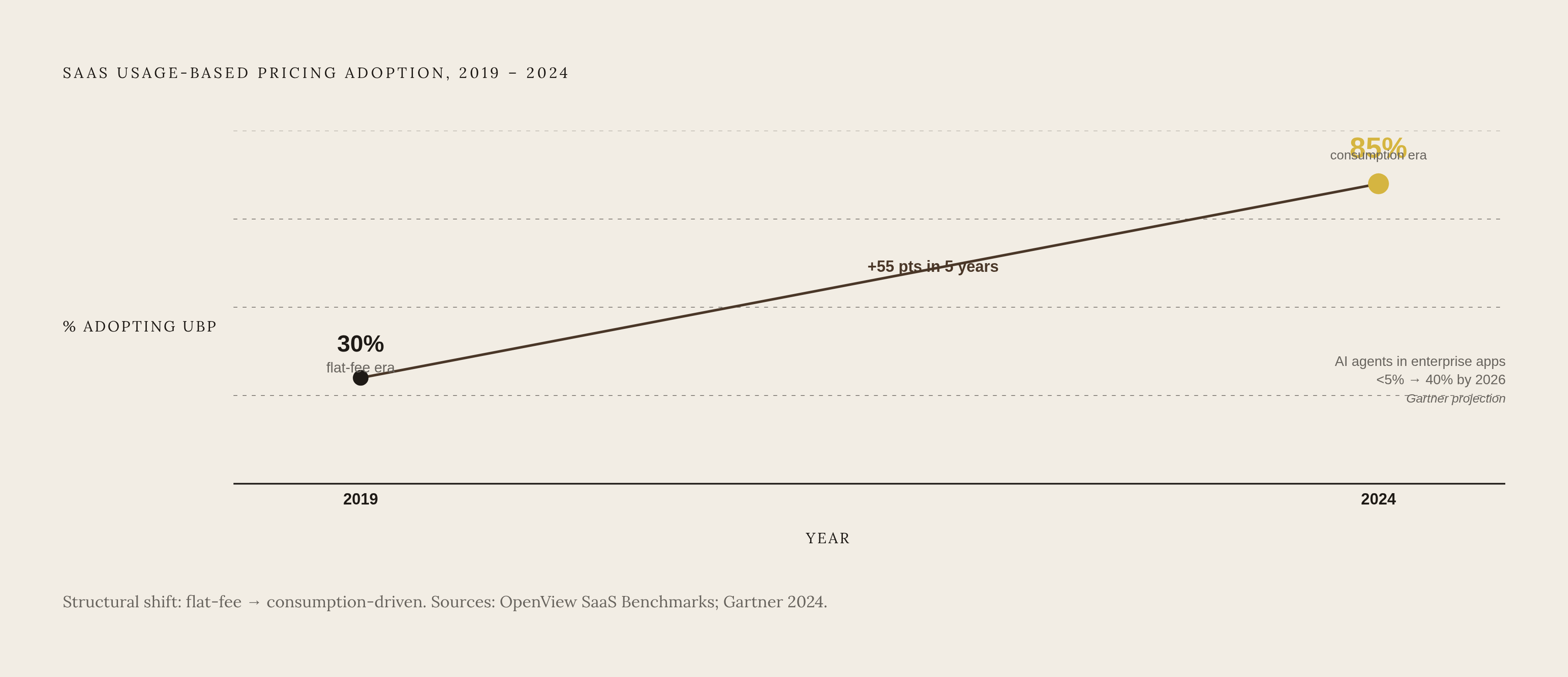
The scale of that shift is already visible in adoption numbers. Usage-based pricing among SaaS companies rose from roughly 30% in 2019 to about 85% by 2024. That's not a niche experiment some startups are running, it's where the market has already gone. And mid-market buyers are a big reason why: per G2 data, one in three B2B buyers now prefers variable pricing, and buyers broadly are pushing back on long-term fixed-fee contracts. An SMB tier built around flat fees or a narrow seat band was designed for a buyer who's disappearing. Packaging has to catch up to what mid-market buyers expect before a rep ever gets on a call.
What a tier architecture built for expansion looks like
Different price points on the same plan structure isn't tiering, it's a discount ladder. Real tier architecture gives each segment a plan that looks like it was built for them. A mid-market customer opening the pricing page should recognize, within a few seconds, that the tier in front of them was designed around how a company their size actually operates.
The hybrid model has become the default answer to that problem: a base subscription covers access plus an included usage allowance, and metered overages pick up anything beyond it. Industry data show that a strong majority of AI SaaS companies now run on some version of this structure. Splitting access from consumption does two things at once. The subscription layer gives mid-market procurement teams the budget predictability their approval processes demand, and the consumption layer captures revenue as usage grows without forcing a renegotiation or a new contract signature. Microsoft's Copilot pricing is a widely cited public example: a per-user base subscription covers baseline capacity, and additional credits absorb usage spikes, so steady-state users pay a predictable amount while heavy workflows get monetized without mid-contract friction.
Setting the gap between entry and mid too small keeps buyers at entry because there's no reason to move, and setting the gap between mid and premium too large stalls buyers at the middle tier instead of converting them upward. Set the gap between entry and mid too small, and buyers stay at entry because there's no reason to move. Set the gap between mid and premium too large, and buyers stall at the middle tier instead of considering the top one. Priced correctly, the tier structure itself pulls the bulk of buyers toward the middle option, which is usually where margin contribution is highest, independent of anything a salesperson does. That's a packaging lever, not a quota lever. High Alpha data show hybrid pricing models produce net revenue retention around 105%, a fairly direct signal that the structure retaining customers best is also the one with an expansion mechanism built into its bones.
None of that works, though, if the mid-market tier is just a bigger number attached to the same feature set. Mid-market buyers are looking for SLA commitments, admin controls, audit logging, custom commit options, and reserved capacity. These aren't upsells bolted onto a bigger price tag, they're signals that tell the buyer the vendor understands what running software at their scale actually requires.
How credit and consumption models create natural expansion pathways
Credits work because they turn usage into an event instead of a conversation. A customer buys or is allocated a pool of credits, spends them down against higher-value features, and eventually needs more, without a rep ever initiating that moment.
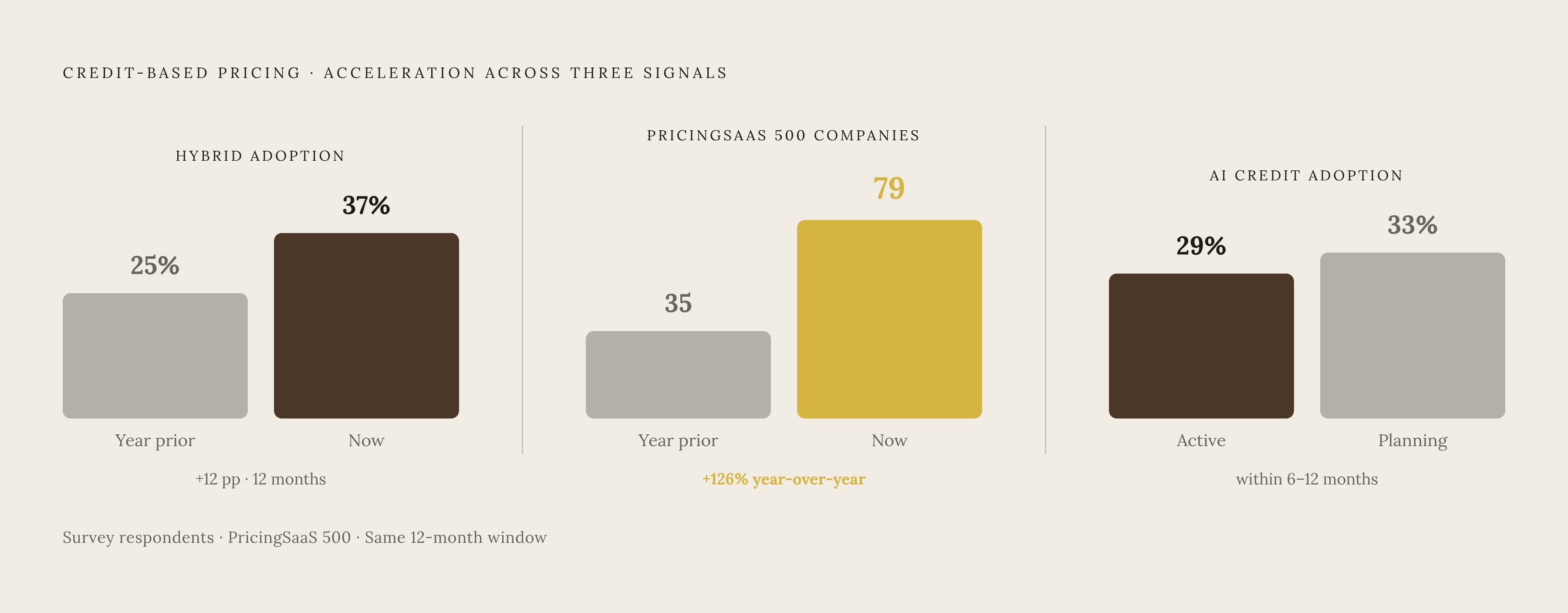
The pace of adoption backs this up. Growth Unhinged's State of B2B Monetization survey found that 37% of respondents now run hybrid pricing, up from 25% just twelve months earlier. The PricingSaaS 500 Index shows the same acceleration from a different angle: 79 of the 500 companies tracked now offer a credit model, up from 35 at the end of 2024, a 126% year-over-year jump. AI-specific credit adoption is 29%, with another 33% of companies planning to introduce AI credits within six to twelve months. This is a fast-moving shift.
What makes credits particularly well-suited to SMB-to-mid-market movement is the depletion mechanic itself. A customer who arrives on an entry-tier credit allocation sized for light usage will, as usage grows, exhaust it. That exhaustion is a packaging-triggered event, not one manufactured by a sales team hitting quota targets. Credit tiers can be calibrated deliberately so an allocation sized for a small-business-sized workload is visibly insufficient for a mid-market workload, making the upgrade the obvious next step rather than something a sales team has to pitch. If an AI-powered analysis burns 10 credits and a basic API call burns 1, a customer whose feature mix skews toward the heavier features will deplete credits faster and get pulled toward the next tier without anyone selling them on it.
Ibbaka's "bridge strategy" framing, cited in one of the sourced pricing reports, describes credits as positioned between simple usage-based pricing and true value-based pricing. They buy time to figure out which outcomes actually matter to customers, while still capturing usage-driven expansion revenue in the meantime, rather than waiting for a fully worked-out outcome metric before charging for value at all.
Credits carry a real risk, though, if spend visibility doesn't come with them. Zylo's SaaS Management Index, which surveyed 218 IT leaders, found that 78% experienced unexpected charges tied to AI or consumption pricing in the past year. That's a churn driver hiding inside what should be an expansion mechanic. The fix isn't shrinking credit pools to make surprises smaller, it's giving customers dashboards and threshold alerts so they see the depletion coming before the invoice does.
Token prices have fallen sharply since 2023. That deflation means included credit allowances can be more generous at the entry tier without eating margin, which makes the SMB tier genuinely useful on its own terms while the ceiling above it still does the work of pulling customers upmarket.
The four packaging experiments worth running to pull SMB customers upmarket
The SMB tier's usage allowance should be set so a customer doing mid-market-level work exhausts it within a single billing period, because that's the signal that tells both sides the customer has outgrown the tier, not because the vendor wants to nickel-and-dime anyone. Growth Unhinged's data show that the top 10% of power users drive the majority of token consumption in these systems, and that cohort is exactly the group closest to a mid-market upgrade. The test here is straightforward: find the usage percentile where customers start hitting their limits, then check whether that cohort converts to the mid-market tier at a meaningfully higher rate. That's the number that tells a pricing team whether the threshold is actually doing its job.
Premium tier design, a fix highlighted in Growth Unhinged's survey data for weak expansion revenue, means adding a premium edition at a substantially higher price point. But the price jump only works if the tier looks different, not just more expensive. SLAs, admin controls, and custom commit options need to be present, because a mid-market buyer who sees the same feature list at a bigger number will assume they're being upsold rather than served. The test is whether win rates on mid-market deals move when the tier carries those enterprise-recognizable signals versus when it's simply a scaled-up SMB tier with a higher price tag.
Add-on architecture: add-ons let the base tier stay cheap and accessible for SMB customers while giving mid-market customers a reason to spend more without forcing everyone into a bigger bundle. The features that belong here are the ones mid-market customers disproportionately need: advanced analytics, compliance exports, priority support, higher rate limits, not features the entire customer base wants equally. Track attach rate by customer revenue band; a high attach rate concentrated among growing accounts is the signal that the add-on is doing its job of pulling the right segment upward.
Annual billing as a commitment signal: an annual discount is now standard practice, and making annual the default choice at the mid-market tier, with monthly available as a premium convenience option, reframes the decision. A mid-market buyer who commits annually is signaling budget seriousness and lowering churn risk in the same motion. Comparing 12-month net revenue retention between annual and monthly mid-market customers is also a reasonable predictor of who's likely to expand further down the line.
Every one of these experiments should run on a cohort before it touches the full customer base. Skipping that step exposes the whole customer population to churn risk over a hypothesis that hasn't been tested. High-growth companies commonly review pricing on a quarterly cadence. Packaging experiments should run on that same rhythm rather than waiting for an annual pricing cycle to roll around.
How customer migration between tiers needs to be managed to avoid churn
A packaging experiment can get the structure exactly right and still fail, if the rollout itself triggers churn among the very customers it was meant to move upmarket. Industry experience shows that pricing changes made without protection for legacy customers reliably trigger churn spikes. That risk is documented.
Strategic grandfathering is the standard answer: give existing customers a time-limited grace period before migrating them to new packaging. Slack's 2022 pricing transition is the commonly cited reference point for how this plays out in practice. Grandfathering works because it separates two different jobs that shouldn't be handled the same way: acquiring new customers on the new structure, and migrating existing customers off the old one deliberately and on a slower clock.
Grandfathering alone doesn't fix everything, though. Growth Unhinged's survey found that companies running hybrid pricing report being generally the happiest with their own pricing model, yet they also struggle to explain that model to customers. A pricing structure a rep can't summarize in two sentences on a sales call slows down every mid-market deal it touches, no matter how well-designed the underlying tiers are. Some agentic AI companies have responded to this in 2026 by advertising flat monthly license options specifically to lower buyer anxiety during early adoption, treating predictability itself as a packaging feature rather than just a pricing feature.
That legibility requirement matters even more for self-serve motion. ICONIQ's State of Go-to-Market report shows high-growth companies projecting self-serve revenue at roughly 20% of total revenue, nearly double the 10% benchmark among their peers. A mid-market tier that can't be understood without a sales call defeats that entire motion before it starts.
What billing infrastructure must do to make packaging experiments operationally possible
None of the experiments above matter if changing a threshold or adding a credit tier takes an engineering sprint. A quarterly pricing-review cadence is meaningless if the systems that support pricing changes can't move that fast.
Usage-based mid-market packaging puts specific demands on metering. Usage events need to be ingested close to real time, sub-second for credit balance enforcement, not batched overnight. The same event arriving twice because of a network retry can't get billed twice. Deduplication tied to a unique event identifier has to be built in rather than bolted on. Events need to carry a timestamp from the moment they happened, not the moment they arrived, so billing period cutoffs land accurately on invoices. And customers need a live view of their own spend, because the 78% unexpected-charges figure from Zylo's survey is a churn risk that real-time dashboards largely eliminate.
Metering and billing also need to run as one system rather than two tools stitched together. A metering platform bolted onto a separate billing platform introduces reconciliation lag, where the billing state sits hours or days behind what actually happened in usage. For a mid-market customer running a prepaid credit wallet next to a standard monthly invoice, that lag turns into confusion at exactly the point where the customer is deciding whether to trust the pricing. Fragmented systems also tend to burn the first week of every billing month on reconciliation work, which is the opposite of what a packaging experiment needs: clean, fast data to judge whether the last change worked.
The last piece is organizational as much as technical. If adjusting a usage threshold or launching a new credit tier requires filing an engineering ticket, the iteration cycle stretches from weeks into quarters, and the quarterly review cadence becomes aspirational rather than real. Pricing logic needs to be something product and finance teams can configure directly. And for mid-market and enterprise customers who require on-premises or sovereign cloud deployment as a condition of procurement, that same configurability has to hold regardless of where the system runs.