Overage Pricing Tests and Their Effect on Plan Upgrade Behavior
How rate, alerts, and automatic upgrades separately influence whether customers bite or flee.

Overage pricing is a design problem before it's a revenue problem. The rate you set, the moment you alert a customer, and what happens automatically when they cross the line combine to decide whether that customer upgrades, quietly resents the bill, or leaves. Most teams treat overage as a single number to get right. It's actually three or four separate levers, and getting the combination wrong produces the exact outcome the pricing was supposed to prevent: churn.
A customer who consistently hits their allowance is telling you something valuable: that's a product-market fit signal, not a billing nuisance. Whether that signal turns into an expansion deal or a support ticket depends entirely on how the overage was designed. Bill shock, the classic failure mode, is a system that failed to make the number visible before the invoice did. It's a system that failed to make the number visible before the invoice did. A customer on a $99 plan who opens a $340 bill wasn't reckless. Nobody told them, in time, that it was coming.
The two strategic postures: nudge versus meter
Overage pricing does one of two jobs, and most designs fail because they try to do both at once without deciding which one matters more.
The nudge strategy sets the overage rate above the per-unit cost baked into the next plan tier, so continued overage costs more than just upgrading. Practitioners call this the "Upgrade Anchor" heuristic: price the overage at 1.25x to 1.5x the per-unit rate of the next tier up. Take a Pro plan at $200 a month for 10,000 API calls and a Business plan at $500 for 50,000 calls. Set Pro overage at $0.015 per call, a 1.5x multiplier on the Business plan's per-unit rate, and a Pro customer who burns 15,000 calls pays $200 plus $75 in overage, landing at $275. After a couple of months of $275 bills, the $500 Business plan reads as savings, not an upsell.
The meter strategy runs on different logic. It exists to capture the full value of consumption at a fair per-unit price, with no expectation that the customer ever moves tiers. Infrastructure and API-first products lean this way because value gets measured discretely, call by call, token by token, and there's no natural "next tier" story to build toward.
These two postures need different scorecards: grading a meter design on upgrade conversion, or a nudge design on raw revenue per user, tells you the wrong thing about how well it's working. A nudge test succeeds or fails on upgrade conversion rate. A meter test succeeds or fails on revenue per customer and churn among heavy users. Plenty of products actually run both in sequence: meter posture for the first couple of months of overage, low friction, no pressure, then a nudge posture kicks in once a customer has logged two or three consecutive overage cycles. That transition point is itself a design decision, and it carries real consequences for what the billing system has to track. Nudge pricing needs cumulative overage tracked across billing cycles, so the system knows when to trigger the upgrade conversation. Meter pricing needs real-time accuracy on every single call, because margin protection depends on it.
Rate levels, alert timing, and automatic-upgrade triggers as independent test variables
Three variables sit inside every overage design, and each one deserves its own test. The rate multiplier, the timing and channel of usage alerts, and what happens automatically once a customer crosses the threshold each need separate scrutiny.
Rate level is the most obvious lever, but it's not the whole story. A 1.25x multiplier leaves the upgrade decision ambiguous, close enough that a customer might rationally stay put. A 1.5x multiplier removes that ambiguity. Testing the two against each other reveals how price-sensitive different segments actually are, and that sensitivity varies enough across a customer base that chasing a single "right" number misses the point.
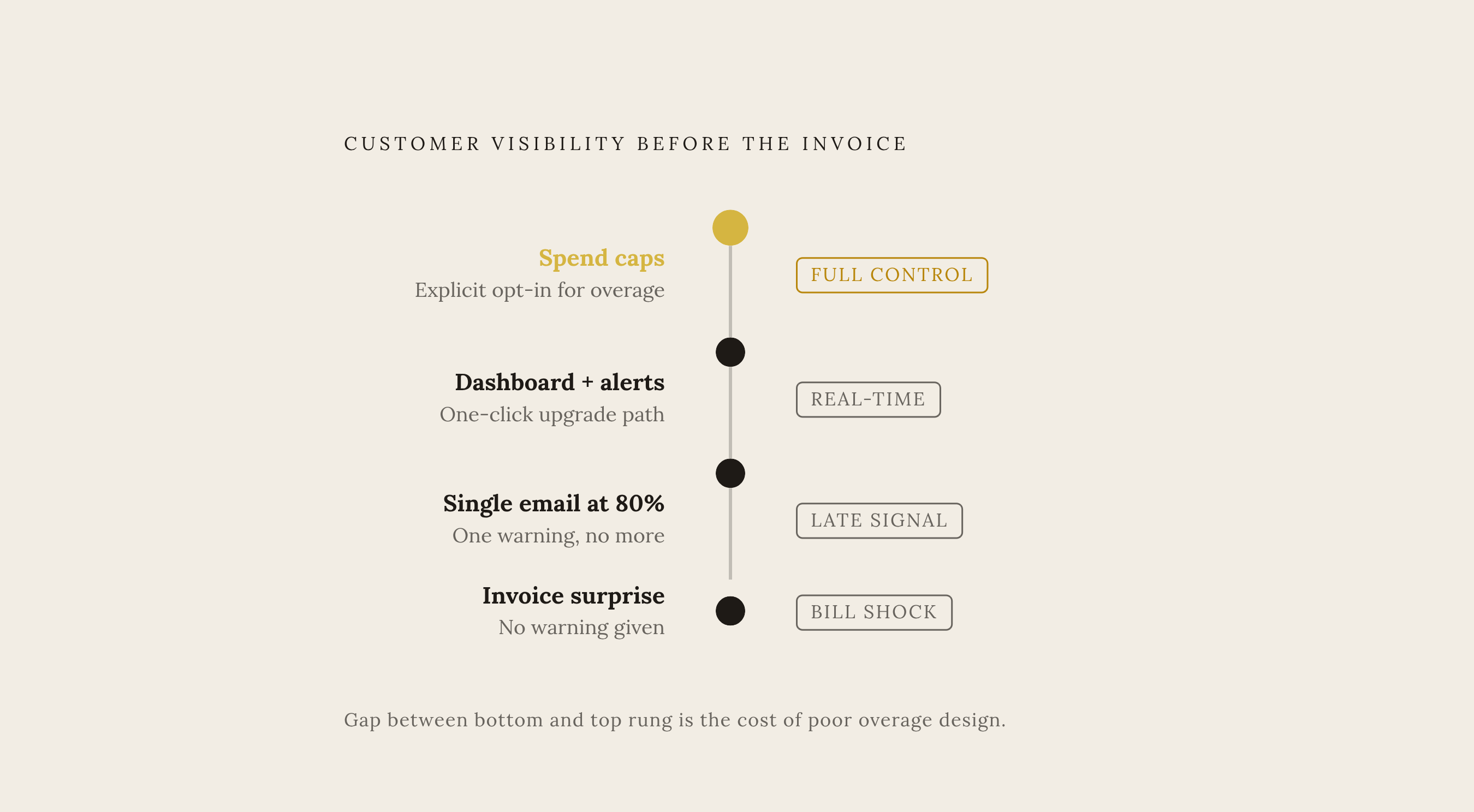
Alert timing is its own dimension, separate from rate. Companies that manage overage well typically fire alerts at 50%, 80%, and 100% of allowance, well before the meter ticks into overage territory. The channel matters as much as the threshold. An in-product banner at 80% behaves nothing like an email digest sent once a day, and a real-time push notification behaves differently still. Think of it as a trust ladder. No visibility until the invoice arrives sits at the bottom. An email at 80% is better, but modest. A real-time dashboard paired with alerts and a one-click upgrade path builds real trust. Spend caps with explicit opt-in for overage are at the top of that ladder, though they carry their own risk: a customer who hits a hard cap mid-task loses access at the worst possible moment.
The automatic upgrade trigger is the sharpest edge of the three, and it's the one teams underestimate most. For a growth-stage customer racing to scale, an automatic bump to the next tier is frictionless, even welcome. For a budget-conscious customer watching every line item, the same mechanism feels like being upgraded without consent, and it can push them straight toward the exit. Runtime enforcement generally falls into one of a few buckets: keep billing overage as usage continues, prompt the customer to upgrade, flag the account for a sales conversation, or restrict access. Each produces a different emotional response even when the underlying math is identical.
Changing rate, alert timing, and trigger mechanism all in the same release is the mistake most teams make, and it wastes the most engineering time. Moving three variables at once means there's no way to know which one produced the result you're looking at. Only a small share of SaaS companies test pricing on any regular cadence, even though a one percent improvement in pricing has been reported to lift profits by roughly eleven percent. That's a lever most companies aren't pulling, and the ones that are usually pull it one variable at a time.
AI products and the stakes of overage design decisions
Everything above assumes overage math with forgiving margins. AI products don't get that luxury.
In a traditional SaaS product, a 2x overage on an API allowance might produce a $50 surprise, annoying but survivable. On an AI product, where every token carries real inference cost, that same 2x multiplier can produce a $500 surprise or more. The gap is structural: AI usage swings far harder than typical SaaS consumption, since a single workflow change, one new automation, one prompt that gets looped into a batch job, can spike token usage overnight. The standard nudge calculus doesn't hold up without real-time visibility into what's actually being consumed.
The industry's answer has been credit-based pricing. Credits create a prepaid buffer between usage and the invoice, so the moment of reckoning becomes "buy more credits" instead of "explain this bill to finance." Adoption has moved fast: within a widely tracked index of 500 pricing-transparent companies, the number offering a credit model jumped from 35 to 79 in about a year, a 126% increase, with names like Figma, HubSpot, and Salesforce among the newer entrants.
The mechanics vary by product, and the variation itself is instructive. PostHog's AI offering includes $5 of free credits monthly, then moves customers to pay-as-you-go or pre-paid plans for heavier use, with a transparent 20% markup over raw LLM cost and the option for pre-paid customers to roll over half their unused credits into the next period. Midjourney takes a different shape entirely: subscribers get a fixed monthly pool of GPU hours that depletes as they generate images, and once that pool runs dry, they buy top-ups. There's no overage rate to set in that model. Depletion just triggers a purchase.
Rate-setting gets harder still because AI inference costs keep falling, and they've fallen a long way, with some comparable model capabilities achieved at a small fraction of earlier development costs. An overage rate calibrated to today's inference cost can turn indefensible within eighteen months. That's why the ability to reprice without an engineering sprint is a requirement of this category, not a nice-to-have, and it tracks with the finding that the overwhelming majority of AI companies that launched with usage-based pricing have since revised that model at least once. Stability isn't the default state here, and any team assuming otherwise is building on sand.
Overage model adoption and hybrid pricing growth
Usage-based pricing has moved from niche to mainstream fast. Adoption climbed from roughly a quarter of SaaS companies in 2023 to nearly two in five today.
The performance case for hybrid pricing, plans that blend a subscription base with usage or overage components, is stark. Companies running hybrid models posted median growth rates roughly double those of pure subscription companies in recent industry benchmarking. That's a real gap, not a rounding error, and it's what turns pricing architecture into a board-level conversation rather than a finance team's side project.
The pace of change backs this up. Among the top 500 SaaS and AI companies tracked for pricing transparency, more than 1,800 individual pricing changes happened in a single recent year, averaging 3.6 changes per company. Rate adjustments, threshold tweaks, alert-timing updates: these are a running conversation now, not an annual review.
The structural backdrop makes this look less like a fad and more like a migration already underway. Available forecasts point to continued growth in usage-based and hybrid adoption, with a majority of software companies already expecting these models to take a larger share of revenue. Usage-based and hybrid models are replacing per-seat pricing. They're replacing it. Which means the real strategic question for a product team isn't whether to run overage experiments, but whether its infrastructure can run them at the frequency the market has already normalized.
Running the experiment: cohort design, measurement windows, and the metrics that tell you what happened
Segmenting by plan tier alone produces noise, not insight, and it's the single most common mistake in how these tests get set up. A customer who hits 95% of allowance every month behaves nothing like a customer who averages 60% and spikes occasionally, and lumping them into one cohort muddies whatever signal the test was supposed to find. Useful segmentation usually runs along several axes at once: company size and revenue stage, depth of feature adoption and engagement, and current subscription tier. Which axis matters most depends entirely on which upgrade transition the test is trying to move.
Timing matters just as much as segmentation. Overage behavior doesn't stabilize in a single billing cycle, it takes several. Recall the tier-upgrade example: the nudge only works because a customer is at $275 a month for a couple of cycles before the upgrade decision crystallizes. A test that measures results after one month will systematically undercount conversion, simply because the customer hasn't yet felt the accumulated weight of the higher bill.
Metrics need to match the strategic posture, not get borrowed wholesale from whichever dashboard is easiest to pull. Nudge tests should track upgrade conversion rate, time-to-upgrade after the first overage event, and the resulting MRR expansion by cohort. Meter tests should track revenue per customer at high usage levels, churn among customers who blow past their allowance by some meaningful multiple, and the volume of support tickets that trace back to billing surprises rather than product complaints.
None of that matters without a counter-metric running alongside it. A trigger that lifts upgrade conversion in month one but drives churn by month three isn't a win, it's a delayed loss, and retention has to be watched in parallel with conversion or the test will lie by omission. Presentation compounds all of this. One well-documented pricing page redesign lifted conversions by 25%, and simply reframing a 20% discount as "two months free" lifted annual signups by 342% in a separate case. Framing interacts with rate and timing in ways that can swamp the effect of the rate itself. It needs to be treated as its own testable variable, not an afterthought bolted onto the launch email.
None of this holds up without basic statistical discipline, either. Sample size has to be calculated against a target confidence level and expected effect size before the test launches, not estimated afterward to justify whatever number came out. An underpowered test doesn't just risk a wrong answer, it actively produces a confident, wrong answer about which overage design is "working." Automatic-upgrade variants deserve one more layer of scrutiny: test the opt-out path alongside the default trigger, because the opt-out rate tells you how much friction the automation created, even among customers who end up staying on the higher plan anyway.
Billing infrastructure and its limits on possible experiments
None of the tests above are possible without infrastructure built for them, and this is where most overage experiments quietly die, usually without anyone noticing the actual cause.
Alert timing tests need real-time consumption data. A system that calculates usage in a nightly or month-end batch job cannot fire a notification at 80% of allowance in time for it to change anyone's behavior. When that variant "fails" in a test, the alert timing usually wasn't wrong. The architecture underneath it couldn't deliver on schedule, and that gap, not the test itself, produces the appearance of a failed test. Real-time capability comes from a specific kind of architecture: events flow in through a message broker, get transformed statefully as they arrive, and land in a billing state store with sub-second latency. That's what makes live dashboards, real-time spend alerts, and hard-limit enforcement possible. Batch systems, by contrast, are always working from a picture of usage that's already hours or days stale by the time anyone sees it.
Combinatorics make the problem worse. A test comparing three rate levels, two alert-timing variants, and two response mechanisms is nine combinations, and if defining each one requires a new engineering ticket, the experiment is dead before a single customer sees it. Accurate metering also depends on getting event ordering right: processing all of a given customer's usage events through a single consumer, keyed by customer ID, is what keeps cumulative totals from drifting out of sync during a billing cycle. Cumulative accuracy is the entire foundation overage calculation rests on, and there's no shortcut around it.
Teams running these experiments on infrastructure not built for it tend to land in the same place: separate billing logic bolted on for each variant, and the first week of every month spent reconciling numbers instead of analyzing them. By the time the reconciliation is done, nobody fully trusts the conclusion the test was supposed to produce.
A broader argument follows from all of this. Product and finance teams should be able to change an overage rate, move an alert threshold, or adjust a trigger without filing an engineering ticket. When they can't, the 3.6 pricing changes per company that the broader market is already running turn into a backlog item instead of a competitive weapon. Enterprise deployment adds another wrinkle: on-premises and sovereign cloud requirements aren't edge cases at that level of the market, and a billing system that only runs in one specific cloud environment gets disqualified from these experiments before it's even evaluated, simply because the usage data can't leave the customer's infrastructure boundary. AI products raise the bar once more, since a credit-based wallet, tracking depletion, top-ups, and rollover, has to run on the same engine as conventional overage billing, or the team ends up building the exact integration work it was trying to avoid.
Overage testing is an ongoing capability. It's an ongoing capability, and the teams that can move rate levels, alert triggers, and upgrade mechanics quickly are the ones building the body of evidence that makes every subsequent test sharper than the last.