Usage Limit Placement in Pricing Tiers and Conversion Lift
Where you set usage limits matters more than that they exist.
Usage limits are no longer a packaging afterthought. They are a quantitative lever that product and pricing teams can measure, place, and move, and the placement itself, not the mere existence of a cap, now determines whether a free user converts or churns. Usage-based pricing appears in 43% of SaaS pricing models analyzed in the SaaS Pricing Benchmark Study 2025, up 8 percentage points from the year before, and 61% of companies now run some hybrid structure, up from 49% in 2024. When more products charge by the unit instead of the seat, the volume a free user can consume before hitting a wall becomes the primary conversion mechanism, and unlike a feature gate, that volume threshold can be calibrated with precision.
What the conversion data shows about usage limits versus feature limits
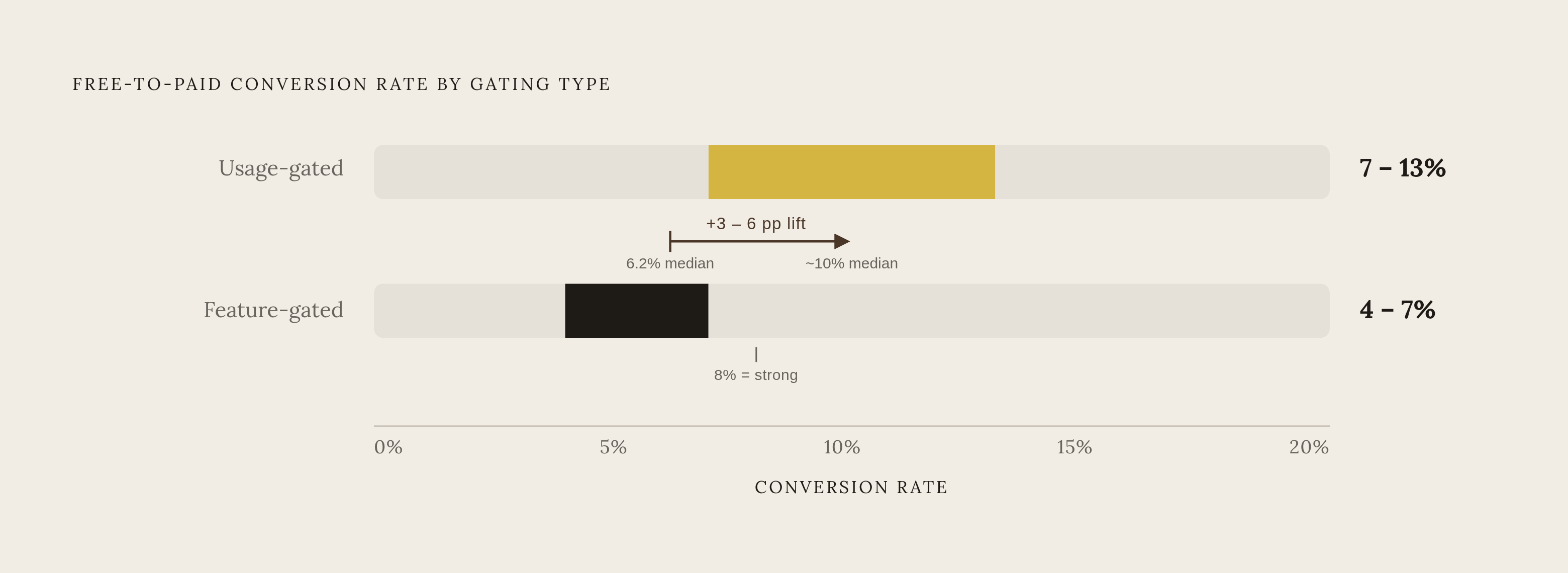
The numbers are not subtle. Per acceleroi's 2026 PLG benchmark, which draws on acceleroi's audit data and broader PLG SaaS research, freemium products that gate on usage limits convert free-to-paid at a notably higher multiple of the rate of products that gate on features. Feature-limited freemium converts at 4 to 7%. The median across PLG SaaS is 6.2%, with 8% treated as the threshold for "strong" performance. Gating on usage instead of features is worth an estimated 3 to 6 percentage points of free-to-paid conversion, according to the same benchmark.
That gap exists because of a mechanism that becomes clear once you sit with it. Feature-gated freemium lets a user linger indefinitely, exploring at their own pace with no clock running. Usage-gated freemium builds in a forcing function: the user hits a cap on seats, API calls, or storage, and that moment is legible in a way "you don't have access to this feature" never quite is. A usage limit hit means the user is already doing the thing the paid tier exists for. The upgrade argument has already made itself.
What the data does not settle is where to put the limit. Knowing that caps outperform feature gates says nothing about how tight the cap should be, and getting that wrong in either direction erases the advantage.
The two failure modes: limits that kill activation and limits that never create pressure
Set the limit too low, and the user never gets far enough to see what the product actually does. Activation stalls mid-arc, the upgrade prompt shows up before there's any reason to pay, and the reflexive response is to leave, not to reach for a credit card. This appears constantly in AI products that cap tokens or API calls so tightly that a user cannot complete one representative task end to end. A coding assistant that runs out of context mid-refactor has not demonstrated value. It has demonstrated a wall.
Set the limit too high, and the free tier quietly becomes a permanent substitute for the paid one. Users settle at their natural ceiling, feel no friction, and stay there indefinitely, which means the free tier has started cannibalizing the paid tier's own addressable market. Credit-based models are especially exposed to this failure, since a generous free allowance trains users to expect a level of usage they were never going to pay for.
There's a third failure mode outside the too-low/too-high spectrum: no limit at all. Cursor's widely discussed $7,225 invoice, generated for a single developer in July 2025, is the cautionary case. Uncapped usage is not generosity. It's a metering architecture failure that shifts unpredictable cost risk onto the customer, and bill shock of that size does more damage to trust than a tight cap ever would. The goal is not the absence of a wall. It's a wall placed just below where the user would naturally stop on their own, tight enough to be felt by anyone growing into the product, loose enough that it never interrupts the arc of getting there.
How to find the natural ceiling: using behavioral data to place limits empirically
The natural ceiling is the usage level a product's median active free user reaches on their own, before any pricing pressure gets applied. Finding it means segmenting free-user cohorts by engagement, not by signup date, which is a distinction a lot of pricing teams still get backwards.
Two numbers matter more than any others. First, identify the usage level where the top quartile of free users actually operates: that's the ceiling to calibrate against, not the median. The median user should stay comfortable inside the free tier. The power user, the one already extracting real value, should feel the friction. Second, make sure the paid tier's limit gives that top quartile clear headroom above their current usage, so the upgrade doesn't just trade one wall for a slightly taller one.
For AI and metered products, the unit has to match whatever drives inference cost: tokens, API calls, GPU-minutes, completions. A limit denominated in something the product doesn't actually spend money on is a limit that will drift out of alignment with margins the moment usage patterns shift.
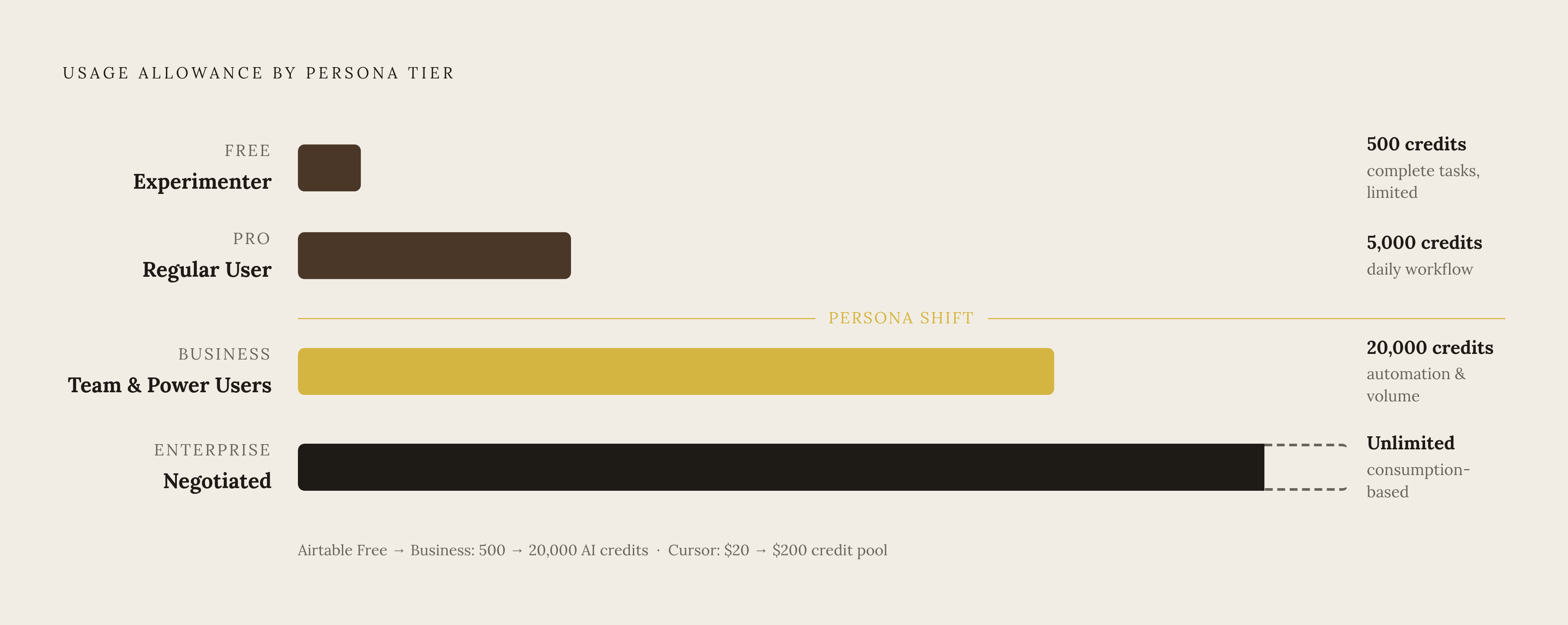
Credit-based models make all of this more visible to the user and, not coincidentally, to the pricing team doing the calibration. The PricingSaaS 500 counted 79 companies running credit models, up 126% year on year. Clay's pricing structure uses credit volume thresholds as a core determinant of plan tier, alongside feature unlocks and, in its 2026 structure, a separate Actions allocation, and that threshold is doing exactly the ceiling-calibration work described above. Airtable's AI credit allowances tell a similar story: 500 credits on the Free plan scaling up to 20,000 on Business, with each band mapped to a recognizable archetype, the individual experimenter at one end and the team-scale operator at the other.
Two questions should drive the underlying analysis. At what usage level do free users stop coming back? That's the activation floor, and a limit should never sit anywhere near it. At what usage level do free users start inviting colleagues or folding the product into a real workflow? That's the value-realization threshold, and it's the zone a limit should target.
Structuring limits across tiers so each boundary creates the next upgrade
A limit only functions as a lever if the tier above it offers a proportionate jump. Hit a wall and find a barely-larger allowance waiting on the other side, and the upgrade stops feeling like an offer and starts feeling like a technicality. The 2025 benchmark study of over 100 companies found the industry norm is 3.2 public tiers plus a custom or enterprise option, and each boundary between those tiers is a chance to capture a distinct usage archetype rather than just a slightly bigger version of the last one.
Cursor's credit pool, scaling from $20 to $200, gives developers a clear read on relative intensity. The ratio between tiers is communicating something specific: this plan is for someone using the product roughly ten times harder, not just someone willing to pay more for the same behavior.
The design principle that produces all of this is that each tier's allowance should map to a recognizable persona, not an arbitrary multiplier. Free tier for the individual experimenter running limited but complete tasks. First paid tier for the regular user or small team folding the product into daily workflow. Second paid tier for team-scale or power users running automation and volume. Enterprise, at the top, often detaches the ceiling entirely, negotiated or consumption-based. Zendesk's approach, charging $1.50 per committed automated resolution or $2.00 pay-as-you-go, is one version of that detachment.
The hybrid pattern, subscription for access layered with usage on top, separates the access boundary from the usage boundary, which lets a team adjust usage limits without repricing the base plan every time. Salesforce's Agentforce shows why that separation matters at the enterprise level: after pushback, the product now runs three coexisting models at once, $2 per conversation, flex credits at $0.10 per action, and per-user licensing at $125 a month for unlimited internal use. No single limit structure covers every buyer segment, and enterprise accounts in particular often need access and consumption decoupled from each other. Asana's AI Studio takes a gentler version of the same approach, escalating credit limits by tier while offering additional purchase options, which keeps the limit as an upgrade signal without ever hard-blocking work already in progress.
The moment the limit hits: why upgrade prompt timing determines whether friction converts or churns
An in-app upgrade prompt that fires at the exact moment a usage limit hits, paired with a discount or a first-month offer, lifts free-to-paid conversion by an estimated 2 to 5 percentage points, per acceleroi's benchmark data. Timing does more work here than messaging does. A prompt dropped at some arbitrary point mid-session underperforms badly against one that appears the instant the user gets stopped cold.
That moment of being stopped is the highest-intent point in the entire relationship. The user wants to keep going, cannot, and the paid tier is sitting right there as the answer. The prompt needs to be present at exactly that second, not five minutes later in an email.
What the prompt says matters, but less than when it says it. It should name the specific limit hit rather than a generic "upgrade for more," show what the next tier offers in the same unit ("You've used 500 credits; Pro includes 5,000"), and carry a concrete bridge offer, a discount, a trial extension, something that lowers the cost of saying yes right now.
The pricing page has to tell the same story. PLG SaaS companies that clearly map free-tier limits to paid-tier benefits convert at 2 to 3 times the rate of those with vague tier differentials, per acceleroi, and a visual side-by-side comparison on the pricing page adds another 1 to 3 percentage points on its own. That's not a design flourish. It's a revenue variable that happens to live on a marketing page. Spend visibility and real-time usage alerts do parallel work: a user who can see the cap approaching arrives at the upgrade prompt already primed, rather than blindsided by a hard stop they didn't see coming.
Credit models and rollover mechanics as limit-softening tools that preserve conversion pressure
Credit models were the defining pricing shift of 2025. Companies using them in the PricingSaaS 500 grew from 35 to 79, a 126% year-on-year jump, and the reason is partly psychological: "you have 200 credits left" reads far more clearly than "you have 14,000 tokens remaining," even when the two numbers represent the same underlying constraint.
Clay's model shows how to soften the experience of hitting a limit without dulling the pressure to upgrade. Credits pool across all users on an account, with rollovers and top-ups available. Rollovers cut down the "use it or lose it" frustration that tends to drive people away rather than toward a purchase. Top-ups give a user who hits their cap a low-friction way to keep going without committing to a full plan change, which captures revenue from someone not ready to upgrade while keeping the upgrade path visible and available.
Gamma takes a different angle on the same idea, metering at the feature level: different actions consume credits at different rates, so heavy use of the product's highest-value features burns through the allowance faster and puts the paid tier's benefit in front of the user sooner.
Worth noting, too, is the countercurrent running against all this granularity. Notion, Slack, and Loom each charged $4 to $10 per user for AI as a bolt-on add-on before bundling it in and raising base prices by $2.50 to $5 per user instead. That move trades away the per-feature conversion signal for simplicity, and it's a live tension in the market right now, not a resolved question: how much metering granularity a product needs versus how much friction that granularity adds to the buying decision. For AI products carrying enterprise contracts, prepaid credit wallets alongside postpaid invoicing let a company commit spend upfront while individual users still feel the limit at the wallet level rather than waiting for a monthly invoice to deliver the news, which changes the psychology of hitting the cap considerably.
What billing infrastructure must support for limit placement to work as a conversion lever
None of the calibration described above means anything if moving a limit requires an engineering sprint. A limit that takes two weeks to adjust is not a lever. It's a fixed constraint wearing a lever's clothing.
Real-time metering is the baseline requirement. A limit breach detected with a 24-hour lag produces an upgrade prompt at exactly the wrong moment, well after the user has hit an unexplained error and moved on to something else, or just closed the tab. Usage dashboards and spend alerts visible to the user in real time aren't a nice-to-have feature bolted onto a metered product. They're the infrastructure that makes the eventual upgrade prompt feel like help rather than punishment.
Hybrid pricing structures also demand that multiple limit types get modeled at once, often on the same account: per-user limits, team-level pools, credit balances, overage thresholds, sometimes all four running simultaneously. The common failure mode occurs when a company runs separate billing codepaths for subscriptions, usage, and credits that don't share state in real time. At that point, no consistent limit experience is possible, because the three systems don't agree with each other about what the customer has actually used.
Purpose-built usage-billing infrastructure, the kind that ingests events as fast as consumption happens, models the full set of pricing dimensions, and exposes limit status to the product and the customer alike, produces the operational floor for everything described in this piece. Without it, limit placement stays a slide in a pricing deck. With it, pricing becomes something product and finance teams can adjust continuously as cohort data accumulates and the natural ceiling comes into sharper focus, no engineering ticket required.
Sources
- SaaS Pricing Benchmark Study 2025: Key Insights from 100+ Companies Analyzed
- SaaS Pricing Is Shifting from Per-Seat to Usage and Outcome — What Changes at Your Next Renewal - SoftwareSeni
- PLG SaaS Free-to-Paid Conversion Rate Benchmark 2026 | acceleroi
- growthunhinged.com
- SaaS Pricing Benchmark Study 2025: Key Insights from 100+ Companies Analyzed
- growthunhinged.com