Paywall Placement Experiments and Their Effect on Signup-to-Paid Conversion
Placing paywalls early and requiring upfront credit cards dramatically increases conversion rates.

The instinct behind most paywall design is simple: let people experience value before asking them to pay. It feels fair, and it feels like good design. The data on paywall placement complicates that instinct almost immediately: where a paywall fires changes who converts, how much they pay, and whether the product ever recovers the cost of acquiring them. Adapty's state of in-app subscriptions 2026 report, built on a large dataset of subscription revenue across thousands of apps, makes the cost of guessing measurable: the gap between the best and worst paywall configurations is not marginal, it is enormous. That gap exists because the paywall is not a screen dropped into a flow after the "real" product decisions have been made. The onboarding sequence and the paywall function as one funnel, and what happens in the five screens before the paywall shapes whether it converts. Once that's understood, ownership changes shape: a UX problem gets fixed by designers, but fixing a pricing architecture problem requires product, finance, and engineering to all have a stake in the outcome.
Placement timing and intent: why Day 0 is the decisive window
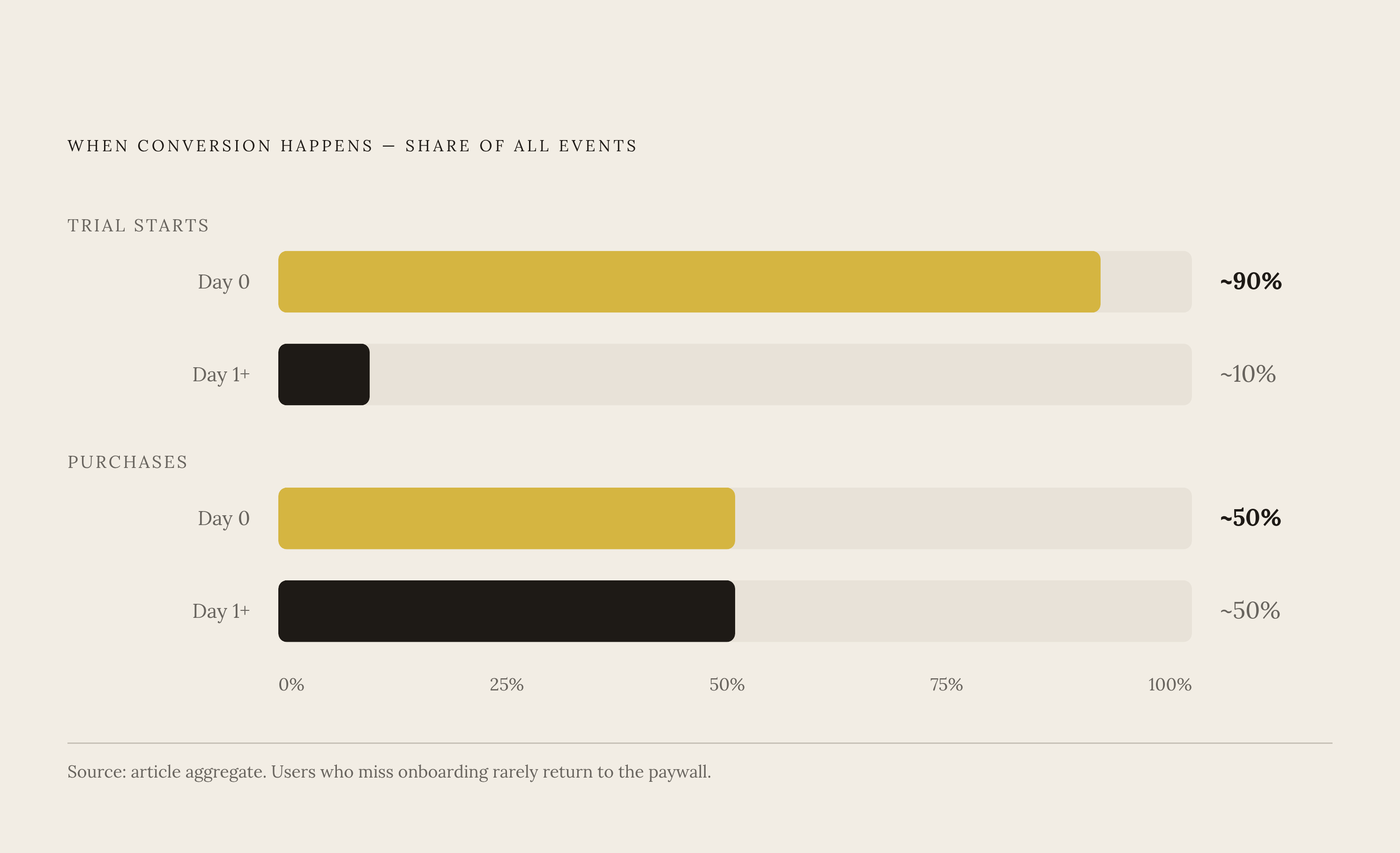
The window in which a user converts is the point of highest intent, almost always the first session. An analysis of a large sample of subscription apps found that apps placing their paywall upfront, before users could access core features, achieved a median 14-day trial-to-paid conversion rate roughly five to six times higher than apps that waited until after users had consumed content. Someone who downloads an app is usually solving an urgent problem, and their intent is at its peak at the moment of download. Every screen placed between that moment and the paywall gives intent room to decay. Adapty's 2026 report backs this with volume data: roughly nine in ten trial starts happen on Day 0, and nearly half of all purchases happen on Day 0, and users who don't convert during onboarding rarely come back to the paywall later.
That has a direct operational consequence. Investing heavily in re-engagement campaigns, win-back emails, and push notifications aimed at getting lapsed users back to a paywall is solving the wrong problem, because the conversion decision is made once, on Day 0, not gradually over a multi-week relationship. Rootd moved its paywall to the first two screens of the app, producing a 5x increase in revenue. Results at that magnitude aren't achieved through better copywriting or a redesigned button. They come from restructuring when the ask happens relative to when intent is highest.
None of this means every product should gate everything immediately regardless of category. Some products genuinely require habit formation before their value becomes legible, and the Day 0 rule applies differently when that value cannot be conveyed through a screenshot or a demo. The resolution is that nearly all users should encounter the paywall within their first few sessions regardless of strategy, and the real design question is what accompanies the paywall when it appears, not whether it appears early.
Hard paywalls, soft paywalls, and the survivorship bias hiding in the conversion data
The most commonly cited number in this debate is a conversion rate for hard paywalls that looks dramatically higher than the conversion rate for soft paywalls, and on its face it reads like proof that locking content outright is simply the better strategy. That reading misunderstands what the number is measuring. Hard paywalls don't make the users who encounter them more likely to convert. They filter out the overwhelming majority of users before those users ever reach the paywall at all, so the conversion rate being quoted describes only the survivors, a population that already carried intense intent before the wall ever appeared.
The revenue data adds a layer of real nuance without overturning that point. Hard paywall users generate substantially more revenue per install by Day 14 than soft paywall users, and hard paywall subscribers show 21% higher lifetime value over their first year, an advantage that comes from pre-qualification rather than from some persuasive property of the wall itself. Adapty's 2026 report measures conversion across the full user population rather than just the survivors: soft paywalls convert meaningfully better than hard paywalls, even though hard paywalls produce higher lifetime value per subscriber on dramatically lower volume.
Hard paywalls fit where value is immediate and obvious, a guided meditation, a financial newsletter with genuinely exclusive research, a tool solving one acute problem in a single session. Soft paywalls fit where value requires exploration, repeated use, or network effects that only appear after a user has spent time inside the product. For content-dependent businesses, a hard wall removes the free content search engines would otherwise index, cutting off the long-tail search traffic that funnels new readers into the funnel in the first place. Adapty's own conclusion on the hard-versus-soft question is direct: the right answer is neither, it's testing both, and apps that run structured experiments consistently earn far more revenue than apps running a static paywall, with top performers averaging a substantial number of experiments over time.
Trial structure and placement gains
Getting a user to the paywall is only the first half of the problem. What happens once they arrive, particularly the structure of the trial behind that wall, decides whether the placement gain actually converts into revenue. Trial length is the clearest data point here. Superwall's 2025 paywall benchmark data finds that apps running 7-day free trials outperform every other trial length tested, and conversion drops progressively as trial length increases beyond that window. The mechanism is intuitive once stated: most users who will ever meaningfully engage with an app do so in the first several days of ownership, and a 30-day trial simply hands them 25 additional days to forget the app exists and uninstall it before any charge would occur. Urgency functions as a psychological requirement for conversion, not an optional design flourish. A 7-day window forces a decision. A 30-day window reads as a problem to deal with later, which for most users means never.
Trial length and credit card requirement multiply or erode the gains from good placement. Requiring a credit card upfront produces free-to-paid conversion more than five times higher than trials that don't require one. And gate design, meaning what specifically is locked versus what remains free, matters roughly as much as where the gate sits. Among B2B SaaS products, opt-out free trials that require a credit card upfront convert at well above double the rate of reverse trials that offer full features temporarily before downgrading, and freemium converts at a substantially lower rate than either structure. Restricting admin and collaboration features specifically, rather than restricting core functionality, lifted freemium conversion and nearly doubled revenue yield without increasing churn, per the 2026 Profitwell SaaS Monetization Index across a large sample of freemium products.
The category exceptions prevent the trial-length finding from being over-applied. Adapty's 2026 report finds the "always offer a trial" assumption fails for at least three categories: in Productivity and Lifestyle apps, users who buy directly generate higher one-year lifetime value than users who go through a trial first, while trials outperform direct purchase in Health & Fitness, Education, and Utilities. The report's placement-and-trial-combination data ties the whole argument together: onboarding paywalls paired with a trial convert at an average of 1.35%, the highest rate of any placement-and-trial combination measured, which confirms that placement and trial structure aren't separate levers to be optimized independently.
Pricing model alignment and placement strategy
Everything above describes conversion mechanics built for flat-rate subscription products, and that logic starts to break down once the underlying pricing model shifts to usage-based or hybrid billing. Intent to use a product is not the same signal as intent to consume it at a particular rate, and a paywall built to capture the former will misread the latter. The SaaS market is moving through exactly this transition, with hybrid models, a fixed base charge combined with variable usage components, becoming increasingly common because customers want planning security while providers want revenue they can actually forecast. Among SaaS companies formally monetizing AI features, roughly half rely on subscription pricing, bundled into existing tiers or sold as a dedicated AI tier, while roughly half use usage-based, consumption-based, or outcome-based pricing. No single dominant model is available to copy.
For a usage-based product, the paywall stops being a single gate encountered once at onboarding. It becomes a continuous decision surface, because users hit pricing friction every time they approach a consumption limit, a credit balance running low, or a feature tied to a specific tier. Placement, in that context, is a recurring architectural question that has to be answered repeatedly across the life of an account, rather than a one-time choice made during onboarding design.
New Relic's transition from host-based subscription pricing to pure consumption-based billing shows what happens when that architecture isn't handled deliberately: net revenue retention fell sharply, from roughly 115% to below that threshold, and revenue growth decelerated, because the consumption model let customers cut spend simply by lowering how much data they ingested. In that structure, the paywall effectively became the usage curve itself, a moving target rather than a fixed moment in a funnel.
Hybrid pricing introduces its own placement problem on top of this. This matters even more as AI agents get embedded directly into production workflows, where usage can scale far faster than a human-driven product ever would. Without consumption guardrails and real-time visibility into spend, that scaling is budget exposure rather than a sign of adoption. The paywall's job in AI products has to include protecting users from bill shock, not just capturing revenue from growth. Some vendors are pushing this even further toward outcome-based pricing, tying fees directly to faster loan approvals, higher eCommerce conversion rates, or reduced fraud losses. In that model, the paywall has to communicate value tied to demonstrable business outcomes, not seat counts or API call volumes.
Dynamic paywalls and AI-driven placement: what selective personalization can and cannot do
Everything discussed so far describes static experiments: a fixed paywall moment, tested and optimized for an average user across the whole population. Dynamic paywalls represent the next step in the same intent-matching logic, attempting to match gate timing and gate type to a given user's predicted value in real time rather than applying one configuration to everyone. Dynamic systems read signals, traffic source, device type, time on page, geography, reading history, return frequency, and decide in the moment whether a specific user should see a hard wall, a soft wall, a discount offer, or no gate at all yet.
Frankfurter Allgemeine Zeitung, one of Europe's leading newspapers, deployed AI-driven paywall decisions and saw increased conversion rates as a result, giving the model a concrete production case rather than a theoretical one. Salem Reporter's 30-day head-to-head test offers a second production case, this time built around registration walls functioning as a dynamic intermediate gate: registration walls generated 16 times more registrations than traditional newsletter signup forms, and a meaningful share of those free-registered readers eventually converted to paid subscriptions. That makes the registration wall a signal-capture mechanism that funds a longer conversion arc rather than a direct ask. Metering functions as a related, deliberately engineered scarcity lever: high-performing publishers maintain a hit rate on their metered limit well above that of struggling publishers, and setting that limit low, rather than generously, forces high-engagement readers into an actual conversion decision instead of letting them read indefinitely for free.
Dynamic personalization has a clear boundary, and the sources are consistent about not overstating it as a solved discipline rather than an active frontier. It optimizes placement within a pricing model that's already correct for the product. It cannot compensate for a pricing model that's fundamentally wrong for what the product does, and it cannot rescue a trial structure that has already destroyed urgency through excessive length or a missing credit card requirement. For usage-based products, dynamic paywalls carry an added layer of complexity, because the signal driving the gate decision isn't just behavioral intent but real-time consumption data. A user approaching a credit limit represents a fundamentally different conversion moment than a user simply on their third session browsing the product, and the gate logic has to be built to recognize that difference rather than treating all returning users the same way.
What the billing infrastructure underneath the paywall must handle
Every placement strategy described above, hard or soft, upfront or delayed, static or dynamic, eventually depends on infrastructure that has to execute the decision correctly at the moment it fires. A paywall that decides, in real time, that a user approaching a usage limit should see an upgrade prompt is only as good as the metering system feeding that decision accurate, current consumption data. If usage events are batched, delayed, or reconciled only at the end of a billing cycle, the paywall ends up reacting to stale information, prompting users too late to prevent bill shock or too early based on data that no longer reflects actual consumption.
Hybrid pricing compounds this. A system that has to gate on both a fixed subscription tier and a variable usage component needs to track two different kinds of state simultaneously, tier entitlement and running consumption, and reconcile them without contradicting each other at the moment a user hits the paywall. The New Relic case illustrates what happens when the usage side of that equation isn't tightly managed: customers were able to reduce spend simply by adjusting how much data they sent, and the billing system had to reflect that shift in near real time or risk misrepresenting what customers actually owed.
Credit-based and consumption-based products add a further requirement: the infrastructure has to support proactive guardrails, spend caps, alerts, and visibility tools, so that scaling usage translates into predictable revenue for the provider and predictable cost for the customer, rather than an unpleasant surprise on an invoice. Outcome-based pricing models raise the bar again, since billing logic there has to tie charges to a measurable business result, a completed loan approval, a conversion event, a fraud loss avoided. The underlying system has to ingest and verify outcome data from outside the product itself, not just usage events generated inside it.
None of the placement strategies covered in this piece, upfront gates, trial-length tuning, registration walls, AI-driven gate decisions, function reliably if the billing layer beneath them can't keep pace with the pricing model the paywall is built around. Placement determines when the ask happens. Infrastructure decides whether that ask is accurate, timely, and trustworthy when it finally reaches the user.