Usage Gate Design in Freemium Onboarding and Upgrade Timing
Placing usage gates after users find value, not before, nearly quadruples freemium conversion rates.

Usage Gate Design in Freemium Onboarding and Upgrade Timing. The timing and position of a usage gate (before or after the user has experienced genuine value) is the primary lever determining whether a freemium user upgrades or churns, and designing that sequence intentionally is what separates 3% conversion from 12%.
Why most freemium products convert at 3% and a few convert near 12%
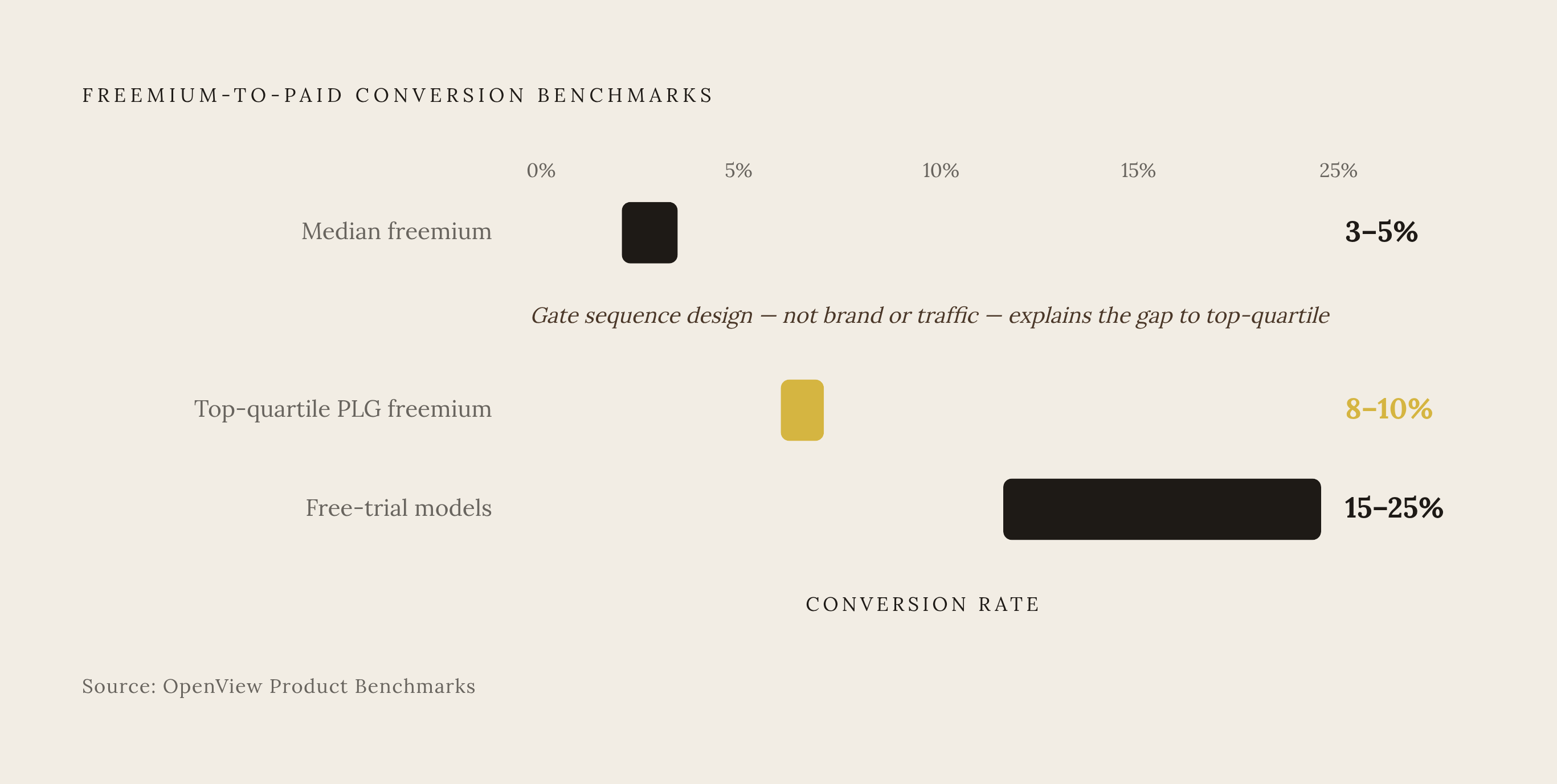
Freemium products convert at a median of 3 to 5%, while free-trial models pull in 15 to 25% OpenView Product Benchmarks. That gap looks like it should be permanent, a structural tax freemium pays for giving the product away. It isn't. Top-quartile product-led growth companies close the gap almost entirely, reaching 8 to 10% freemium conversion, because building the sequence correctly lets freemium match trial economics.
Whether a business lands at the bottom or the top of that range has nothing to do with pricing page design, brand trust, or how much traffic hits the signup form. It comes down to what happens in the first 72 hours after a user creates an account, and more specifically, what happens the moment that user runs into their first real constraint. Gate placement relative to when the user actually experiences value appears to be the variable doing most of the work in separating 3% conversion from 12%, though this framing draws on pattern-level inference rather than a single confirmed study source unverified; not confirmed in [Gatilab.
Three levers decide whether a gate helps or hurts: finding the right threshold at which the gate should fire, timing the upgrade prompt against how the user actually consumes the product, and building billing infrastructure that can enforce and revise those gates without forcing an engineering sprint every time the number needs to move. Each one compounds on the others. Get the threshold right but the timing wrong, and the prompt lands as an interruption. Get both right but build the gate on infrastructure that can't count usage in real time, and the whole design collapses the moment the product scales past a single pricing dimension.
Usage gates versus feature gates
A usage gate is a quantitative threshold, a counter tracking seats, API calls, storage, credits, or tokens that fires the moment consumption crosses a set line. A feature gate is a different animal entirely: it's a commercial decision about which capabilities belong to which plan, and it stays fixed regardless of how much or how little the user actually does with the product. Feature flags get mentioned alongside both of these often enough to cause confusion, but they're an engineering concept, a way to toggle code in production, not a billing control at all, and treating them as interchangeable with gates is a common source of architectural mistakes further down the line.
The reason traces back to how each one makes a user feel. A feature gate makes the upgrade abstract: the user imagines what they'd get if they paid, a hypothetical benefit sitting behind a locked door they've never opened. A usage gate makes the upgrade personal and immediate, because the user just ran out of something they were actively using. One is a sales pitch. The other is a wall the user built for themselves, one action at a time, and now stands in front of.
Hunter.io's free tier illustrates the mechanic cleanly. Fifty credits a month, where finding an email address costs one credit and verifying one costs half a credit. A sales development rep running outbound campaigns burns through that allocation fast, and when it's gone, the Starter tier at $49 a month (or $34 on annual billing) isn't a hypothetical upgrade, it's the obvious next step to keep doing the job already in progress. The upgrade path that makes this work generally runs through five linked stages: free-tier onboarding, limit exposure, a signal that confirms the user is getting real value, the upgrade nudge itself, and finally payment. Skipping a stage, particularly the value confirmation step, causes the nudge to arrive as noise instead of a natural next move. According to acceleroi.com benchmarks, usage limits convert 1.5–2× higher than feature limits.
The activation sequence that must come before any gate fires
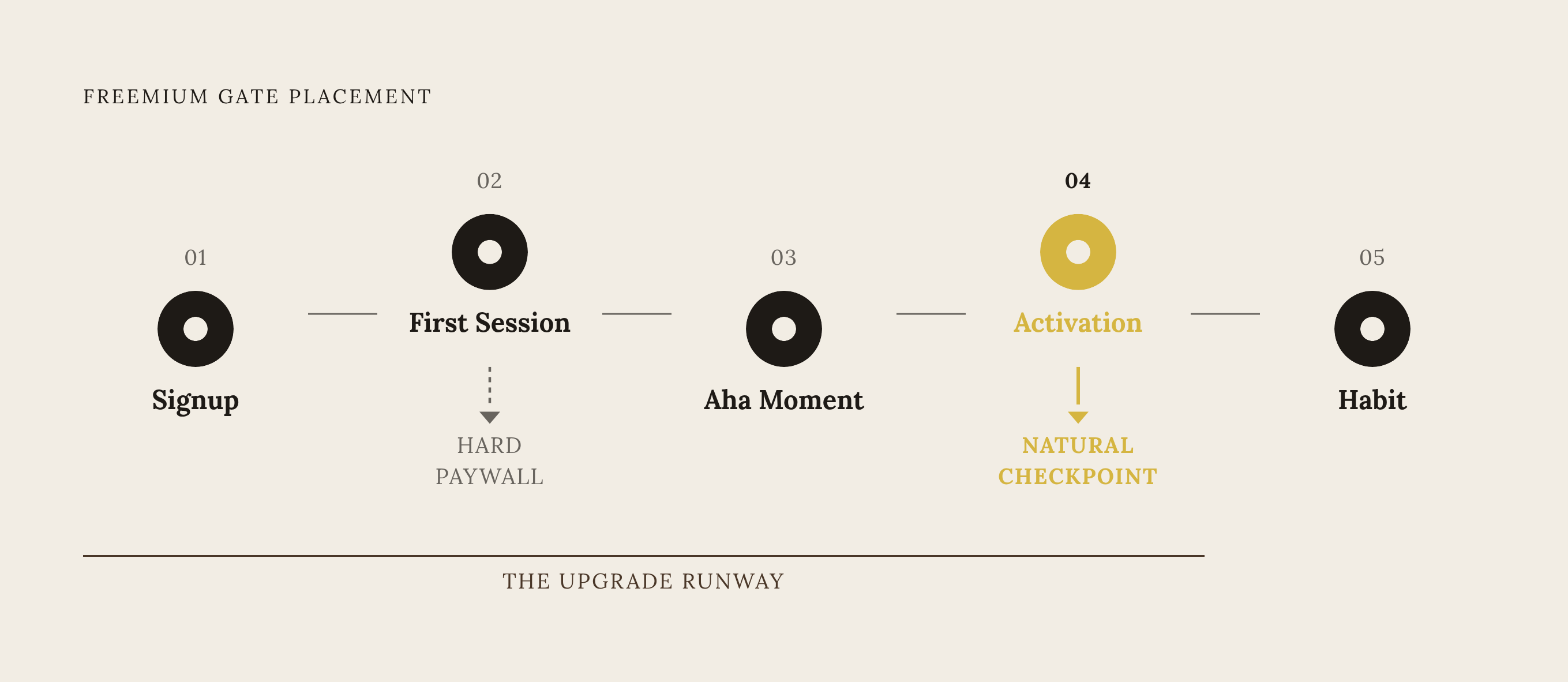
Gating too early kills activation before a user understands what they'd even be paying for. The rule holds regardless of how well the threshold itself is chosen: a gate is only as good as what happened before it fired. One useful model breaks the freemium journey into five stages: signup, first session, the aha moment, activation, and habit. Gates belong at the fourth stage. A limit that fires during someone's first session is a hard paywall wearing a free trial's clothes.
Several well-known products solve this by forcing a single action before anything else can happen. Notion won't let a new user wander until they've created a page. Linear requires an issue. Loom requires a recording. None of these are onboarding tours, and that distinction affects how the product directs a new user's first actions. A product tour is the vendor's agenda: look at this feature, then this one. A forced first action is the user's agenda, collapsed into a single completed task, because the user logged in to do a specific job and the product's desire to show off its feature set is, frankly, a competing interest. Resolving that conflict in favor of the user's job is what makes the aha moment possible at all, and a gate placed downstream of that moment behaves like a natural checkpoint. A gate placed upstream of it behaves like a wall thrown up before the user even knows what's on the other side.
How to find the right gate threshold for your product
Setting a threshold correctly requires three specific inputs, not intuition and not a workshop full of opinions. First, the behavior that predicts long-term retention appears only through cohort analysis run against real historical data. Second, the median usage volume at which retained users actually hit that behavior. Third, the distribution of usage among the users who churned before they ever got there.
Slack's activation research found that teams that sent 2,000 messages within their first 30 days retained at 93% Gatilab. That number didn't come from a feature list or a product spec. It came from running cohort analysis across 6 to 12 months of historical usage data and finding the leading indicator buried inside it Gatilab. Activation, in other words, is discovered through cohort analysis.
Notion's own threshold logic backs this up from a different angle. There are no feature gates and no countdown timers anywhere in Notion's free tier; the conversion trigger is storage limits and team size, calibrated so the paywall only appears after a user has stored enough content to feel genuinely invested in staying Sacra. Estimated freemium-to-paid conversion for Notion is 4 to 6%, against a user base north of 100 million Sacra. That's a modest conversion rate riding on top of an enormous base, and the threshold design is precisely why users don't leave the moment the free tier gets uncomfortable: by the time it does, they've already built something they don't want to lose.
None of this is an engineering decision, even though engineering ends up enforcing it. It's a product analytics decision first, and a great many teams get this backwards, setting thresholds by guesswork because nobody ran the cohort analysis to begin with. Behavioral signals matter here too. Repeated, consecutive stretches of limit exhaustion tell you the user is deriving enough return to justify paying, and that signal should arrive before the upgrade nudge does, not after. Move a genuinely high-value feature behind a prompt that only appears after a user completes a specific milestone, then measure the conversion lift against a control group that sees the prompt on a fixed schedule instead. A threshold set too low creates churners who never got far enough to feel the product's value. A threshold set too high creates comfortable free riders who never feel any urgency. The right number sits in the narrow space just past the aha moment and just before the habit locks in.
Timing the upgrade prompt against actual consumption patterns
There's a specific moment product teams sometimes call the "happy moment," the point right after a user hits a milestone, finishes a first project, or reaches a usage goal they set for themselves. Prompting an upgrade there works because the value is freshest in the user's mind, and the ask reads as a natural next step rather than a penalty for using the product too much. DemoGo, in November 2025, ran this exact play: advanced analytics stayed hidden until a user completed their first public demo, at which point preview access opened up and created real, felt demand for the paid feature rather than an abstract pitch for it.
The data on timing backs the intuition. An in-app prompt delivered at the exact moment a usage limit is hit, paired with a discount or a first-month offer, lifts free-to-paid conversion by 2 to 5 percentage points, and the timing of the prompt affects conversion more than what the prompt actually says acceleroi. Soft gating, offering limited preview access during onboarding instead of a hard block, produces a reported 15% lift in conversion compared to strict feature blocking Artisan Growth Strategies OpenView Product Benchmarks Gartner. The lesson across both figures is the same: a wall that appears exactly when the user needs to get past it converts better than a wall that appears on the vendor's schedule.
That schedule question matters more for freemium than it does for trials, because freemium's nurture window runs long. Time-to-paid for freemium users stretches to 60 to 180 days, a span that makes the single-session upgrade moment only one part of the picture Gatilab. Practically, that means upgrade nudges (in-app banners, email drip sequences, redirects to the pricing page) need to fire within a high-intent window, typically the 48 hours right after a limit is hit. Onboarding checklists play into this too: showing a checklist that's already partially filled in, rather than one starting from zero, increases completion, and checklists overall lift feature activation by roughly 27% on average. An upgrade prompt, done right, is a bridge the user is glad to cross.
What credit card gates and trial length do to the top of the funnel
Requiring a credit card before a free trial starts cuts signup volume by 60 to 75% compared to reverse-trial models that skip that requirement Gatilab. That's not a small optimization problem; it's a fork in strategy. The trade-off is qualified volume against total volume: teams with weak activation sequences tend to hide behind the credit-card gate because it makes the funnel numbers look tidier on a dashboard, while teams confident in their activation design remove the gate and absorb the unqualified traffic, because the math further downstream still works in their favor. Opt-out trials, card required upfront, convert at a higher rate among the people who do sign up. But the signup volume drop is steep enough that the absolute number of paying customers can end up lower than an opt-in model, depending entirely on how strong the activation funnel is Gatilab.
Trial length carries its own logic. Freemium plays by different rules entirely, given that 60-to-180-day time-to-paid window, because the nurture economics of a freemium motion and a trial motion differ Gatilab saasfactor. Increasingly, companies aren't choosing one over the other. Hybrid models, freemium acquisition paired with a time-boxed trial of premium features, represent the fastest-growing approach heading through 2026, adopted by roughly 65% of product-led growth SaaS companies saasfactor. Sustaining a pure freemium model long-term generally requires either a 4%-plus free-to-paid conversion rate or a progressive usage gate structure, because without one or the other, the support burden of a large free user base eventually overwhelms the business saasfactor. The credit card gate, in the end, is a blunt substitute for good activation design. The sturdier answer is building the activation sequence well enough that the gate becomes unnecessary, rather than adding friction upfront to paper over what happens after signup.
The billing infrastructure requirements that gate design creates
Product teams can do everything right, find the correct threshold, time the prompt against real consumption data, and still watch the whole design fail once it reaches engineering, because the billing system can't actually count usage in real time. That gap appears starkly in AI products billing on tokens, API calls, or GPU-minutes, since those events generate at millisecond speed. A billing system running nightly batch jobs will show a user a stale balance, won't be able to enforce a hard gate at the moment it should fire, and can't trigger an in-the-moment upgrade prompt when the limit hits.
The common workaround, bolting a separate metering tool onto a separate billing tool and reconciling the two once a month, doesn't solve the underlying problem so much as relocate it. It's two products pretending to be one system, and for a gate-heavy freemium product, that's the wrong foundation to build on. There's a quieter technical requirement hiding in here too: usage events in a distributed system arrive out of order and sometimes get retried, so a billing system needs deduplication through unique event IDs, or it will double-count usage, over-enforce gates that shouldn't have fired yet, and send upgrade prompts that are simply wrong.
What changes when the product bills across multiple usage dimensions simultaneously
A product that started with one usage counter rarely stays that way for long. A maturing AI or API product typically ends up gating on several dimensions at once: tokens consumed, API calls made, storage used, seats active, and GPU-minutes allocated, each with its own separate limit on the free tier. Pricing has followed that complexity upward. Hybrid pricing, a base fee combined with variable usage components, is already used by 43% of SaaS companies and is projected to reach 61% by the end of 2026, and a 2026 industry pricing report found 62% of SaaS platforms had introduced AI-premium tiers nxcode.io.
Credit-based pricing emerged as one way to simplify that mess, collapsing several usage dimensions into a single counter a user can actually track. The number of companies offering credit models more than doubled in a single year, climbing from 35 at the end of 2024 to 79 in a widely tracked pricing index Gatilab PricingSaaS 500 Index. But credits carry a real weakness once usage gets complex enough. Windsurf retired its credit billing system in March 2026 because a flat credit rate charged the same amount for a trivial request and a demanding one, and users responded by cramming multiple requests into a single prompt to game the rate rather than using the product the way it was meant to be used. The gate, in that case, didn't just fail to convert users. It actively distorted how they behaved.
GitHub Copilot moved in the opposite direction, shifting to token-based AI Credits effective June 1, 2026, specifically because flat per-seat pricing punished agent-style workflows that consume far more compute than a human typing in an editor ever would. Salesforce's Agentforce shows the same evolution playing out in real time: launched at $2 per conversation, moved to Flex Credits priced at $0.10 per discrete action in May 2025, and then added a Flex Agreement letting enterprise customers convert user licenses into Flex Credits and back again, reallocating spend between human headcount and digital labor as needs shift softwarepricing.com. Gate granularity, in other words, isn't a decision made once at launch. It evolves as a company learns more about how its own product actually gets used, and a billing system needs to be able to follow that evolution rather than constrain it.
How to select billing infrastructure that can support evolving gate design
The pattern across nearly every example here points to the same conclusion: a billing system that can only model one or two usage dimensions will eventually force a company to flatten its pricing into something cruder than the product deserves, whether that's a single credit counter or a flat per-seat fee, and that flattening undermines the gate design work already done at the product level. The infrastructure has to keep pace with the pricing model.
Practically, that means real-time event ingestion rather than batch processing, so a gate can fire the instant a threshold is crossed rather than hours later. It means an event schema built for deduplication from day one, since distributed systems will retry and reorder events regardless of how carefully the rest of the system is built. It means support for multiple simultaneous usage dimensions, tokens alongside seats alongside storage, rather than a system that only knows how to count one thing at a time. And it means thresholds that a product or finance team can adjust directly, without waiting on an engineering sprint, because the right gate threshold is discovered through cohort analysis that keeps producing new answers as more data comes in.
Gate design, at the end of all this, is not a one-time decision made at launch and left alone. It's a continuous practice of watching where users actually find value, adjusting the counter that measures it, and making sure the systems underneath can move as fast as the pricing model needs to. Get the sequence right, the threshold right, and the infrastructure right, and freemium stops being the discount version of a free trial. It becomes a conversion engine that can, on the evidence here, close most of the distance to what trial-based pricing has always promised.
Sources
- 7 SaaS onboarding flows that convert free to paid | userTourKit
- SaaS Onboarding: 5-Stage Playbook for 2026 - Gatilab
- Freemium vs Trial Models in SaaS: What Really Boosts Conversions?
- PLG SaaS Free-to-Paid Conversion Rate Benchmark 2026 | acceleroi
- SaaS Feature Gating 2026: What 25 Companies Keep Free vs Paid
- demogo.com