Trial Length Variation Tests and Their Effect on Activation Rates
Activation speed in the first 90 minutes, not trial length, drives subscription conversion.

A large randomized field experiment found that shorter and longer trials produce nearly identical subscription rates, which contradicts almost everything the industry believes about trial length. That single result is the reason this piece exists, and it deserves attention before looking at any other number. The conversion numbers seem to back this up at first glance. Seven-day trials converted at 24.7%, 14-day trials topped the list at 28.4%, and the easy conclusion is to run a 14-day trial because the data says so.
That reading doesn't survive contact with the field experiment. The gap between 14-day and 30-day cohorts is small, and when researchers ran the comparison at scale under randomized conditions, duration alone barely moved the needle. So what's actually happening in the benchmark gradient? Products that get users to value fast convert well no matter when the trial window closes, and the duration figure is just riding along, picking up credit for something else entirely. Duration isn't the lever. It's the shadow of one. The conventional wisdom holds that the 14-day trial is the industry default, used by a majority of the roughly 200 products in ChartMogul's January 2026 study, while 7-day and 30-day trials each claim a much smaller share.
Trial model and motion type versus duration in shaping conversion
Widen the lens past calendar days, and the real structural differences appear fast. Opt-out trials, the kind that require a credit card at signup, convert at a substantially higher rate than opt-in trials according to GrowthSpree's benchmarks. ChartMogul's data tells the same story from a different angle: opt-in trials have good and great conversion bands, but both sit far below what credit-card-required trials achieve at the same performance tier. Reverse trials, where a user gets full product access before being downgraded to a lower tier, are in the middle: a median of 24% with a range between 18% and 32%.
Raw conversion percentage only tells part of it, though. Look at conversion per visitor instead, and credit-card-required trials bring in fewer people at the top of the funnel but end up producing almost three times as many paying customers as standard free trials, per ChartMogul's data. Fewer signups, more revenue. That tradeoff should reframe how a team thinks about funnel volume as a success metric.
None of this means one model beats another in some universal sense. It means the "optimal" trial length question doesn't have a single answer independent of the motion a product runs. Deal size complicates the picture further: for enterprise products, a hybrid of a live demo followed by a trial period tends to outperform a standalone trial on its own. The structural choice of model, plus who's buying and at what price point, does more to shape the outcome than any adjustment to the calendar ever will. Which raises the obvious next question: if trial model sets the ceiling, what explains the enormous variation of outcomes within any single model?
Activation rate as the variable that explains the substantial conversion spread
ChartMogul's report on 200 B2B products found that conversion rates vary enormously between top and bottom performers, and this holds true regardless of which trial model a product runs. Most products don't cluster near some tidy median. They sit at the extremes, either converting very well or very poorly, with little in between. That spread demands an explanation, and the trial model differences from the previous section don't fully account for it, since the gap occurs even among products running the identical structure.
Activation rate is the variable that closes that gap. GrowthSpree's 2026 benchmarks attribute somewhere between 60% and 75% of trial conversion variation to activation rate alone, even as GrowthSpree also flags credit card requirement at signup as the single largest determinant of overall conversion level. Both things are true at once: model sets the baseline, activation determines who clears it. The arithmetic behind that is blunt. Products that get users activated convert at rates many multiples above what un-activated trials manage, which is the mechanism behind why a 14-day vs. 30-day A/B test run on top of a 30% activation rate is testing duration on top of a broken activation baseline, and cannot surface the real problem.
Median SaaS activation rates are low industry-wide, according to Lenny's Newsletter's activation survey of more than 500 products from October 2022, and the top-performing companies in that same dataset achieve activation roughly double the median. A gap that wide, sitting entirely on activation and nothing else, explains far more of the conversion spread than any duration test ever could.
A product running a 14-day vs. 30-day A/B test but with a 30% activation rate is testing duration on top of a broken activation baseline. It's testing duration on top of a broken foundation, and the broken foundation will swamp whatever signal duration might have produced. The experiment can't surface the real problem because the real problem was never in scope.
Where activation breaks within the aha moment window
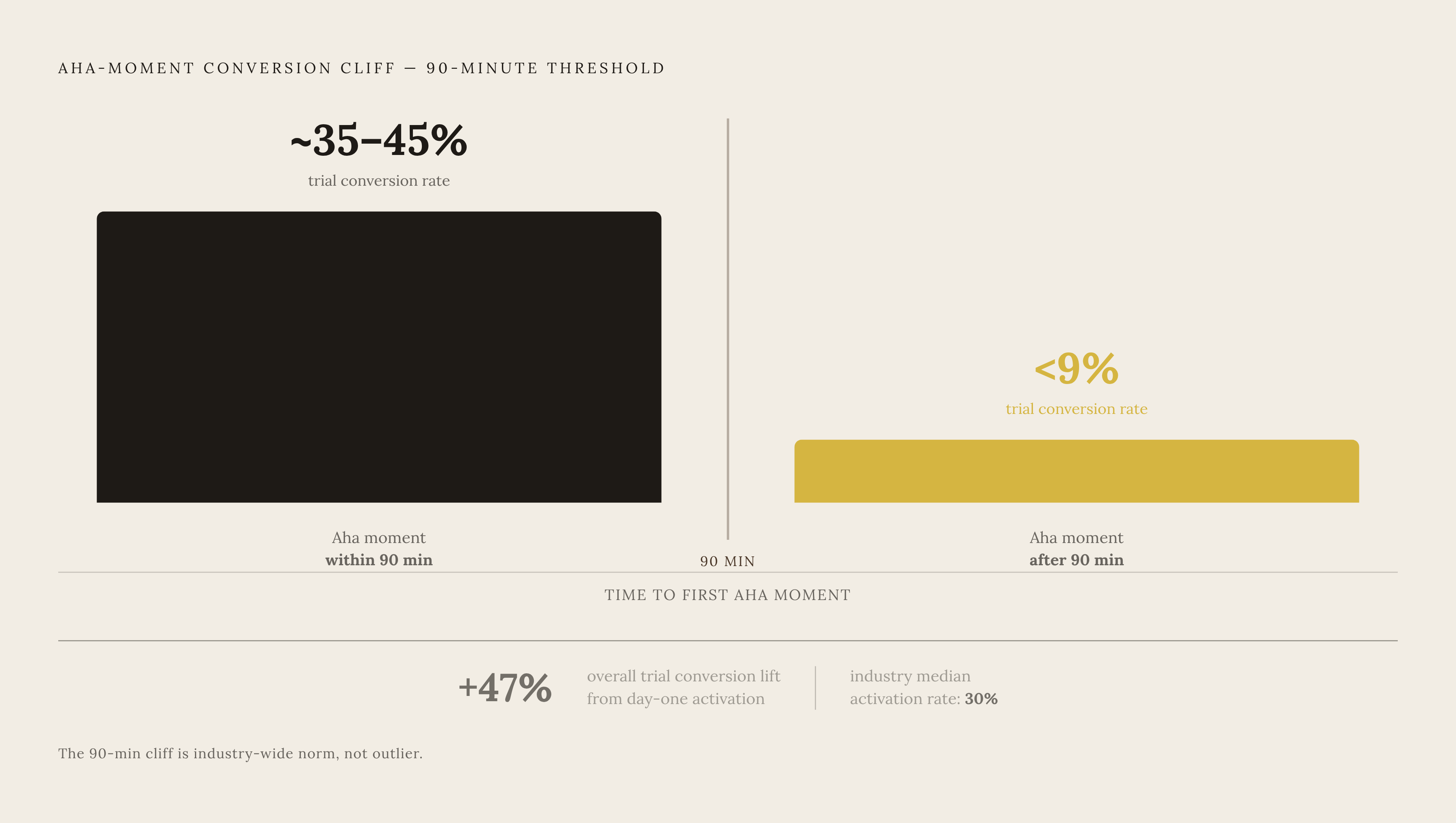
The 2026 benchmark data draws a hard line at 90 minutes: trials where users take longer than that to hit their first aha moment collapse to single-digit conversion. Once that window closes, the trial is functionally over, no matter how many days remain on the clock. Ninety minutes. Not ninety hours, not the first week. That's how narrow the actual leverage point is.
Day-one activation lifts overall trial conversion by 47%, which makes the first session the single highest-leverage moment across the entire trial lifecycle. And yet the industry-wide median activation rate is 30%, per Lenny's Newsletter's survey, while OnRamp's report sets an aspirational bar of under 14 days to reach first value.
A few failure patterns recur. Products that require multi-day setup, things like data import, team invites, or configuration steps, run straight into trouble on a 7-day trial, because the trial ends before activation even has a chance to start. Longer trials carry a different trap. Thirty-day windows create a kind of false slack: users feel like they have time, so they defer engagement, and the majority of signups never come back after that first session regardless of how many days are left on the clock. GrowthSpree's 2026 data backs this up from another direction: un-activated trials in days 1–3 rarely activate later, so the activation window is front-loaded even in longer trials.
Put together, these facts point to a specific diagnostic. When a trial length test comes back showing no meaningful difference between durations, the likely explanation isn't that duration doesn't matter. It's that activation is breaking in the first half of both windows being tested, and the test is measuring the symptom rather than the disease.
The onboarding levers that move activation within any trial window
Fixing this starts with definition, not tactics. Vague activation definitions, "engaged users" or "active accounts," don't meet any of these three bars and can't be used to fix anything.
What this looks like varies by product category. An API-first developer tool might define activation as the first successful API call made from a production environment, not a sandbox. A sales engagement platform might define it as the first outreach sequence sent to five or more contacts. The event has to be specific enough to instrument and consequential enough to predict what happens next.
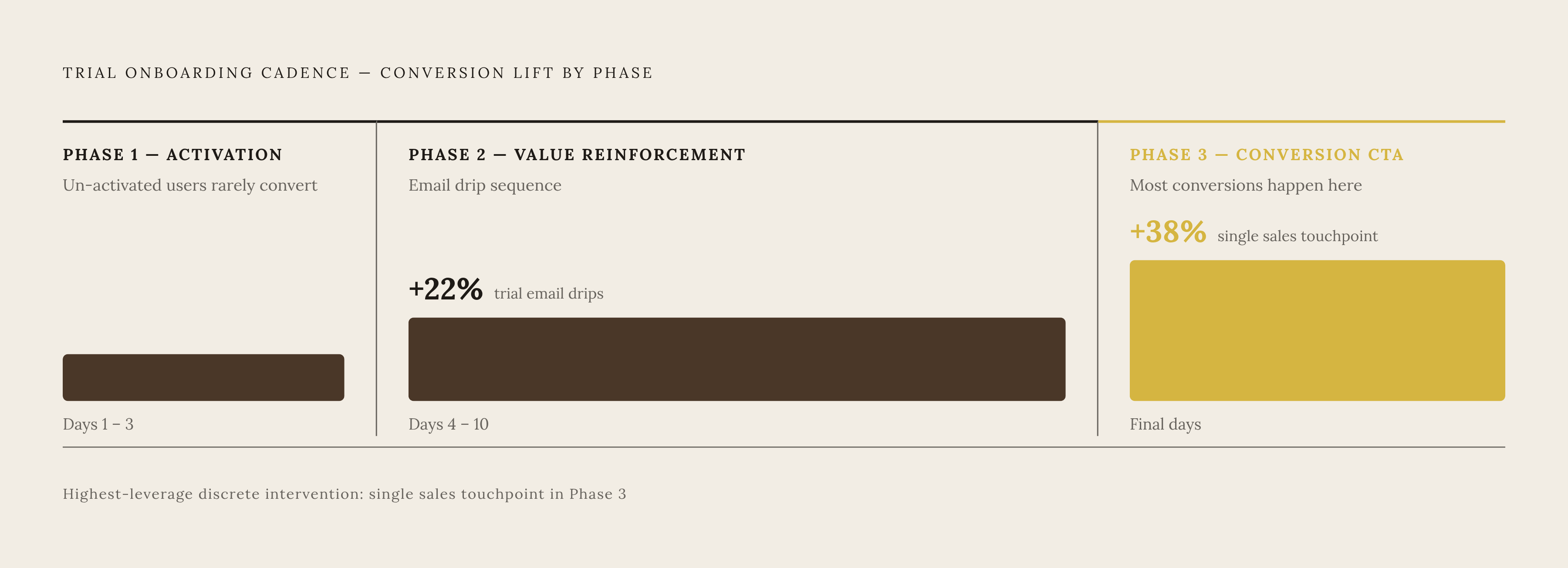
Timing matters just as much as the event definition itself. Engagement timing matters: the large majority of trial-to-paid conversions happen in the second half of the trial, but un-activated users in days 1–3 rarely convert, pointing toward a phased cadence: an activation push in days 1–3, value reinforcement in days 4–10, and a conversion CTA in the final days.
Specific interventions carry real, measured lift. Trial-specific email drips lift conversion by 22%. A single sales touchpoint inserted during the trial lifts product-led conversion by 38%. Product-qualified-lead-driven conversion runs well above the average conversion rate, according to a ProductLed survey of more than 600 B2B SaaS companies, yet only about 24% of product-led companies actually use PQLs as a signal. That's a wide gap between what works and what's actually deployed. Feature gating is a subtler lever: light gating works, but heavy gating during the trial period actively suppresses activation rather than protecting revenue.
Hila Qu, Director of Growth at GitLab and a Reforge instructor, put the underlying mistake this way: founders tend to think product-led growth just means shipping a free version or a free trial, when what actually matters is designing how activation happens and how the upgrade path works. The trial is a starting point. It was never the strategy on its own. Per GrowthSpree's framework, defining the activation event is the prerequisite, as every PLG product needs a single, clearly defined activation event that is (a) observable in product analytics, (b) correlated with paid conversion at a multiple of the un-activated baseline, and (c) achievable within the first half of the trial.
Designing a trial length experiment that tests what it claims to test
When activation rate differs between the cohorts in a trial length test, the experiment stops measuring duration and starts measuring which cohort happened to onboard better. Randomizing the assignment doesn't fix this on its own, because randomization only guarantees the cohorts are similar going in, not that they're treated consistently once the test starts. If one cohort's onboarding flow is inconsistent or under active iteration during the test window, the comparison is contaminated regardless of sample size.
There's a sequence to get right before running duration as a variable. Define and instrument a single activation event first. Then measure the current activation rate broken out by day, so it's clear where in the existing trial window most users activate, and where most of them stall out. If that activation rate sits below the bottom quartile, meaning under 30%, fix onboarding before testing duration at all, because a broken activation baseline imposes a floor effect that no amount of duration tuning can escape.
Segmentation matters just as much as sequencing. B2B and B2C populations convert on different timelines: conversions tend to peak in week one for a lot of segments, according to ChartMogul's Go-To-Market Report, but that pattern doesn't hold evenly across buyer types. Mixing both populations into a single test produces a result that can't really be interpreted, so segmenting by buyer type and by ACV before running the test isn't optional; it's a prerequisite.
Once the test is live, conversion rate alone is a thin thing to measure. Track time to the activation event within each cohort, not just whether a conversion eventually happened. Track activation rate within each window as the real leading indicator. And track mid-trial engagement depth: did the longer-window users actually use more of the product, or did they just push their engagement back because they had more calendar room to do it in?
Two specific conditions genuinely favor a shorter trial. Products with fast, demonstrable time-to-value, the Sleeknote example that Userpilot documented shows core value visible in the very first session, benefit from urgency because urgency adds pressure without costing anything in activation quality. That only holds when the activation event is reliably achievable within days 1–3. Two other conditions favor going longer. Opt-out motion is one: credit card pre-commitment already removes the cancellation risk that urgency is meant to manage, so extra time lets activation run deeper rather than just adding slack. Multi-stakeholder B2B evaluation at very high ACV is the other, since a single trial user's activation often isn't what drives the actual purchase decision, and compressing the timeline doesn't reflect how the buying committee actually operates.
Implications for products billing on usage rather than seats
Usage-based products carry a harder version of this whole problem. The aha moment doesn't just require using the product, it requires consuming enough of it, tokens processed, API calls completed, agent steps executed, to actually reach the outcome that proves value. That makes time-to-value structurally longer than it is for a seat-based product, and it means trial design has to account for consumption runway, not just the number of days on a calendar.
Sizing the trial window against consumption instead of duration alone becomes the whole game. A 14-day trial paired with a thin credit allocation can cut a user off before they ever reach the outcome that would have converted them, because the activation event itself depends on how much of the product they've consumed, not how many days have passed.
That dependency turns into a billing infrastructure requirement, not just a product design one. Tracking consumption in real time during the trial, enforcing credit limits without lag, and giving users clear visibility into how much of their trial allocation remains all become necessary. A batch billing system running hours behind the actual usage can't support any of this.
Visibility isn't a nice-to-have layered on top. AI and metered products that can't show users their in-trial consumption create confusion about the value being delivered while the trial is still running, not just the bill shock that occurs after conversion. Activation, in a consumption-based product, depends on the user actually understanding what they got for what they used. Some products have started offering a fixed credit grant at signup instead of a time-limited window, which shifts the entire activation lever away from a countdown clock and toward a simpler question: can the user prove value to themselves before the credits run out. Making that mechanic work at scale means the billing engine underneath has to handle prepaid and postpaid logic on the same rails, cleanly, without treating one as an afterthought bolted onto the other.
Sources
- SaaS Free Trial Conversion Statistics 2026: An 84,200 Trial Study
- Free Trial Length in SaaS Doesn’t Matter As Much as You Think in 2026
- B2B SaaS Trial-to-Paid Conversion Rate Benchmarks 2026
- Longer or shorter? A large-scale randomized field experiment on the impact of free trial duration on sustainable user conversion in the Freemium model
- The SaaS Conversion Report: A new look at free-to-paid conversion | ChartMogul
- Why AI Companies Have Adopted Usage Based Pricing in 2026 | Flexprice