Separate Pricing Page Tests for Enterprise vs Self-Serve Buyers
Separate tests reveal how enterprise and self-serve buyers convert differently.

Pricing page tests for enterprise and self-serve buyers must run separately because the buyers make different decisions, take different risks, and convert on different timelines. A pooled result obscures those differences. For usage-based products, the separation also reaches billing infrastructure, including Flexprice, because each audience needs pricing promises the product can fulfill.
Why self-serve and enterprise buyers are structurally different pricing page audiences
A self-serve buyer is usually an individual or small team making a low-risk, reversible commitment. The buyer can evaluate the product, pay with a card, and begin without a procurement process. The pricing page is thus one of the last steps before the buyer pays. Its job is to give someone enough confidence to act immediately. A trial can make that decision feel like an experiment.
An enterprise buyer represents a committee. An IT director, CFO, procurement manager, and technical evaluator read the same page for different reasons. They also check legal, security, and finance requirements that paying with a card cannot settle. Consequently, “Start free trial” and “Contact sales” represent different buying motions. The first begins product use, while the second begins qualification for a purchase that others must approve.
This distinction is structural rather than a simple difference in company size or budget. The self-serve visitor needs the power to start, while the enterprise visitor needs reasons that will help a proposal move through the organization. A page can receive both visitors at the same URL without serving the same decision.
What each buyer type actually needs from a pricing page — and why those needs conflict
Self-serve buyers need visible prices and a choice they can understand quickly. Three to four tiers, a recommended plan badge, and a frictionless trial CTA reduce the work of choosing. Risk reversal such as “cancel anytime” or “no credit card required” addresses the hesitation immediately before commitment. A scannable feature table also lets a buyer forward a screenshot to a manager without rebuilding the comparison.
Enterprise confidence rests on a different foundation, including budget predictability, compliance signals, and clarity about the sales conversation. SOC 2, GDPR, and audit logs answer concerns that a trial offer does not. A “starting at $X/year” anchor provides a frame for budget discussions, while expected volume matters more than entry-level packaging. The feature comparison must also survive several readings, with capabilities for end users, compliance for IT, and cost scaling for finance.
These requirements compete for attention. A compact plan grid can make self-serve selection easier while leaving enterprise concerns unanswered. Conversely, a page built around procurement scrutiny can burden an individual who only needs to choose a plan. Hiding prices may be appropriate for genuinely custom enterprise deals, but applying that approach to self-serve visitors blocks their independent decision.
How shared pricing pages corrupt test results for both segments
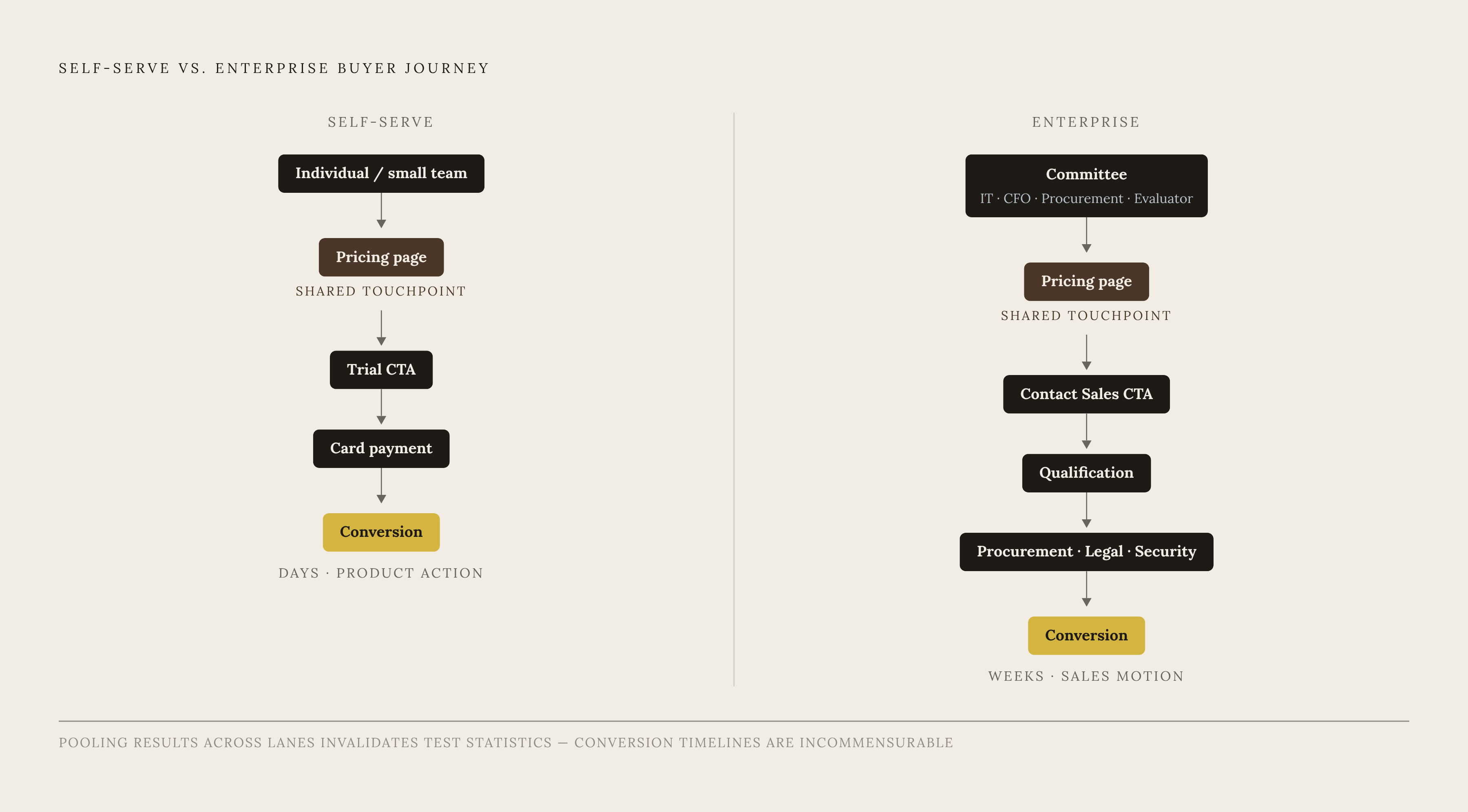
A pooled pricing page conversion rate is a weighted average of different outcomes. A self-serve conversion may be a trial start or paid signup, while an enterprise conversion may be a demo booked or qualified sales conversation. Combining them produces a number that describes neither journey. It also gives the segment with more traffic greater influence over the apparent winner. A meaningful improvement for the smaller segment can disappear inside the average.
Consider a test of “Start free trial” against “Book a demo”. If self-serve visitors dominate, the result will largely reflect their willingness to start a trial. It will not establish which CTA produces qualified enterprise conversations. Similarly, a “Most Popular” badge may help individuals choose while suggesting to enterprise visitors that the product is built for a smaller scale. The aggregate can conceal both effects.
Timing adds another distortion. Self-serve conversions happen sooner, so a pooled test can name a winner before enterprise qualification has had time to develop. Even when total actions go up, higher-ACV enterprise opportunities can fall without showing up in that total. The test combines incompatible definitions of success and then treats their average as an actionable answer.
What variables are actually worth testing on a self-serve pricing page
Self-serve tests should examine the cognitive cost of choosing and the perceived risk of committing. Tier structure provides a starting point, including whether three tiers outperform four and whether customer-type names outperform capability-level names. A recommended-plan badge tests whether guidance changes plan selection. These are hypotheses specific to this audience. Enterprise traffic must be excluded from their evaluation.
Billing presentation is another distinct variable. Defaulting the annual/monthly toggle to annual may change annual contract adoption, while displaying the savings percentage may change selection behavior. Value framing tests whether showing how outcomes differ between plans works better than listing features. At checkout, showing the amount actually due tests whether buyers hesitate less when they know what they will pay. A zero-charge confirmation belongs at that moment.
Consumption pricing introduces a further decision about how to explain cost. A usage calculator or concrete “what $X buys you” example can be tested against abstract token or credit rates. Real-time metering and customer-facing budget alerts support that transparency beyond the page, giving buyers the information to check costs themselves. Trial start rate and direct paid conversion rate measure success, and tests can run for a short time when there is enough self-serve traffic.
What variables are actually worth testing on an enterprise pricing page
Enterprise experiments should test whether the page makes a purchase easier to evaluate across stakeholders. A pricing anchor against a blank “Contact Us” wall tests whether partial transparency improves self-qualification. The outcome is qualified pipeline. Compliance signal placement offers another hypothesis, with SOC 2, GDPR, and audit log information near the CTA compared with placement in the footer or a separate trust page.
The organization of information also deserves testing. A stakeholder-organized comparison can be tested against a standard capability list to assess whether each evaluator can find the relevant evidence. Explaining the demo structure and expected response time tests whether uncertainty about the next step deters contact.
For usage-based products, a starting price alone cannot tell buyers what their consumption will cost. A base subscription plus usage charges gives buyers a fixed commitment to weigh, but they still need to understand the part of the bill that varies. Tests can therefore try consumption examples, committed consumption bands, and an enterprise FAQ about budgeting. When billing supports both fixed commitments and metered overages, those explanations can more closely match the bill buyers will get.
Measuring demo-booked rate and sales-qualified lead rate takes CRM integration and more time. That slower feedback loop is part of enterprise purchasing.
How to separate the audiences in practice — traffic, page architecture, and test design
Separate URLs provide the simplest instrumentation and the cleanest distinction between test queues. Each audience gets its own CTA path, pricing architecture, and experiments. The operational decision is how to route visitors upstream. Available mechanisms include campaign tracking parameters, product qualifier questions, firmographic enrichment, and an explicit audience selector that branches to the appropriate page.
A single URL with segment-aware assignment is a different approach. It preserves SEO consolidation and avoids a separate page-routing decision, but makes instrumentation more complex. Assignment still needs a reliable signal, such as company size from enrichment, plan tier from product data, or an explicit qualifier. Without that signal, assignment noise undermines the result regardless of how well the variants are designed. The choice is between two ways to separate measurement.
Both approaches need separate stopping rules because self-serve events mature in days while enterprise events mature in weeks. Instrumentation should treat pricing as a funnel, tracking page views, CTA clicks by type, plan card interactions, scroll depth, and exit destinations. Segment attribution belongs on each event when it fires. For consumption products, assignment must also distinguish a self-serve credit plan from an enterprise consumption contract, since the billing requirements differ.
Why usage-based and AI product pricing makes segment separation more urgent, not less
Self-serve buyers need to translate tokens, API calls, or credits into an expected bill. Enterprise buyers need to commit budget before they have a reliable usage baseline. Per-token precision can help the first audience model a purchase while leaving the second without a usable forecast. AI agent and per-step pricing deepen that gap because tasks, queries, and outcomes introduce unfamiliar units of consumption.
Hybrid models add parallel billing mechanics that also need different explanations. A self-serve calculator can show a base subscription and usage overages together. An enterprise evaluation must address how overages enter a contract, how credits are reconciled, and what the audit trail looks like. Likewise, a test of seat-based packages or usage caps can mix self-serve demand for predictable prices with enterprise interest in consumption alignment. The pooled response cannot show which of those preferences drove the result.
Customer-facing spend dashboards and real-time usage visibility, which a metering and billing platform such as Flexprice can provide, help both audiences track what they use. They do not remove the need to explain costs differently before purchase. A self-serve-only billing approach may support a simple starting offer, while enterprise contracts can require prepaid credit wallets together with postpaid invoicing and on-premises deployment. Testing those promises without planning their fulfillment leaves barriers to conversion unresolved until later.
The most common objections to running separate tests — and why they do not hold
Insufficient enterprise traffic is a reason to narrow the enterprise test queue. Fewer experiments with larger expected effects, including pricing anchors, compliance signals, and demo-framing copy, make better use of a limited signal.
The concern that separation will damage bottoms-up adoption belongs to routing design. A product-led path can still let an individual begin with self-serve use and later enter an enterprise conversation.
Two test queues do create maintenance work. However, a pooled winner that suppresses enterprise conversion can damage pipeline through the sales cycle before the effect becomes visible. The relevant comparison is the work of maintaining valid tests against the cost of acting on an invalid conclusion.
Confusing credit-based pricing is also not a reason to postpone testing until buyers gain experience. For enterprise visitors without a usage baseline, a test can check whether explaining consumption or helping them forecast a budget will reduce bounce.
How to sequence pricing page tests across both segments as a company grows
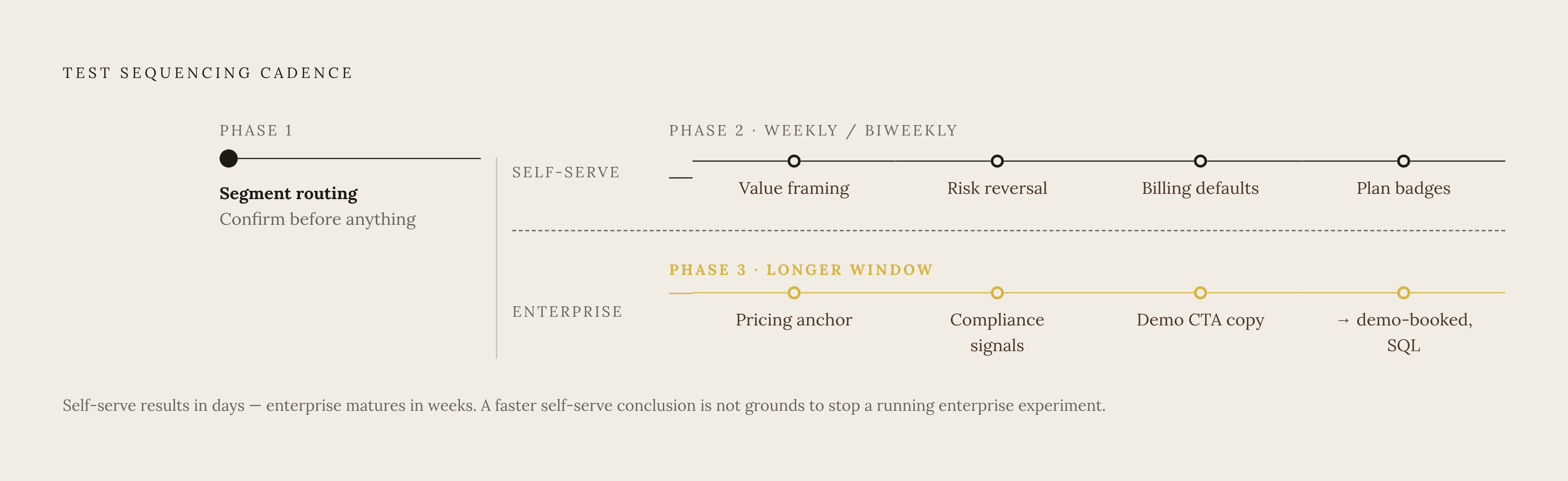
Make sure segment routing works before running pricing experiments. Once assignment works, begin with self-serve variables that can generate a usable signal quickly, including value framing, risk reversal placement, billing toggle defaults, and recommended-plan badges. With sufficient traffic, these can support a weekly or biweekly testing cadence. Their results become available while enterprise experiments are still developing.
Enterprise tests should run for longer and test changes that are expected to have larger effects. Early tests can try adding a pricing anchor, moving compliance signals, and adding explanations beneath the demo CTA. Their results must be judged by demo-booked and sales-qualified lead rates, on a schedule that allows more time than self-serve tests. A faster result from another queue is not a reason to stop an enterprise experiment.
Learning can inform the next hypothesis without transferring the result. If self-serve buyers respond to a usage calculator, that can motivate an enterprise test of consumption-scenario anchoring. It does not establish that the same treatment will work for procurement. Each queue should turn its own evidence into the next experiment.
As enterprise consumption offers develop, billing readiness becomes part of that sequence. Flexprice supports metering at millisecond speeds, prepaid and postpaid mechanics on the same contract, and on-premises deployment for regulated buyers. Those capabilities make it a fit when experiments move from self-serve credit plans to enterprise consumption commitments. The next pricing test should therefore be paired with a decision about whether the resulting offer can be delivered, so that a gain in qualified pipeline does not become a fulfillment gap after purchase.