Simultaneous Pricing Experiments Across PLG and Enterprise Segments
Running separate price tests for each segment prevents cross-contamination between buying motions.
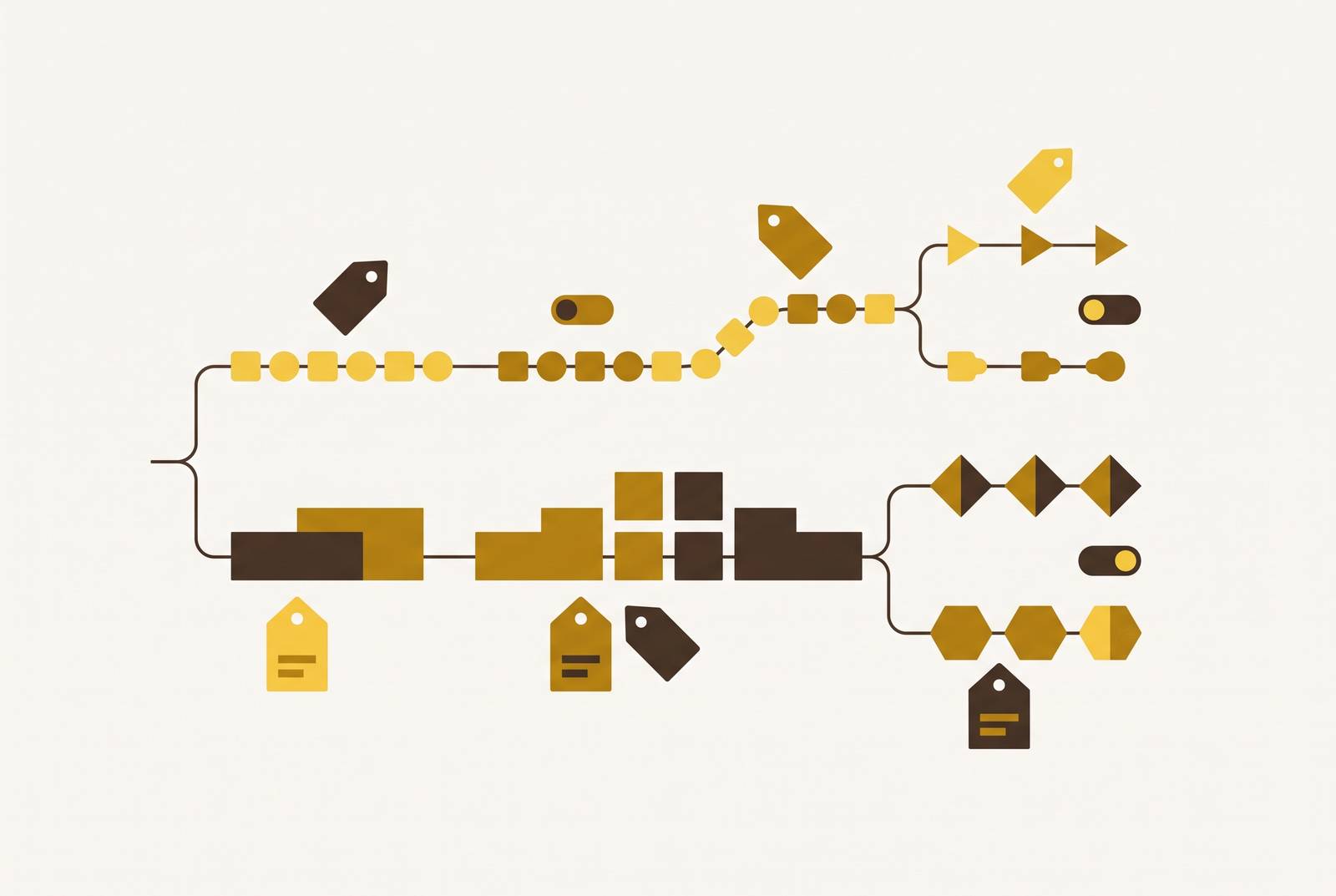
Each segment needs its own hypothesis, success metrics, and rollout controls because each discovers value and responds to pricing risk differently. The practical goal is to test both motions at once without letting enterprise negotiations distort PLG behavior or self-serve pricing undermine enterprise deals.
Why PLG and enterprise pricing experiments cannot share the same logic
Cursor provides a concrete example of a company navigating PLG and enterprise motions simultaneously. These motions involve different buying processes. An individual or small team discovers value through the product, converts when pricing removes an acceptable amount of friction, and expands as usage grows. An enterprise buyer instead evaluates pricing through procurement, risk, and contractual protection. An experiment that covers both cannot treat these responses as evidence of the same thing.
Below a low-thousands annual contract value, PLG is needed because sales-led customer acquisition costs are too high to pay back. Above a high five-figure threshold, sales-led is usually the only motion the economics support. The segment boundary therefore reflects the cost of acquiring and serving the customer. Conversion rates, activation depth, and usage-triggered upgrades describe one buying mechanism, while deal velocity, negotiation patterns, and renewal behavior describe the other.
A PLG price change can reach enterprise contacts through internal champions before a deal closes, weakening the negotiating position. In the opposite direction, an enterprise-tier price signal can suppress conversion if it reaches freemium-facing surfaces. This is contamination in both directions. The experiment design must distinguish the two buying processes while accounting for the people who move between them.
What each segment is actually testing when it experiments with pricing
That distinction starts with the question each experiment is meant to answer. A PLG experiment typically tests whether a pricing model reduces friction at first value or whether a free-to-paid gate sits at the right activation milestone. It may also test whether usage-based expansion feels fair enough to retain users and encourage upgrades. These are questions about the relationship between product behavior and willingness to pay. For the result to be valid, it must show what happened before and after the user saw the price.
Activation rate, which is the share of free users who reach the core value milestone, is the leading indicator. When a large share of free users never activates, a low conversion rate cannot by itself establish that pricing failed. The user may not have reached the point where paying becomes a meaningful decision. Separating activation from conversion prevents the experiment from attributing a product-value problem to the price. It also keeps an apparent conversion gain from standing in for evidence about usage-driven expansion.
Enterprise experiments test a different proposition. They ask whether a structure survives procurement scrutiny, whether outcome-based or consumption-based framing accelerates a deal, or whether a new tier creates upsell leverage at renewal. Enterprise demand for ROI clarity makes outcome-linked pricing relevant because it shifts the discussion from cost to demonstrable business impact. The signal is deal velocity and win rate against a control cohort, although small samples make statistical noise a real constraint. Using self-serve conversion to judge this change, or deal velocity to judge a PLG gate, can lead to findings that are accurate on paper but misleading in practice. The most common failure mode is mismatched metrics.
How hybrid pricing models create the experiment design problem in the first place
Hybrid pricing makes it harder to test these questions separately because parts of the price can be shared by both segments. A significant share of SaaS companies combine seats, usage, and outcome-based components, and hybrid adoption is projected to reach 61% by end of 2026. A subscription no longer necessarily defines the whole price. Instead, the final charge may depend on usage or outcomes that also matter to customers in another segment. The shared structure creates the exposure through which one experiment can affect another.
For example, a change to a usage component can reach self-serve customers through usage tiers and enterprise customers through negotiated caps. The component is the same, but the constraint each buyer experiences is different. Credit-based pricing adds another variable because buyers see a fixed number of credits while consumption is metered underneath. The vendor-controlled credit-to-consumption conversion rate means a credit repricing can affect customers differently according to their usage patterns. An aggregate revenue result cannot establish which segment benefited or which part of the structure caused the change.
Windsurf retired credit billing in March 2026 because the flat credit rate “charged the same rate for both simple and complex requests,” creating behavior distortions. Users skipped quick questions and put several requests into one prompt. Tying the credit to an action the buyer recognizes, pairing it with a predictable base, and adding spend alerts addresses that problem, but the experimental implications still differ by segment. PLG responses show how each user behaves, while enterprise responses show how much the account spends as a whole. Hybrid experiments must isolate both the component that changed and the segment responding to it, or a positive overall result can conceal segment-level damage.
Separate rollout controls for each segment without cross-contamination
The setup starts with separate groups for the rollout, separate holdouts, and separate ways to judge success. Even with different dashboards, the accounts are still exposed to the same experiment unless they are kept apart. Define the population at the account level before showing any pricing surface, using ACV signals, company size, or the self-serve versus sales-assisted entry point to route participation. This makes assignment part of the buying context rather than a consequence of which page a user visits. It also establishes where the boundary between the experiments must be enforced.
Within PLG, run the A/B test at the pricing gate, where free converts to paid or a usage limit appears. The gate is where the price changes behavior. Keep the holdout long enough to see activation and the usage expansion that follows, beyond day-1 conversion. Treat proactive usage alerts and spending caps as control variables because a warning before a user reaches a limit affects the conversion measurement. Keep those conditions constant within each test arm so the result does not conflate the price with the warning.
Do not randomize individual deals without sales team awareness, because an uninformed rep can negotiate away the difference the experiment is meant to measure. Instead, cohort by time period or by geographic or vertical territory, with explicit rep briefings about which structure applies to which deals. A time-based test can apply the new structure to Q1 deals while the control arm uses the prior structure. Measure deal velocity as the time from the first qualified conversation to the signed contract, and measure win rate against a defined competitor set.
Both enterprise measures need a minimum cohort of deals to produce reliable signal, which limits how many tests can run simultaneously. Outcome-based and consumption-based experiments also need their measurement frameworks before launch, since an unmeasurable priced outcome cannot yield a valid result. Finally, flag internal champions who move from PLG self-serve into enterprise evaluation and remove their accounts from the PLG experiment population. Their behavior is now shaped by enterprise sales, outside the self-serve conditions being tested.
Why the billing infrastructure underneath determines whether the experiments are even possible
Those controls are executable only if the billing system can enforce different pricing structures for different account cohorts simultaneously. A platform that cannot do this forces serialized changes. The same engine must support PLG usage-based, credit-based, or freemium-gated pricing and enterprise negotiated tiers, consumption caps, or outcome-based components for the same product. With multiple billing codepaths, teams have to reconcile the data, which slows the feedback loop the experiments need.
Clean segment-level evidence also requires usage data at the granularity and speed of the experiment. Pricing dimensions can include tokens, GPU-minutes, API calls, and outcome metrics, so the system must ingest the events that correspond to the tested component. Daily batching cannot provide the real-time signal a PLG pricing experiment needs. Similarly, prepaid credit wallets and postpaid invoicing must coexist on the same system because an enterprise account may need both a prepaid pool for AI usage and a postpaid invoice for seat licenses, with its experiment kept on that system.
The next requirement is control over pricing without an engineering ticket for every change. If a new price point or usage component takes weeks rather than days to introduce, the two experiment cycles cannot stay in sync. For most B2B SaaS, building metering in-house costs $1.0M–$1.6M over three years, so purpose-built infrastructure costs much less, even with the work to integrate it. The build case does not strengthen until usage-linked ARR reaches a scale most teams running these experiments have not reached. Purpose-built billing is therefore a prerequisite for the framework.
However, buying that capability only removes the constraint if the developer API is fit for the work. A clumsy event ingestion API forces engineering to build the abstraction layer the purchase was supposed to provide. That work reintroduces latency and reconciliation problems. API quality is consequently a first-order selection criterion, together with simultaneous cohort pricing and timely usage data.
Managing the migration risk when an experiment succeeds and pricing must change for real
Existing PLG users and enterprise customers are still on the old pricing structures, and moving them carries risks that differ from those of testing new pricing. For PLG, the primary failure mode is bill shock when the first usage-based invoice materially exceeds the prior per-seat or flat cost without warning. The resulting churn in the critical first months can erase the gain the experiment found. Proactive usage alerts, spending cap options, and pre-invoice usage summaries are therefore retention mechanics.
Phase the PLG migration by adding the usage component to the existing subscription without first removing anything. If the user stays within the usage allowance, the bill remains the same, making the transition an addition. That continuity must be paired with visibility into consumption while it is happening. Without real-time usage alerts and spend visibility, the migration can generate churn and support costs that dwarf the revenue gain. A favorable test result does not remove the need to control how customers encounter the new bill.
Enterprise migration instead centers on contract disruption. Signed agreements contain specific pricing terms, so a unilateral mid-contract change creates legal and relationship risk. Customers moving to outcome-based or consumption-based pricing need to agree on measurement frameworks before the move. If the new structure requires an outcome metric absent from the contract, the migration negotiation is effectively a re-sale.
Both plans depend on a billing engine that can run legacy pricing for grandfathered accounts, new pricing for migrated accounts, and ongoing PLG experiments at the same time. This is where a fragmented stack most visibly fails, because migration does not neatly replace experimentation. Among companies selling AI products and charging for usage, 92% had subsequently adjusted their pricing. Repricing is a normal part of the cycle. Pricing must remain a lever teams can pull without engineering involvement, supported by infrastructure that preserves separate segment controls indefinitely. Treating success as a destination rather than the next step leaves the pricing model unable to keep pace with the market.