Annual vs Monthly Pricing Discount Calibration Experiments
Testing presentation beats tweaking the discount itself.

Annual vs Monthly Pricing Discount Calibration Experiments.
The 20% annual discount as a default, not a decision
The 20% annual discount has become the SaaS industry default, but it was never derived from data about any specific product or customer base Digital Applied / Subscription Pricing Page Psychology Fungies.io / Annual vs Monthly SaaS Pricing. That gap between "widely used" and "actually tested for your business" is where most of the money gets left on the table.
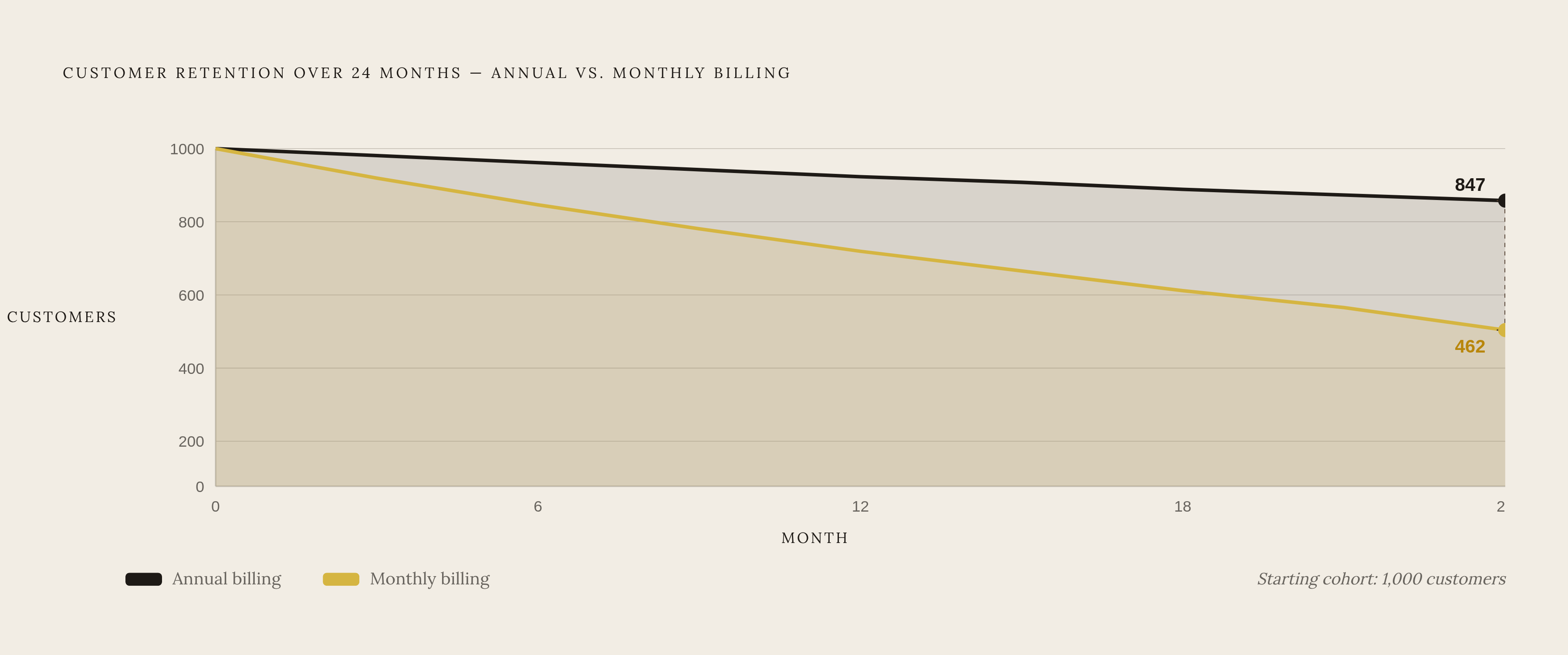
The stakes are bigger than they look at first glance. Run that gap forward at scale: starting from 1,000 customers, two years of annual billing leaves around 847 still on the books, while monthly billing leaves around 462, a gap far larger than a rounding error would produce Baremetrics. That's not a small optimization. A company that compounds and one that treads water depend on that gap.
So the discount is never just a number on a pricing toggle. Setting the discount starts a chain reaction through churn, cash flow, lifetime value, and the mix of customers choosing annual over monthly. Treating it as a one-time decision made in a launch meeting and locked in means it never gets to earn its keep the way it should. Treating it as an experiment, revisited as the customer base and product change, makes it one of the highest-leverage levers a pricing team has. Before running that experiment, though, it helps to understand what's being traded away every time the number moves.
The four-way trade-off that makes annual discount calibration hard
Annual discount calibration is not a single-variable problem: changing the discount simultaneously affects acquisition, retention, cash flow, and LTV in directions that can conflict. That's what makes this harder than a standard A/B test on a landing page: there's no single metric to optimize because the metrics disagree with each other.
Start with acquisition against retention. Monthly billing converts new signups at roughly 50% higher rates than annual, simply because it asks less of the buyer upfront: lower friction, lower commitment Baremetrics. Deepen the annual discount and plan mix shifts toward annual, but each of those customers now pays less per period, so the experiment has to track both the mix shift and the per-customer revenue hit at the same time, weighing each equally rather than favoring the more flattering figure Baremetrics.
Then there's cash flow against margin. But that cash comes at a price. Deeper discounts shrink recognized revenue per customer, and once a discount pushes past 30%, it starts to say something unflattering about the monthly price, namely that it was inflated to begin with Fungies.io / Annual vs Monthly SaaS Pricing. For AI products and anything usage-heavy, this tension gets sharper still. Bundle "unlimited" access into a discounted annual plan and variable inference costs can eat the margin alive without anyone noticing until the invoice comes due.
The third tension sits between lifetime value and the timing of churn signals. Annual subscribers tend to be more committed, less sensitive to price, and more likely to expand their usage over time, so their lifetime value runs meaningfully higher than monthly subscribers. But annual billing has a blind spot built into it: a customer who turns sour in month four has no reason to cancel until the renewal date arrives, so the team loses the early warning that monthly churn would have given them. That has a direct consequence for how experiments get read. A three-month check-in on an annual cohort's "success" can be premature, because it's measuring people who are unhappy and simply haven't had the chance to leave yet.
None of this is readable from a single dashboard number. Before running any discount experiment, split the data into voluntary churn, involuntary churn, plan mix shift, cash-flow delta, and LTV trajectory, and keep them separate. Blend them together and the read on any experiment becomes guesswork dressed up as a result. Annual contracts deliver 12 months of revenue upfront, and companies where 60% or more of revenue comes from annual contracts grow 1.8x faster than those relying on monthly GetPricePulse / SaaS Pricing Report H1 2026.
Presentation experiments teams can isolate before touching the discount percentage
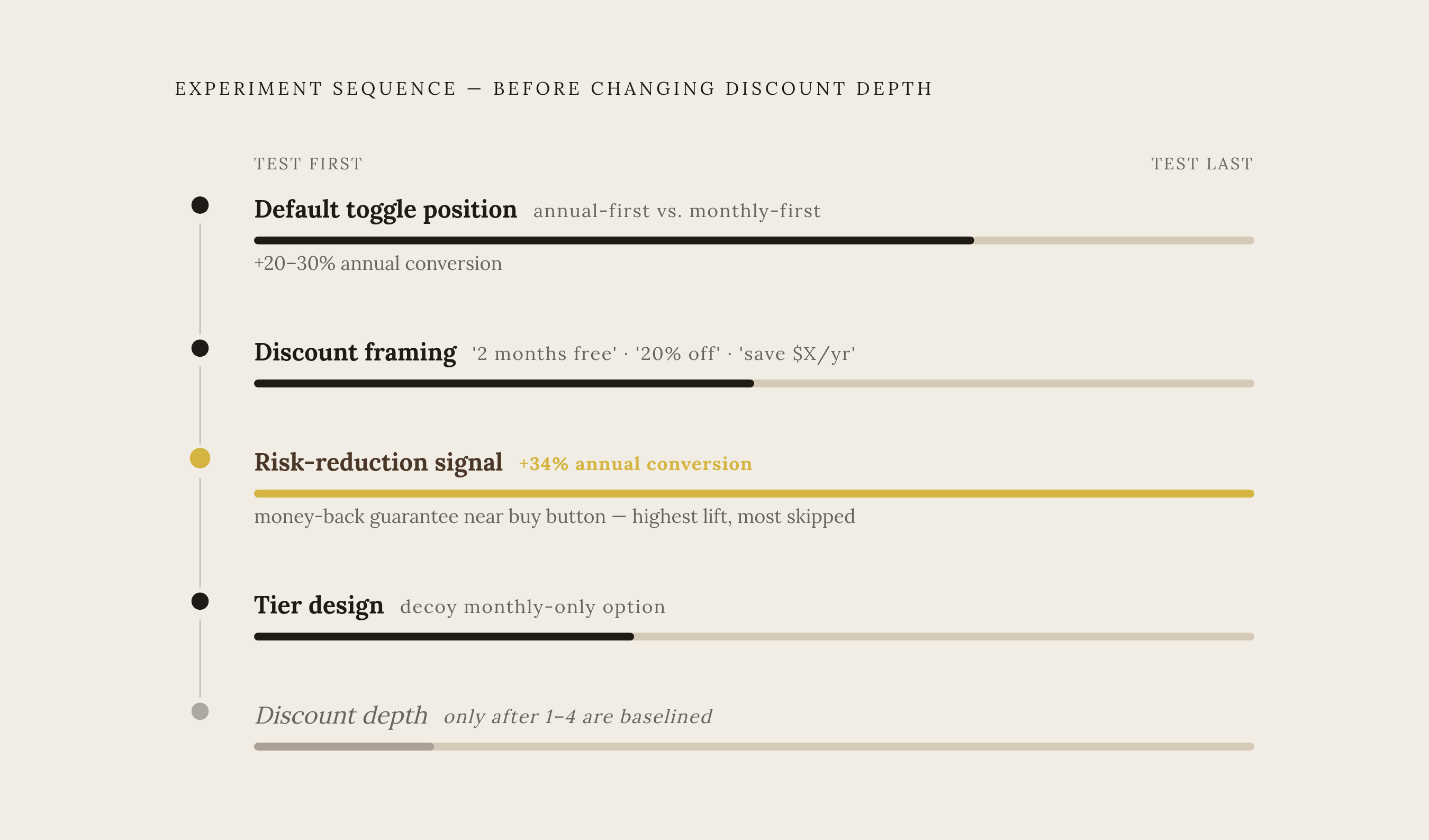
Most teams reach for the discount percentage first. Reaching for the discount percentage first gets the order backwards. Presentation and framing changes cost almost nothing to test, take hours to reverse, and often move plan mix more than the discount itself does.
Start with the default toggle position on the pricing page. Monolit.sh data cited by Fungies.io show that products defaulting to the annual price convert 20 to 30 percent more customers into annual plans than products defaulting to monthly Fungies.io / Annual vs Monthly SaaS Pricing. The mechanism is straightforward anchoring: whatever price a visitor sees first becomes the reference point for everything after it, so showing the annual-equivalent monthly rate, say $80 a month billed annually, instead of the standalone $99 monthly rate, wins the comparison before a single word of copy gets read. It's the cheapest test on this whole list and often the one with the biggest payoff.
Framing the discount matters almost as much as showing it. 2 months free" outperforms "20% off" in virtually every A/B test, a concrete benefit against an abstract percentage Digital Applied / Subscription Pricing Page Psychology Fungies.io / Annual vs Monthly SaaS Pricing. At higher price points, "save $X per year" can outperform both, once the dollar figure gets large enough to feel emotionally resonant. The right way to settle which wins for a given product is a three-cell test, percentage-off against months-free against dollar-saved, measured against actual annual plan adoption, not just clicks on the pricing page.
Risk-reduction signals near the buy button close a different gap entirely. A money-back guarantee attached to the annual plan can lift annual conversion by up to 34%, ConversionXL research cited by Fungies.io found, because it answers the unspoken objection every annual buyer is silently running: what if this turns out to be the wrong tool in month three Fungies.io / Annual vs Monthly SaaS Pricing (ConversionXL research cited) GetPricePulse / SaaS Pricing Report H1 2026. Most people who invoke the guarantee would have churned regardless, so the real cost is low and the conversion lift is close to free. Test it placed right next to the annual call-to-action, not tucked into the footer, and test it with and without "cancel anytime" copy running alongside it.
Tier design carries its own lever, too. Dan Ariely's Economist subscription experiment, run with 100 MIT students across three pricing options, found that adding a deliberately weak middle option redirected choice toward the bundle from 32% up to 84%, without changing a single price dev.to. A pricing page with a bare-bones "monthly only" option sitting next to well-built annual tiers can do the same job, making the annual discount look like the obvious choice by comparison rather than by math.
The discipline that ties all of this together: run the presentation experiments first, get a clean baseline, and only then start moving the discount percentage itself. Changing both at once leaves no way to tell which effect produced which result.
Structuring discount-depth experiments once presentation is dialed in
Segment before testing anything. A product charging under roughly $20 a month is asking a customer to commit a large chunk of money upfront relative to what they're used to paying, and no amount of percentage-off arithmetic reliably clears that psychological hurdle, monthly billing may simply be the right default for that price band Digital Applied / SaaS Usage-Based Pricing Models. At $100 a month and above, the math changes: a 20% discount is a real number in absolute terms, and it moves behavior, which lines up with Baremetrics' 2026 finding that 42% of B2B SaaS buyers say they prefer annual billing when a discount is on the table Digital Applied / Subscription Pricing Page Psychology Fungies.io / Annual vs Monthly SaaS Pricing eltherion.com. Enterprise buyers complicate the picture further, since they often want annual contracts to line up with their budget cycles regardless of discount depth, so payment terms, net-30 annual invoicing against upfront payment, can move the needle more than the size of the discount itself. AI and usage-heavy products add one more constraint: discount depth can't be set in isolation from the usage cap or overage policy, because a 30% annual discount wrapped around an "unlimited AI" plan with variable inference costs underneath it is a margin trap waiting to happen Fungies.io / Annual vs Monthly SaaS Pricing.
Once the segment is defined, keep the experiment design disciplined. Change one variable at a time, discount depth on its own, not discount depth stacked with a framing change in the same test. Run it long enough to see the full cycle play out: a 30-day read on annual adoption misses the churn signal completely, so 90 days is the floor, and getting through a first renewal is better still. Every cell in the test needs the same metric set tracked against it, annual adoption rate, the rate at which monthly customers upgrade to annual, voluntary churn measured at 90, 180, and 365 days, LTV, and the cash-flow delta.
The upgrade path from monthly to annual deserves its own experiment surface entirely, separate from new customer acquisition. The 3-month mark is the optimal upgrade window, since customers who have survived that long have passed the activation threshold and are extracting value; at that point an email offering "switch to annual and save 2 months" converts at 2–3x the rate of generic discount emails. A second cohort at 6 months responds to usage-personalized nudges tied to what the customer has actually done in the product rather than a flat percentage pitch, and this is a different experiment from new acquisition, requiring its own measurement. In-app prompts triggered right after a customer hits a high-usage moment tend to convert better than a cold email, so the upgrade experiment should test both channels rather than defaulting to email alone.
One more check belongs in every annual experiment design, because annual billing hides dissatisfaction by design. Signal validity check: annual billing delays churn signals, so build in a "masked dissatisfaction" test by surveying locked-in annual customers at months 4–8, not just at renewal; NPS decline during the locked-in period is an early warning the discount bought commitment without value.
The effect of usage-based and hybrid pricing models on the experiment
Everything above assumes flat-rate or per-seat pricing, and that assumption is getting shakier by the year. Usage-based pricing has grown from 27% of SaaS companies to 38% of them, and hybrid models, a base fee plus a variable usage or outcome component, now are 43% of SaaS companies, with projections putting that at 61% by the end of 2026 Baremetrics NxCode / SaaS Pricing Strategy Guide 2026. The annual-versus-monthly framework wasn't built with this in mind, and it starts to strain the moment a product has a consumption layer sitting on top of the subscription.
The pattern that's emerging looks consistent across companies: split access from consumption. Access is the subscription, priced flat, predictable, easy to discount the normal way. Consumption is usage or credits, variable, and priced separately. An annual discount on the access tier behaves exactly like a normal SaaS discount experiment Digital Applied / Subscription Pricing Page Psychology Fungies.io / Annual vs Monthly SaaS Pricing. The consumption tier does not, and shouldn't get the same treatment.
That's a real design decision, and getting it wrong costs money fast. Cursor's now-well-known $7,225 invoice for a single developer, from July 2025, shows what happens when an annual plan wraps around uncapped usage.
Credit-based pricing has become a common way to route around this problem, and it's grown fast, up 126% year over year as a way to monetize AI features layered onto existing plans NxCode / SaaS Pricing Strategy Guide 2026. Selling credit bundles annually does the same job an annual subscription discount does: it pulls in cash upfront, shrinks the window in which a customer can churn, and signals commitment. But the experiment questions are different here. Instead of testing a percentage off, teams are testing credit volume, expiry terms, and bundle pricing NxCode / SaaS Pricing Strategy Guide 2026. And most teams running credit pricing today treat it as a bridge, a way to hold the business together while it migrates toward outcome-based or fuller hybrid pricing. The experiment tests which bundle converts best, and it also points to when the business should move off credits.
One principle governs what's even testable here. The unit customers get charged for should map to how they actually get value out of the product, not to what it costs the company to deliver, a video transcription tool should charge per transcription finished, not per CPU-second burned. Get that unit wrong and no amount of discount experimentation on top of it will fix the underlying mismatch. The hybrid structure that is emerging as the dominant pattern separates access (subscription, predictable) from consumption (usage or credits, variable), as seen with Microsoft Copilot, which offers a $30/user add-on subscription (enterprise tier) for access to Copilot in M365 apps, plus separate Copilot Credits consumed on a pay-as-you-go basis for agent and agentic task work medium.com.
The metering infrastructure that makes usage-aware annual experiments possible
A discount experiment on a flat-rate plan needs a pricing page and a way to track cohorts over time. A discount experiment on a usage-based or hybrid plan needs a system that can count consumption accurately, in real time, at whatever scale the product runs at.
The bar for that system is specific. Sub-200ms synchronous quota enforcement requires in-memory state and a Redis or stateful stream processing layer, budgeted at roughly $50,000–$120,000 per year in infrastructure plus 0.5–1.0 FTE of ops for this layer alone eltherion.com.
Real-time enforcement is the thing standing between an annual plan and a support crisis. An AI agent firing off thousands of events a minute can blow straight past a usage cap before the metering pipeline has caught up, so the enforcement logic ends up reading stale state, the overage gets charged anyway, and the customer opens a bill that contradicts the entire pitch behind paying annually in the first place, namely predictability. The pricing experiment doesn't fail; the metering architecture underneath it does, but the customer never draws that distinction. The metering architecture fails, but the customer never draws that distinction. They just conclude the annual plan lied to them, and the discount that was supposed to buy loyalty ends up buying a churned account instead. A production-grade usage billing system targets 100,000 events per second throughput, under 100ms latency for event ingestion, and 99.99% uptime dev.to. At scale (10M active customers), this implies roughly 8.6 billion events per day and 8.6TB per day of raw data, numbers that determine infrastructure cost and, indirectly, what consumption can be included in an annual plan without margin destruction dev.to. SOURCE PAGES (what the pages behind the outline's links say).
Sources
- Annual vs Monthly SaaS Pricing in 2026: Data-Backed Strategy for Founders
- Is Monthly or Annual Pricing Better for Retention?
- Pricing Page Psychology 2026: A SaaS Decision Framework
- SaaS Pricing Strategy Guide 2026: Per-Seat, Usage-Based,… | NxCode
- State of SaaS Pricing H1 2026 — Editorial Review
- digitalapplied.com