Add-On Pricing Experiment for Enterprise-Facing Features
Enterprise teams are testing add-on prices monthly instead of yearly to find where real value lives.

The era of setting an add-on price once a year and moving on is finished. Among the top 500 SaaS and AI vendors with public pricing, 2025 saw more than 1,800 pricing changes, roughly 3.6 per vendor. Even mature, well-resourced companies are still guessing where the value sits in their AI and enterprise features, and they're adjusting fast enough to call it a discipline rather than an occasional correction. Enterprise add-ons sit at the center of that pressure, squeezed between buyers who want a predictable bill and vendors who need to monetize capability they spent real money building. Treating an add-on price as a settled decision, instead of a live experiment, is the mistake this piece is written to correct.
What "add-on" means in an enterprise context and why the definition shapes the experiment
Before anyone touches a price point, the team needs to agree on what kind of add-on it's actually pricing, because the word covers at least five structurally different mechanics and each one demands a different test.
A seat-based add-on is a fixed charge for access that unlocks advanced analytics, SSO, or audit logs for a named user or account. A usage-metered add-on scales with consumption: tokens, API calls, compute minutes, agent actions, voice minutes. An outcome-based add-on charges for a delivered result, a resolved ticket, a completed workflow, a generated output, rather than for access or volume. An entitlement bundle sits inside the enterprise tier as a defined allowance with overage priced separately, the way Atlassian bundles a defined credit allowance into each tier, with overage priced separately past that line. And a prepaid credit wallet layered onto a subscription flips the economics again: the customer buys credits upfront and draws them down, which behaves nothing like a postpaid invoice even when the underlying usage is identical.
These aren't cosmetic distinctions. A seat add-on experiment is really testing willingness to pay for access. A usage add-on experiment is testing elasticity, whether consumption bends when the price does. An outcome add-on experiment tests whether the buyer trusts the value signal enough to pay for it. AI features make this messier still, because a single feature is often access-gated at the plan level and consumption-metered underneath it. The billing system has to handle both logics on the same account at the same time. Skipping this step, and running an experiment before naming which type of add-on is under test, is how teams end up with data they can't interpret.
Defining the experiment: the metrics that tell you if an add-on price is working
Conversion rate is the metric everyone reaches for first, and it's the one that tells you the least. It shows adoption. It says nothing about whether the price captures the value delivered or sets up a healthy expansion path later.
The right primary metric depends on the add-on type. For a seat add-on, watch attach rate (the share of accounts that buy it), time to first purchase, and its effect on net revenue retention overall. For a usage add-on, track average revenue per account, elasticity (does consumption actually drop when price rises, or does it hold), and how often accounts cross into overage. For an outcome add-on, the comparison that matters is cost per outcome against perceived value, alongside resolution rate and whether customers, when asked, report value proportional to what they're charged.
None of that is complete without downstream metrics running in parallel. Does the add-on charge accelerate cancellations or downgrades in the treatment group relative to a control? It can generate enough billing confusion to raise a spike in support tickets, which is really a proxy for a pricing-clarity failure rather than a product failure. And does the add-on function as a stepping stone toward a larger contract, or does it get perceived as a tax that caps how far an account is willing to expand? Pricing work of this kind isn't a side project for the finance team to run quietly. Optimizing monetization has been shown to drive roughly four times the growth impact of acquisition-focused effort alone, which puts add-on pricing rigor on the same list of priorities as the product roadmap, not below it.
Isolating variables across enterprise customer segments so the experiment produces clean signal
Enterprise accounts don't behave like consumer or SMB cohorts. They vary wildly in size, usage pattern, contract structure, and how much leverage they can bring to a renewal conversation, which makes clean experimental signal much harder to get.
The discipline that protects the experiment is simple to state and hard to follow: change one variable at a time. Move the price point, or the packaging structure, or the billing mechanic. Never move two of them together, because a joint change makes it impossible to know afterward which one produced the result. AI feature add-ons are particularly prone to this trap, since the underlying feature often ships around the same time the charge for it goes live, and untangling adoption of the feature from willingness to pay for it after the fact is often not possible.
Segmentation needs its own discipline too. ARR cohort matters: companies above $50 million in ARR reported that consumption and outcome-based revenue made up 40% of total ARR, against only 20% at the $1 to $5 million range. Smaller companies experimenting with usage add-ons are working with thinner precedent and less charted territory. Usage intensity matters separately: a heavy user and an occasional user carry different price elasticity, and testing one add-on price across both groups will blur the read. An account on an annual commitment behaves differently than one running month to month toward renewal, and failing to control for contract type turns the result into an artifact of contract structure rather than a signal about the price itself. Regulated buyers in financial services or healthcare may need different packaging at an identical price point, so industry vertical also affects the read.
True random assignment is often not available in enterprise, since many accounts already have a dedicated account manager, an existing relationship, or negotiated terms that make a clean holdout impossible. The workaround is to build comparable cohorts instead of random ones, and to say so in the writeup rather than pretending the holdout was cleaner than it was.
Handling the enterprise buyer's cost predictability problem without abandoning usage-based add-ons
Unpredictability is a packaging and communication problem. It's a packaging and communication problem, and it should be treated as one of the variables under test rather than as an argument against the model.
A handful of mechanisms should be tested directly against each other. Spend caps put a hard ceiling on consumption once an account hits a threshold, which tests whether buyers actually prefer a stop button over uninterrupted access. Prepaid credit wallets convert an unknown future bill into a known upfront commitment, and they can run alongside postpaid invoicing on the same contract without conflict. Committed minimums with overage pricing give finance a budget number to plan against while preserving upside for the vendor above the floor. Real-time usage dashboards and budget alerts give the buyer visibility into consumption as it happens, so they can self-govern before the invoice arrives rather than being surprised by it.
That visibility matters more now than it used to, because usage on automated features can scale dramatically once agents move from a pilot into production workflows. That's the invoice-shock scenario enterprise buyers are actually afraid of, and any pricing experiment that ignores it is testing the wrong thing. The read on these mechanisms shouldn't stop at which one converts best. It should track whether the predictability mechanism chosen correlates with fewer billing disputes, lower churn, and stronger net revenue retention over the following year.
Designing the experiment cadence: when to read results, iterate, and commit
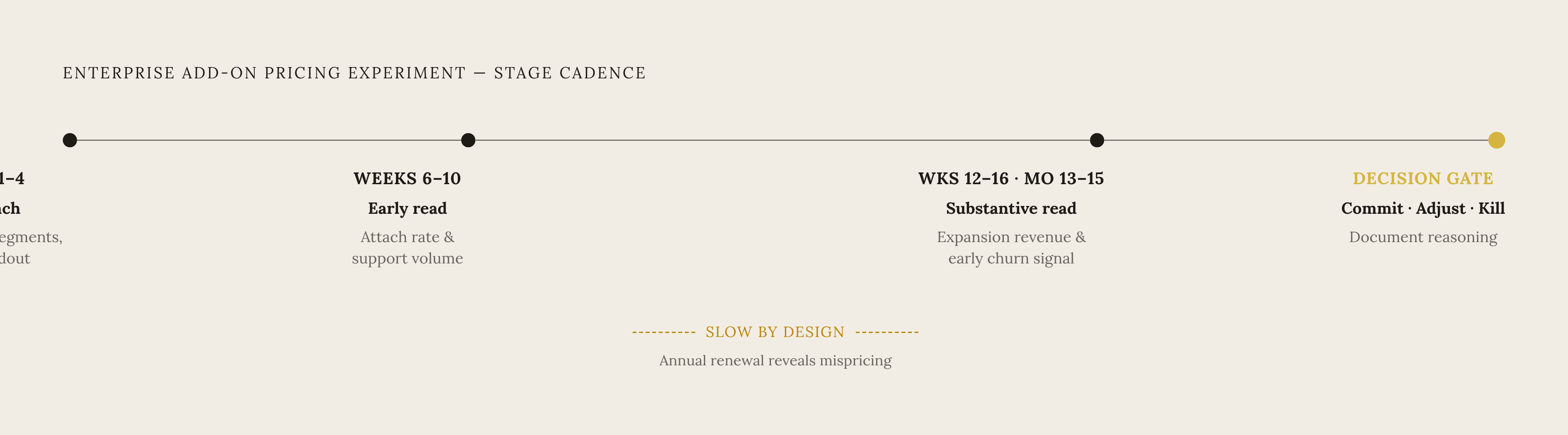
Enterprise experiments move slower than consumer ones, full stop. Deal cycles are longer, adoption signals take time to appear, and churn caused by a mispriced add-on might not become visible until the account's contract comes up for renewal a year later.
A workable cadence has four stages. The first four weeks serve as pre-launch, locking the metric definitions, the segment assignments, the billing configuration, and the composition of the holdout group before any price change goes live. Weeks six through ten are an early read, looking at attach rate and support volume, an indicator of whether the packaging is clear rather than proof the price itself is right. Weeks twelve through sixteen for monthly billing, or months thirteen through fifteen for annual contracts, is the substantive read, where there's enough data to see expansion revenue and early churn signal. Then comes the decision gate: commit to the price, adjust it, adjust the packaging, or kill the variant, and write down the reasoning so the next experiment doesn't start from zero.
Pricing strategy deserves a quarterly review, not an annual one. That pace implies a tempo faster than most finance and product organizations currently run. And there's a real cost to moving too fast without warning: 79% of IT leaders reported hitting a price increase at renewal in the past twelve months. Enterprise buyers are primed to push back hard on anything that reads as a test they never agreed to be part of.
Billing infrastructure is the constraint that makes or breaks the experiment before it starts
None of the cadence above is achievable if turning on a new add-on variant requires an engineering ticket. The billing system sets the actual speed limit on the experiment, regardless of how well the metrics and segments are designed.
A handful of capabilities are non-negotiable. Activation has to work at the account level, on or off, without a code deployment, because segment assignment and holdout management depend on it. Metering has to run close to real time and produce usage records that are accurate and auditable; for AI-adjacent add-ons the event volume is high, and a pipeline that reads stale state will overbill or underbill accounts and quietly corrupt the experiment's revenue data. Pricing rules need to be configurable per segment, a price point, a credit allowance, an overage rate, without rebuilding the underlying billing model each time; that configurability is what lets an experiment launch in a day instead of taking a sprint. Prepaid and postpaid mechanics need to run on the same engine, since some accounts in the same experiment will be on credit wallets and others on straight invoicing, and splitting that across two separate codepaths invites errors. And every usage event needs to be retained and replayable, so that a dispute, a customer saying they were charged for usage they never generated, can be resolved from the record instead of a manual reconciliation project.
The common workaround, a separate metering tool bolted to a separate billing tool, creates its own tax: finance ends up spending the first week of every month reconciling two systems against each other instead of reading the experiment's actual results. On top of that, a meaningful share of enterprise accounts require on-premises or sovereign-cloud deployment, and a billing platform that can't run there is disqualified from those accounts before the experiment ever reaches them.
Giving product and finance teams direct pricing control without routing every change through engineering
None of the infrastructure above matters if the people running the experiment can't touch it directly. Read-only dashboards don't count. Product and finance need actual control over price points, entitlement limits, and segment assignments.
Most organizations aren't there yet. When the billing system is configured in code, a price change to an add-on means a pull request, a code review, a deployment, and a test cycle, adding weeks to what should be a same-day iteration. Getting past that requires a pricing configuration layer exposed through a UI or a simple API rather than buried in application code, along with role-based access so finance can move a price, product can reshape a package, and engineering keeps ownership of the infrastructure underneath, without any of the three waiting on a ticket from the others. Audit logging of who changed what, and when, isn't optional either: it protects the integrity of the experiment and gives regulated environments the documented approval chain they need.
The organizational split that falls out of this is straightforward. Product owns the hypothesis and the segment design. Finance owns the metric definitions and the revenue model behind them. Engineering owns the infrastructure that lets the other two operate without opening a ticket every time they want to test something new. Get that division right, and pricing becomes a lever the business pulls continuously, with evidence behind every pull, because the ownership split lets it work that way.