Sales-Assist Triggers in PLG Expansion Funnels
Tie sales handoffs to consumption signals, not guesses.

Above $10M ARR, most companies default to a hybrid PLG-plus-sales motion, and at that stage the question is when to bring sales in and on what signal.
Field data on product-led growth in 2026 draws the structural line clearly: product is the acquisition engine, and sales is the expansion engine. The two do different jobs, and treating them as one continuous motion, where the product is expected to close its own largest accounts, is where growth plans go wrong. The product can get a team of five using a tool daily. It usually cannot get that same account through procurement, a security questionnaire, and a multi-year commitment without a human on the other end of the negotiation.
The gap is between PLG investment and PLG instrumentation, and that gap is where most expansion revenue quietly disappears. Companies pour engineering effort into onboarding flows, free-tier limits, and self-serve checkout, but then they leave the handoff to sales almost entirely undefined. That absence, not the existence of a free plan, is the primary reason PLG programs convert well at the top of the funnel and stall when accounts are ready to grow. A free plan does not cap revenue. An undefined handoff does.
Why product-qualified leads outperform marketing-qualified leads
A product-qualified lead is not a tweak to a lead-scoring spreadsheet. The account has done something inside the product that correlates with a willingness to pay for more of it.
The mechanism works on a threshold. The goal is to reach the account at the moment its commercial intent is highest. Sales-assisted PQLs should convert in the range of 25% to 35%, with CAC payback under 12 months. The PQL motion is addressing accounts that have already told the product, through their own behavior, that they are ready to talk.
None of this works without a defined activation event, and that definition is the step most teams skip. A PQL threshold needs something to anchor to. If activation itself was never defined and tracked, the scoring model sits on top of behavior nobody measured, and the trigger fires on noise. The first engineering investment a PLG team should make is the activation instrumentation that gives the trigger something real to read.
The specific consumption signals that reliably predict account readiness for sales contact
Usage signals are not interchangeable: consumption-based events outperform engagement-based ones because they measure value being extracted from the product. An account bumping against a usage ceiling is already telling you, through its own behavior, that it would pay for more room.
The first tier of triggers fires when usage approaches or breaches plan limits. An account that burns through its allocation in the first third of a billing period needs a negotiated volume commitment before the next cycle starts, not a renewal email once the cycle ends.
A second tier covers cross-product and feature-adoption behavior. Feature adoption velocity is how fast an account takes up advanced or premium features in a short window, and it marks an account on a steep value curve, so a PQL score should weight recent feature breadth more heavily than raw session counts.
A third tier runs on intent signals that complement the consumption data. When a procurement or IT team requests a questionnaire or vendor assessment, that security review ranks among the strongest buying signals you can get, because the account has already decided internally to evaluate a formal commitment. These three tiers aren't a rigid sequence. An account can trigger a security review before it ever approaches a usage ceiling, particularly in regulated industries where procurement moves ahead of adoption. The taxonomy works as a set of lenses, not a checklist to march through in order.
None of these signals mean anything to a sales team if they arrive late. A trigger is only useful if the system detects the underlying event close to the moment it happens, a dependency the next section takes on directly.
How ARR stage shapes sales triggers and motion
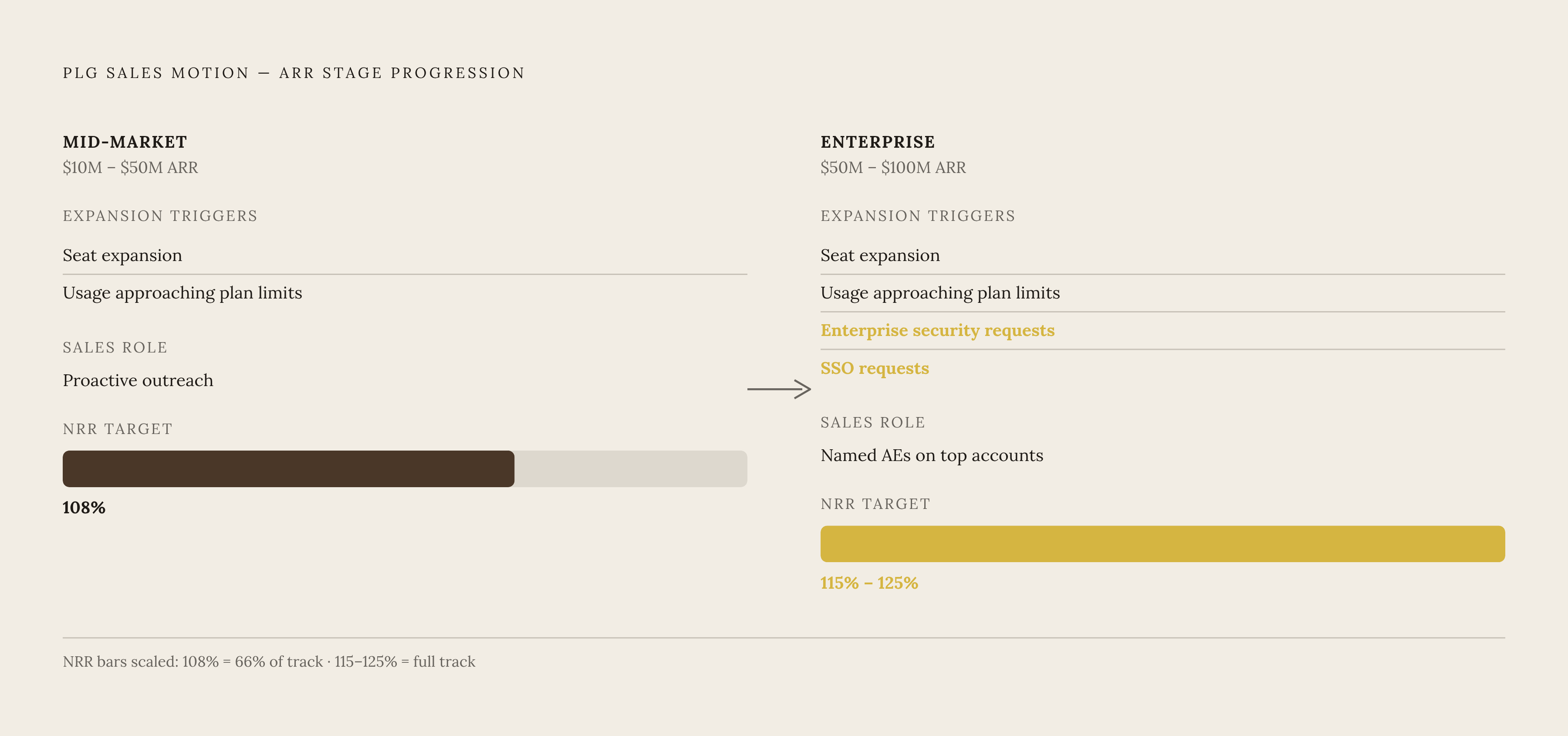
The threshold that correctly identifies a ready account at $10M ARR is premature at $5M and already too late at $100M. At $10M to $50M ARR, the primary triggers are seat expansion and usage approaching plan limits, and the sales-assist role is proactive outreach aimed at a net revenue retention target around 108% for mid-market accounts. At $50M to $100M ARR, enterprise security and SSO requests join consumption signals as first-class triggers, named account executives get assigned to top accounts, and the NRR target climbs to a range of 115% to 125%.
This progression isn't arbitrary. It tracks the broader pattern in hybrid PLG companies, most of which begin layering sales-assist motions somewhere between $10M and $50M ARR, not on a fixed calendar but on signal: enough accounts are hitting consumption thresholds and asking security questions that a dedicated sales motion becomes worth building.
Stage alone doesn't settle the matter. Annual contract value determines which trigger justifies which kind of sales motion, and not every PQL warrants a phone call from an account executive. In the $5K to $50K band, a hybrid motion works best: automated outreach first, with an AE stepping in for accounts that respond or escalate. This is also where sales-assisted PQL conversion economics perform strongest, the band where most B2B SaaS expansion revenue actually lives.
Real-time metering as the infrastructure prerequisite for trigger systems
A sales trigger is only as timely as the metering layer underneath it. A system that processes usage data in daily or hourly batches creates a window in which an account can breach its limit, churn, or quietly self-upgrade before sales ever learns the signal fired. In AI products where credit consumption happens at the speed of individual API calls, this constraint becomes acute: a batch pipeline surfacing yesterday's numbers is close to useless for a handoff that has to happen before a credit wallet runs dry today.
The architecture this requires is event-driven and asynchronous, capturing usage metrics without blocking the request path, so the trigger system always reads current consumption as a live signal. Teams that answer no have a metering layer that bottlenecks both trigger accuracy and pricing iteration at the same time.
Volume changes what "working" means. At lower event volumes, a simple pipeline can surface usage accurately enough for someone to review by hand. Some engineering teams split the problem deliberately: they keep ownership of the event pipeline, since they already run streaming infrastructure for analytics or anomaly detection, and buy the billing and trigger layer that sits on top of it. That's a reasonable architecture, but it only works if the owned half of the pipeline is genuinely real-time and not a batch job wearing a new label.
The same metering layer that powers internal triggers also has to power what the customer sees. An enterprise AE's credibility on a renewal call depends heavily on the account already knowing, in detail, what it has consumed.
How usage signals defuse bill shock
Consumption-based pricing introduces a kind of spend volatility that many enterprise buyers have never had to manage, and unmanaged volatility kills expansion before sales ever gets a chance to act on the signal that should have triggered it. AI-driven consumption models bring budget unpredictability that most finance organizations aren't structured to absorb. That unpredictability is itself a trigger: accounts that breach spend thresholds need a human to negotiate caps, commit discounts, or structure an enterprise license agreement before the next billing cycle closes, not after the invoice has already landed and the damage is done.
The same usage infrastructure firing the sales trigger has to power customer-facing spend visibility at the same time: real-time dashboards, proactive alerts at thresholds the customer configures, and in-app warnings before a limit gets breached. Skipping that turns the signal that should have triggered an expansion conversation into a procurement review, with IT cutting the project rather than expanding the contract.
Spend visibility is a precondition for enterprise conversion, not a nicety layered on afterward for the sake of a better interface. An enterprise AE calling an account that just received a surprise invoice is managing damage, not driving expansion. The outreach has to happen before the bill does, so the metering layer has to surface the signal before the invoice ever closes. Intercom's Fin AI Agent offers a useful illustration of the trust mechanism at work here: starting at $0.99 per resolved conversation and growing from $1M to more than $100M in ARR on outcome-based pricing, Fin backed that pricing with a $1M guarantee tied to resolution targets. The guarantee alone didn't make that pricing model credible at enterprise scale. It was the account's ability to verify, in real time, whether the outcomes it was being charged for had actually happened.
The trigger system and the customer-facing visibility layer run on the same consumption event stream, but they serve two different audiences. Internal sales routing and external account trust-building are the same infrastructure doing two jobs at once.
Pricing dimensionality and the limits of trigger systems built on simple seat or plan-limit signals
A trigger system anchored to one plan limit works cleanly for a product with one pricing dimension. It breaks down fast for a product billing across tokens, GPU-minutes, audio minutes, and hardware tiers at the same time, which describes most AI and developer-tool products today. The real signal is category-specific saturation: that account is expansion-ready in one dimension even while it has headroom in others, and a flat trigger system has no way to see it.
Multi-dimensional pricing needs a scoring model that can read combinations of signals rather than check individual thresholds one at a time. Building that interaction logic in-house costs more every time you add a pricing dimension. Each new metric needs its own ingestion path, its own threshold definition, and its own alert routing rule, and all of that competes directly with time the engineering team could spend on the product roadmap.
Pricing experimentation makes the cost concrete. Changing a threshold on one dimension shouldn't require touching the ingestion pipeline at all, yet in most homegrown systems it does. That's a meaningful part of why only about 24% of SaaS companies regularly run pricing experiments: the infrastructure cost of iterating suppresses the rate at which anyone tries.
Build vs. buy for the billing and metering infrastructure that trigger systems depend on
The question facing an engineering team isn't whether it can build usage-metering and trigger-routing infrastructure in-house. Most competent teams can. What matters is whether that infrastructure becomes the team's most durable advantage or a tax paid indefinitely on top of the product the company actually sells.
Building in-house means owning a system permanently, with uptime, security, audit, and maintenance obligations attached to it for as long as the company runs it. Open-source billing infrastructure doesn't solve this either. Its real cost is the engineering team that owns, upgrades, and debugs it indefinitely, plus the features that don't get built while that team is occupied with maintenance instead.
The case for buying purpose-built infrastructure is strongest exactly where pricing dimensionality, trigger complexity, and enterprise compliance requirements converge, which is precisely the position a scaling PLG company tends to find itself in. Enterprise billing demands detailed audit trails and regulatory coverage across ASC 606, IFRS 15, SOC 2, and GDPR, along with multi-layered, role-based access for finance, sales, engineering, and outside auditors. Prepaid credit wallets and postpaid invoicing aren't two separate problems to solve twice. A trigger system needs to fire on credit burn-down in a prepaid wallet and on an invoice threshold in a postpaid account, simultaneously, off the same engine.
Developer API quality deserves evaluation as seriously as any pricing feature. A platform with a clumsy event ingestion API or a weak SDK forces the engineering team to build the abstraction layer it was trying to avoid building in the first place, and the integration project quietly becomes the build project under a different name. A fair test at evaluation time: can the team ingest a new event type, wire up a new trigger threshold, and route it to a new sales destination without an engineering sprint? If the answer is no, the platform hasn't actually taken the maintenance burden off anyone's plate.
Closing the loop: how to wire the trigger system so sales, finance, and product share the same consumption view
Expansion revenue from PLG compounds only when the signal firing the sales trigger is visible to every team that needs to act on it. A trigger system visible only to sales just recreates, inside the company, the same information asymmetry that caused the handoff problem in the first place.
If finance teams work off end-of-month reconciliation, they can't forecast expansion revenue from consumption-based accounts with any confidence. When engineering teams have to route billing data requests through finance or sales, they lose the direct visibility they need to diagnose metering errors and confirm that a new pricing dimension lands correctly on invoices before customers see it.
Customer-facing dashboards, internal sales routing, and finance revenue recognition are three audiences reading the same underlying data, and the infrastructure decision made earlier, build or buy, sets whether those three audiences share one system or maintain three disconnected pipelines that slowly drift out of agreement with each other. The trigger system described throughout this piece is a consumption intelligence layer, and the expansion revenue it unlocks scales with how many teams inside the company are actually reading from it.