Automated Upsell Triggered by Usage Velocity Signals
Catching customers during growth spikes converts better than catching them at usage limits.

A customer who hits a hard usage ceiling and a customer whose usage has been climbing for three straight weeks look identical on a dashboard that only reports totals. They are in different states of mind, and that gap shapes whether an upgrade prompt converts or alienates. Acceleration in consumption, not the raw amount consumed, is the signal that actually predicts a customer's readiness to pay more. Getting this distinction wrong turns an upsell that should read as recognition into one that reads as a toll booth.
Velocity acceleration versus volume metrics as a signal of upgrade intent
A customer who gets a well-timed upgrade conversation while their usage is actively climbing converts at materially higher rates than a customer who has just slammed into a hard limit and feels cornered into paying. That gap is the entire argument for building expansion motions around velocity. Logins, raw event counts, and page views only tell you where a customer sits today. They say nothing about which direction that customer is moving, and direction is what upgrade timing depends on.
Growth in usage almost always precedes growth in willingness to pay, which makes rate of change the leading indicator. A velocity-based trigger reaches the same customer earlier, while the product is still delivering value and the experience of upgrading still feels like keeping pace with their own growth. The conversion-rate gap between these two conditions is a structural consequence of catching the customer at a different point in their own trajectory.
The five behavioral signals that translate acceleration into a scoreable trigger
Upgrade intent appears as a cluster of behaviors well before a customer decides to open a pricing page, so a scoring system needs to watch five of these signals at once to separate real expansion readiness from statistical noise.
The first and primary signal is usage velocity acceleration itself: a customer's weekly count of core actions increasing by a meaningful margin over the last two weeks, measured against their prior four-week average. This is the rate-of-change signal described above, converted into something a scoring engine can actually compute on a recurring basis.
The second signal is feature boundary contact, defined precisely as a customer viewing, hovering on, or clicking a feature that is locked on their current plan two or more times within the last 14 days. This is upgrade intent expressed directly as product behavior rather than inferred from aggregate counts. A customer repeatedly bumping against a locked feature is, in effect, telling the product what they want next.
The fourth signal in the underlying framework is API or integration limit approach: a customer consuming a large share of their monthly API call quota.
The fifth signal is high engagement paired with low plan age: a customer early in their current contract who is already logging in frequently. Early engagement at this intensity predicts high lifetime value, and it tells a revenue team that the account is worth engaging now rather than waiting for a renewal cycle to surface the same information months later.
These five signals are not meant to be read individually. Weighted scoring combines them into a composite score calculated per customer per day, and outreach only fires once that composite crosses a defined threshold. Because the threshold is set above any single signal's maximum possible weight, at least two meaningful signals have to fire at once before a playbook triggers. No single indicator, however strong on its own, is sufficient to launch an outreach motion by itself.
Correlating signals with health score and timing window to prevent false-positive upsells
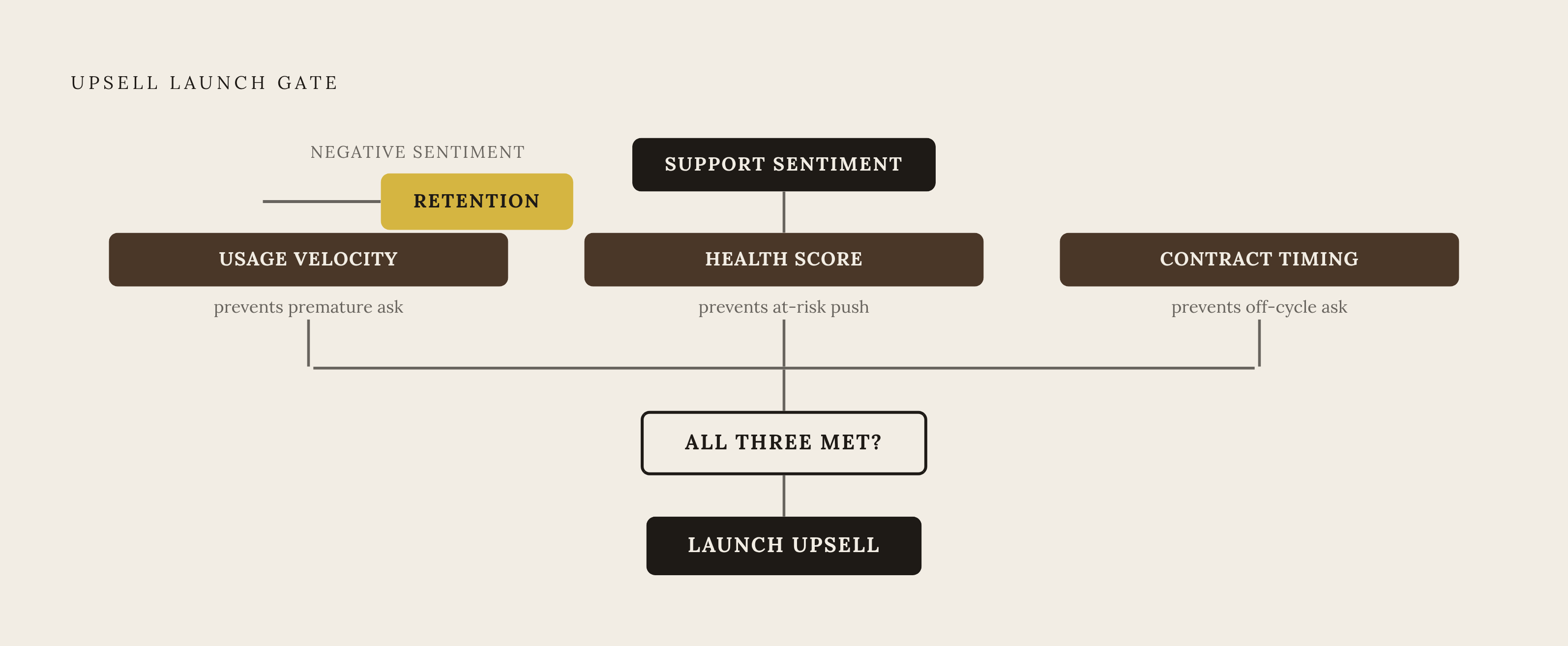
High feature engagement on its own does not mean a customer is ready to spend more. A power user who logs in daily may simply be extracting the maximum value available inside their current tier, with no intention of upgrading at all, and a system that cannot tell this apart from genuine expansion intent will damage the relationship by pushing a sale the customer did not ask for.
The practical safeguard is a three-condition alignment: a usage signal, a health score above a meaningful floor, and a favorable contract timing window all have to be present simultaneously before any playbook launches. Each of these three conditions filters out a different failure mode, and removing any one of them reopens the door to a false positive.
Support sentiment functions as a fourth input layered on top of that alignment. If an account generates frustrated support tickets while also showing a rising velocity score, it is a candidate for a retention conversation rather than an upsell conversation, and conflating the two is exactly the kind of error that a volume-only or single-signal system cannot avoid making. Signal-based selling frameworks emphasize that speed from signal detection to the right action matters because the window of peak receptivity is brief, but speed only pays off once the signal has been filtered correctly. Acting fast on a false positive just moves the damage earlier.
How AI-native pricing models make velocity signals structurally unavoidable
Hybrid and consumption-based pricing have changed what revenue growth depends on. Revenue no longer grows on a fixed schedule by adding seats at renewal time. It grows continuously as customers consume more of the product, and that makes expansion revenue inseparable from real-time visibility into usage as it happens rather than usage as it gets reported at the end of a billing cycle.
Agentic AI workloads sharpen this problem considerably. A system that cannot see consumption in flight cannot distinguish a customer who is lightly exploring a feature from one who is running the product hard, and that blindness extends directly to the velocity signals described earlier: there is no acceleration to detect if there is no continuous measurement to accelerate against.
Credit-based pricing has emerged as one practical answer to this problem. Customers prepay a pool of units that depletes as they use specific capabilities, so both the buyer and the vendor get a packaging layer between raw LLM token pricing and something a buyer can actually reason about. Credit depletion velocity is itself a velocity signal, measured against a prepaid balance.
Major platforms are already repricing around this logic rather than around traditional seat-based entitlement. Microsoft has shifted GitHub Copilot to a hybrid seats-plus-consumption model, with AI credits launching in June 2026, and Anthropic has moved toward usage-based pricing for Claude enterprise seats. Both moves treat consumption as the thing being sold, not as a side effect of a seat count. Clay's dual-track monetization, introduced in March 2026, illustrates the same principle from a different angle: separating the value of the platform itself, billed as Actions, from the cost of marketplace data, billed as Data Credits, puts two different consumption velocities in front of the customer as two legible, separately trackable numbers. That separation is a pricing design decision built specifically to make velocity visible to the billing system and understandable to the customer at the same time.
Requirements for metering infrastructure to support velocity signals
You cannot build any of the signal architecture described above without metering infrastructure built for a different job than subscription billing systems were originally designed to do. Velocity signals require infrastructure that ingests usage events continuously, computes rate of change across configurable time windows, and surfaces that computation in real time. A system built around monthly batch reporting cannot generate a two-week velocity trend, because it holds no rolling window of granular events.
Event ingestion has to be decoupled from the core application. Buffering and batching matter for the same reason at a larger scale: processing every single event individually creates write volume that becomes unsustainable once consumption gets high enough, so the system collects events into a temporary buffer and sends them downstream in batches, smoothing traffic spikes without losing the fidelity of any individual event.
Where credit-based pricing is in play, wallet balance becomes a first-class object inside the infrastructure, tracked continuously as consumption happens. When customers prepay a pool of credits shared across products, users, or even multiple agents acting on their behalf, the billing system has to track that balance in real time, because the rate at which the wallet depletes is itself a velocity signal capable of triggering either an upsell conversation or a spend alert.
That last point connects directly to trust. The same metering infrastructure that makes proactive upsell possible becomes a liability if spend visibility is not surfaced to the customer alongside the internal signal. A customer who cannot see their own in-flight consumption before a vendor's sales team reaches out with an upgrade prompt experiences that prompt as bill shock rather than as a recognition of their own growth, and that reaction undoes the entire advantage the velocity approach is meant to deliver.
In-product triggers on live metering data versus email-based upsell campaigns
An in-product upsell prompt triggered at the moment a behavioral signal fires reaches the customer at the point of maximum receptivity. An email campaign fires on whatever schedule the marketing calendar dictates, a schedule that is almost never aligned with what the customer happens to be doing in the product that week.
Timing an upgrade conversation to a quarterly business review instead of to the customer's actual, current usage state is one of the most common failures in expansion revenue. The same behavioral logic that makes in-product prompts work disqualifies the scheduled alternative: a user who has spent the last two weeks building inside a feature gated behind their current plan is in a fundamentally different state than one who logged in twice all month, and a generic monthly email has no way to tell the two apart because it was built to run on a schedule, not to look at behavior.
Evidence has to precede the ask for either channel to work. The infrastructure described in the previous section is what makes the better version mechanically possible: a system that can detect a live behavioral signal and fire a prompt inside the product at that exact moment, rather than queuing the same message into next month's newsletter.
The real cost of building this metering and signal layer in-house
Everything described above, event ingestion, tiered pricing logic, prepaid credit wallets, real-time velocity computation, and clean invoice generation at the end of it, requires a substantial engineering investment before a single signal ever reaches a sales or customer success team. The number quoted for an initial build is rarely the real number. Integration code carries an ongoing annual maintenance cost layered on top of the original build, and every engineer assigned to maintain that billing infrastructure is an engineer not working on the product capabilities that generate the usage velocity being measured.
This cost is most visible at companies that have already shipped an AI product and only then opened their existing billing tool to discover it cannot count variable usage. Companies billing across several pricing dimensions at once, tokens, GPU-minutes, API calls, voice minutes, hardware tiers, run into a dimensionality problem that compounds the build cost further, since no single in-house data model represents all of those dimensions cleanly without custom engineering work for each new one that gets added.
Building this layer in-house is a defensible decision under specific conditions: when billing genuinely is the product, when a regulated environment demands controls that no purpose-built platform currently implements, or when an existing internal platform already owns the necessary capabilities. Outside of those conditions, the maintenance burden does not plateau. It compounds every time a new pricing dimension or a new product gets added to the business.
Beyond the Build Path: What a Purpose-Built Usage Billing Platform Provides
A purpose-built metering and billing platform treats event ingestion, the pricing engine, credit wallet management, and invoice generation as one connected system, not as an integration stitched together between two separate vendors. That design choice is what eliminates the reconciliation work that fragmented billing codepaths generate every month.
Pricing needs to work as a live lever, so product and finance teams can pull it without filing an engineering ticket. Prepaid credit wallets and postpaid invoicing need to run on the same engine rather than as separate paradigms, since AI and enterprise products routinely need both running simultaneously for different customer segments. A platform that only supports one forces the buyer to stitch together two billing systems on their own, recreating the fragmented billing they were trying to escape.
Deployment flexibility matters just as much as the billing logic itself. Real-time spend visibility for the customer, dashboards that show in-flight consumption, and alerts before a credit balance runs out work as a churn prevention mechanism, not just a cosmetic UX feature. Customers who experience bill shock because they had no visibility into their own velocity generate support costs and cancellations that outweigh the cost of the billing platform many times over.
Developer API quality belongs at the top of any evaluation criteria for this reason: a platform with a clumsy event ingestion API forces the engineering team to build the exact abstraction layer they were trying to buy in the first place, recreating the build-path cost problem inside a product they are already paying for. The infrastructure that makes velocity signals possible, that ingests events continuously, tracks wallet balances in real time, and surfaces spend before the customer ever feels blindsided by it, is the same infrastructure that makes the upgrade conversation feel earned. That is the standard the rest of this piece has been arguing for from its first paragraph.