Usage Threshold Alert Experiments and Upgrade Conversion Rates
Usage thresholds convert better when alerts fire in real time.

A usage threshold alert fires at the exact point where demonstrated value meets approaching friction, and that combination makes it unlike any other message a product sends. Most in-app notifications interrupt someone who is browsing, idle, or mid-task on something unrelated. A threshold alert reaches a user while they are actively consuming the product and getting value from it. The consumption itself has already answered the hardest question in any conversion motion: does this product work for the person using it? What remains is a narrower question about capacity, not fit. That narrowing collapses the objection surface that most upgrade prompts have to fight through. A feature-gate prompt often lands on a user who doesn't yet understand what they're being asked to pay for, and has to do the work of explaining value before it can ask for money. A threshold alert skips that step, because the user's own behavior has already made the case. If an alert reaches someone at that moment, it deserves the same rigor applied to any other conversion lever in the business: deliberate variables, deliberate tests, and a method for knowing what actually moved the number.
How consumption-based pricing creates a repeatable upgrade moment
Seat-based pricing never produced this moment, because there was no threshold to cross. Expansion lived entirely in human hands: a renewal call, a customer success manager reaching out, a contract amendment signed months after the actual need appeared. Usage-based and hybrid pricing change the mechanics by making the billing unit an event, a token, an API call, a resolution, and events accumulate visibly toward a limit in a way that seats never did. That shift is largely a function of where AI infrastructure costs actually come from: compute, not headcount. Vendors who have repriced around tokens or API calls now have a metered unit that builds up on its own and can trigger an alert without anyone picking up a phone. GitHub Copilot's move to AI Credits tied to token consumption is one version of this: Business and Enterprise plans draw from a pooled organizational allotment, and approaching that pool is the signal. Salesforce's Agentforce runs on Flex Credits consumed per AI action, at 20 Flex Credits ($0.10) per action, so high-volume customers approach their limits often, and each approach is a chance to convert or expand if someone has bothered to instrument it. The risk of not instrumenting it appears on both sides of the relationship. A customer who consumes without any visibility into an approaching limit can be hit with an invoice that bears no relationship to what they expected to pay, and a vendor who lets that happen absorbs the churn and the reputational cost of looking like it hid the meter. Uncapped usage without a threshold alert is a design failure with consequences for the customer's trust and the vendor's retention. Because consumption recurs every billing cycle, the upgrade moment repeats: a limit resets or accumulates monthly, giving a team multiple experiments per customer per year. That also means threshold experiments can run against an existing, known customer base instead of waiting on new logos, which gets them to statistical significance faster than most acquisition-side tests ever could.
Timing: the variable that separates alerts that convert from alerts that arrive too late
The window in which a user acts on a threshold alert is measured in minutes, not days. A team whose alert pipeline lags by hours, or arrives the next morning as a digest email, is running a different product, not a slower version of the same experiment. A real-time in-app alert that fires the instant a user crosses a threshold and a scheduled email sent on a batch job are two distinct interventions, and comparing their conversion rates tells you nothing about framing or trigger point, because the delivery mechanism alone decides whether the user is still in the moment that made the alert relevant. Real-time delivery requires real-time metering. An alert system sitting on top of hourly or daily usage rollups cannot fire inside a six-minute conversion window, no matter how well the message is written or how well the trigger point is chosen, because the data it depends on hasn't arrived yet. That makes metering architecture inseparable from alert strategy. Running a timing experiment with any integrity requires an event pipeline capable of ingesting usage at the speed the business actually operates at, down to the millisecond in high-frequency products like agentic AI workflows. If a team runs usage billing on infrastructure not built for real-time aggregation, its threshold experiments end up constrained by pipeline latency rather than by anything true about customer behavior, so the experiment measures the infrastructure, not the customer.
The trigger-point variable
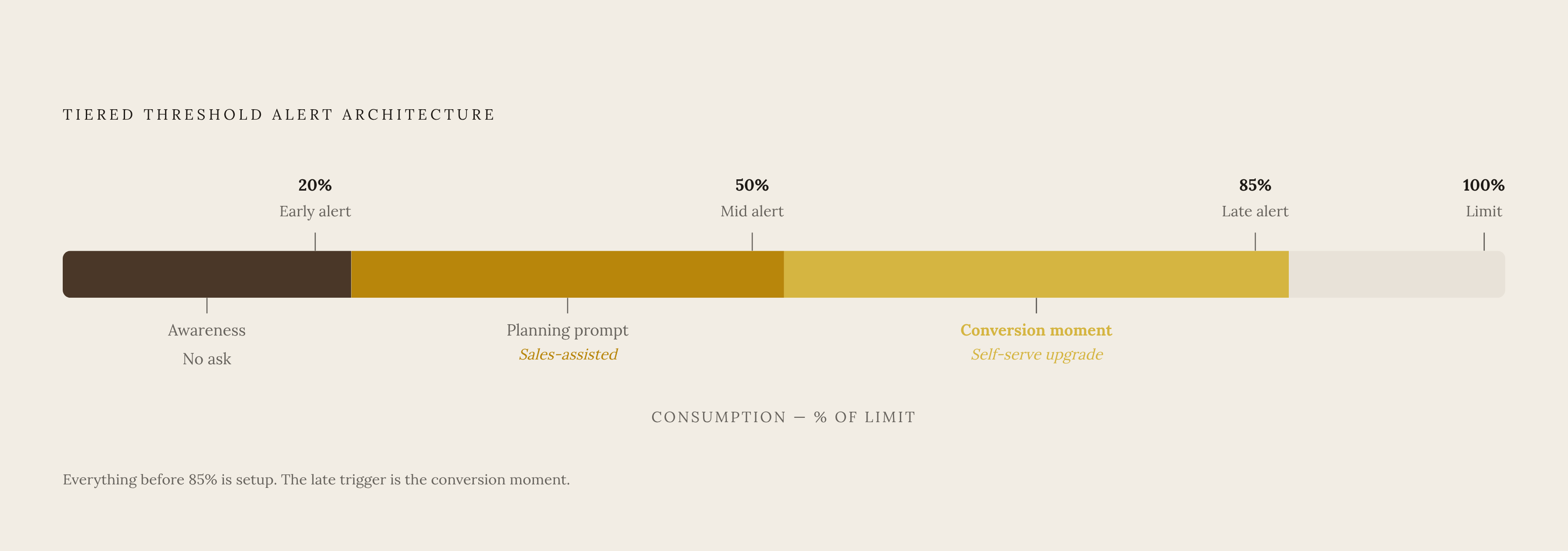
Once timing is handled, the next variable is where in the consumption curve the alert fires. The baseline architecture most teams should start from is tiered: an early alert, a mid alert, and a late alert, each doing a different job. The early alert is an awareness signal: it tells the user that usage is real and building, without asking for anything. The mid alert is a planning prompt, nudging the user to start thinking about capacity before it becomes a problem. The late alert is the conversion moment itself, arriving when the user has already committed to the consumption pattern and the only remaining question is whether to extend it. The mid and late triggers are the ones to test against each other directly. The early alert informs but rarely converts, and anything fired before it tends to function as noise. At the mid-point, the user still has runway left, so urgency is lower but so is anxiety, and some products will convert better here, particularly ones where the upgrade itself takes time, such as procurement approval or an internal budget sign-off. At the late trigger, urgency is high and the window to act before hitting the cap is narrow, so it favors products with an instant, self-serve upgrade path where friction is removed completely. The right choice depends on the sales motion attached to the product. Self-serve products tend to favor the late trigger, because the upgrade is frictionless and urgency does the work. Sales-assisted products may favor the mid trigger instead, because it buys time to loop in a customer success manager before the customer hits the wall and gets frustrated. The test itself should be structured as a direct A/B comparison of mid versus late, with upgrade rate as the primary metric and time-to-upgrade as a secondary one, because together those two numbers show both how many people convert and how urgently they move once they do.
Message framing at the threshold
Trigger point and timing decide whether the alert reaches the user at the right moment. What the alert says decides whether that moment gets used. Framing that leads with progress, something like "You've processed most of your monthly API calls," positions the threshold as evidence of value already delivered, which reframes the entire message as a receipt. Framing that leads with the limit instead, something like "You're approaching your API limit," positions the product as a constraint the user is bumping up against, which taps into loss aversion and can be useful for urgency, but risks reading as punitive if it's the only note struck. The strongest performing messages tend to combine both moves: acknowledge the usage as a value signal, name the limit as an urgency signal, and present the upgrade as a continuation of what the user is already doing. A line like "You're approaching your API limit. Upgrade for unlimited calls plus priority support" does both jobs in two sentences: it names the constraint and immediately resolves it with a concrete, specific benefit. Framing experiments should isolate at least three dimensions rather than testing the whole message as one variable: the opening line itself (progress versus limit versus benefit), the label on the call-to-action, and whether the alert previews the next tier's limits directly. Showing next-tier capacity inside the alert removes a step, because the user doesn't have to go to a separate pricing page to see whether the upgrade solves their problem. One framing to avoid entirely is language that implies the user's usage is abnormal, such as "Your usage is unusually high," which tends to produce shame and works against conversion. Frequency capping belongs in this same category of decision, as framing in its own right: showing the same alert repeatedly turns a genuine urgency signal into something that reads as spam, and a user who dismisses a late-stage alert should see a different message format next time, since the dismissal tells the team something about framing preference, separate from whether the user intends to upgrade.
Structuring threshold alert experiments for valid, actionable results
The variables of timing, trigger point, and framing are only useful if the experiments testing them are built correctly, and most threshold alert experiments fail for a methodological reason. The most common failure is peeking: declaring a winner before the experiment has accumulated enough data to support the conclusion. Expansion experiments run against an existing metered user base reach significance faster than new-logo experiments, because the population is already known and its behavior is directly observable, and that speed is what makes early stopping tempting and why a team has to resist it. You should pre-specify sample size and duration based on the size of the upgrade-rate difference you actually care about detecting, decided before the experiment runs. Upgrade rate should never stand alone as the only metric either. Time-to-upgrade and post-upgrade retention belong alongside it as secondary measures, because a framing that converts quickly but produces upgrades that churn soon after isn't a win, it's a deferred loss. Results should also be segmented by usage velocity: a user who hits the late-stage threshold within the first few days of a billing cycle is a fundamentally different conversion candidate than one who hits it near the cycle's end, and treating them as the same population will blur the read on what's actually working. The deepest methodological problem in this category, though, is the standing objection that threshold experiments simply select for users who were going to upgrade regardless of any alert, which would mean the experiment is only showing correlation. The way to answer that objection is a holdout group: a set of users who cross the threshold but receive no alert at all, compared against the group that does. The difference in upgrade rate between the two groups is the alert's actual causal contribution, not just the base rate of high-usage users upgrading on their own. Without that holdout, an experiment is only measuring how often heavy users upgrade, not whether the alert did anything to cause it. The holdout also has a secondary use: it reveals what share of high-usage users would have found their way to an upgrade without any prompt at all, which gives a team a baseline for deciding how much further investment in alert design is actually worth making relative to other levers available to move expansion revenue. Because each billing cycle produces a new cohort of users crossing thresholds, you should run this entire structure as a continuing program rather than a single optimization project completed once and left alone. Teams that treat monthly threshold crossings as a standing experimental population compound what they learn cycle over cycle in a way that one-off tests never can.
The metering infrastructure that threshold experiments depend on
None of the preceding variables, timing, trigger point, or framing, can be tested with any confidence unless the underlying metering system can produce an accurate, real-time count of what a customer has consumed. A threshold is only meaningful if the number behind it is correct at the moment the alert fires, and a trigger-point experiment comparing a lower alert to a substantially higher one is only valid if both are being calculated against the same reliable measure of usage, updated continuously. Metering is not a separate concern sitting underneath alert design; every experiment described here can only be trusted if the metering behind it is accurate. A system that aggregates usage in daily batches can still produce a threshold alert, but it will always be reporting on consumption that already happened some hours earlier. The trigger point a team believes it tested is not the trigger point the customer actually experienced. For a consumption-based billing unit, whether that unit is a token, an API call, or a resolution, the event has to be counted as it happens, attributed to the right customer and plan, and checked against the relevant threshold continuously, so that the alert firing at a given share of a limit is firing against a real, current number. Building threshold alert experiments on anything less than that kind of metering doesn't just slow the alerts down. You put every conclusion drawn from the experiment in question, because a result that looks like a framing effect or a trigger-point effect may simply be an artifact of delayed or inaccurate usage data. The infrastructure is the precondition for every other section in this discussion.