Free Plan Removal Experiments and Paid Conversion Rates
Credit-card-required trials convert five times better than free options, yet remain rarely tested.

What free-to-paid conversion rates actually look like across models in 2026 is not one number. It is a spread so wide that the median hides more than it reveals, and the companies still quoting "8% conversion" as a benchmark are measuring the wrong thing.
What free-to-paid conversion rates look like across models in 2026
The ChartMogul, Growth Unhinged, and ProductLed 2026 Conversion Report studied 200 B2B software products and landed on a median free-to-paid conversion rate of 8%. Treat that figure as a starting point, not an answer. About a quarter of freemium products convert below 2.5%, another 29% are between 2.5% and 7.5%, and roughly a quarter clear 10% to 15%. Top quartile to bottom quartile runs a full 10x apart. The median describes almost nobody in the dataset.
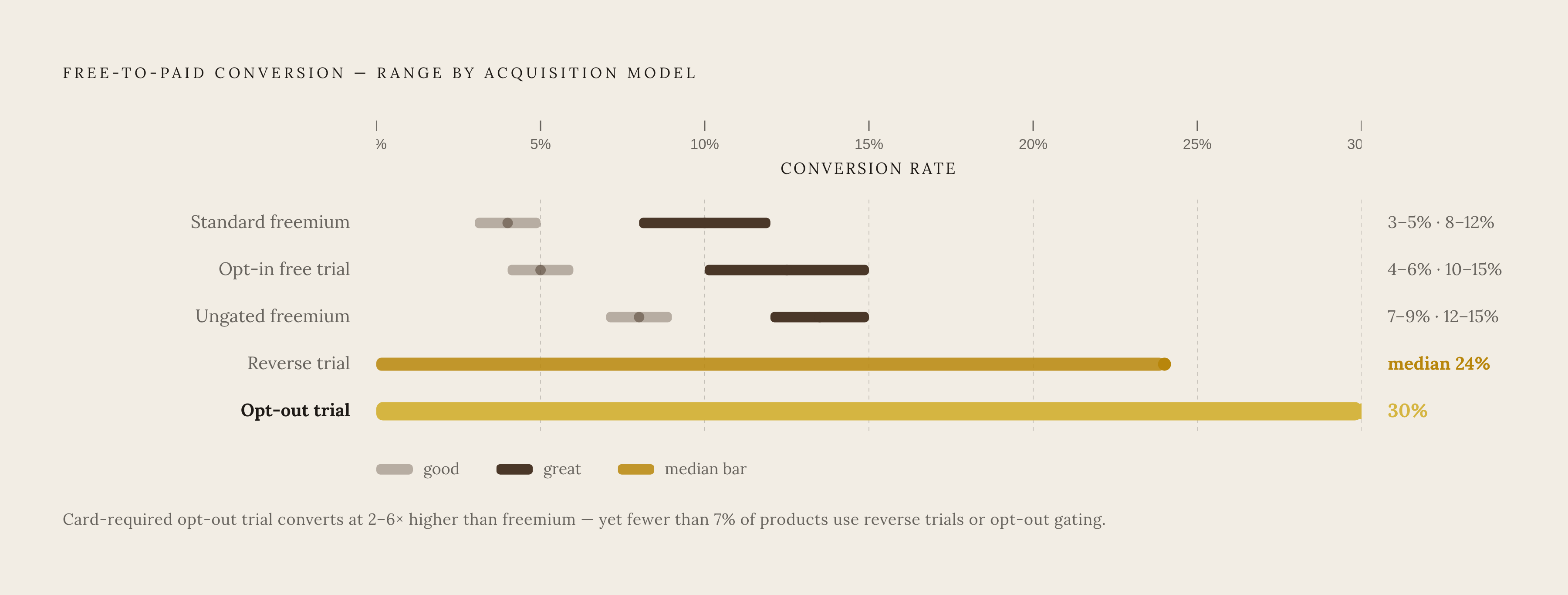
Break it down by model and the picture gets sharper, and more damning. Opt-in free trials, the kind that skip the credit card at signup, hit 4% to 6% on a good day and 10% to 15% on a great one. Standard freemium runs lower across the board: 3% to 5% is good, 8% to 12% is great. Ungated freemium, where the whole product sits open with no wall anywhere, actually beats both of those: 7% to 9% good, 12% to 15% great. Then there's the number that should reorder the entire conversation: credit-card-required opt-out trials convert at 30%, more than five times the rate of trials that skip the card. Reverse trials sit close behind at a median of 24%.
Free trials serve as the primary landing point for 57% of the 200 products studied, and freemium accounts for 26%, which should bother anyone running a pricing team. Reverse trials beat freemium by more than 5x, yet are at just 7% adoption. Paid trials round out the field at 4%. The best-performing model in the entire dataset is also the one almost nobody uses, and that gap is not an accident of taste. It's a failure of nerve. Asking for a card up front feels like it will kill signups, so most companies never test whether it actually does.
How a free plan removal changes what you are measuring
Pulling a free plan does not create new customers. It reveals which of the existing free users were already paying customers in waiting, and that distinction changes how the resulting numbers should get read.
Top-of-funnel volume drops the moment the free plan disappears. The people still walking through the door are the ones with demonstrated intent. That shrinks the denominator of the conversion rate itself, so a raw before-and-after comparison of percentages tells you close to nothing unless someone corrects for the collapse in signup volume first.
Removal is retroactive. The users who start paying once the free option vanishes were already extracting value from the product; they just never had a reason to open their wallet before the door closed behind them. Freemium at scale is a volume play, and a 3% conversion rate against a free base in the tens of millions can build a durable business. The same 3% against a smaller, AI-cost-heavy base is a different animal entirely, because the non-converters stop being free to keep around the moment inference costs enter the picture. Removal forces an honesty about unit economics that a free user count climbing every quarter can hide for years. A growth chart trending up and to the right looks great right up until someone runs the number on what it costs to serve everyone on it who never paid a dollar.
What documented removal experiments show about who converts
A documented wave of SaaS companies eliminated or severely restricted free plans in early 2026, and the pattern across them has more to do with survival than strategy. The ones still standing share one trait: they got honest about unit economics before the market forced the issue.
Removal data splits the free base into two groups, every single time. The first is the latent payers: people already getting real value, already sitting on budget somewhere, who convert the moment the free door closes. That's the signal the experiment exists to find. The second group is the permanent non-payers, users who churn entirely rather than reach for a credit card. High resource consumption, zero revenue. That's the exact cost removal finally puts a number on.
Slack complicates the case for removal, and it deserves to be taken seriously rather than waved off as an exception. Slack's model relied on network effects doing the heavy lifting: message history limits and integration caps nudged teams toward upgrading only after the free version had already spread across an organization and built its own internal advocates, with enterprise deals frequently tracing back to that grassroots free adoption. Products with genuine network effects, where free users generate social proof and quietly build the internal case for a paying champion, are exactly the products where removing the free plan is the wrong experiment to run. Slack's free plan was never a cost center waiting to be cut. It was the sales team.
The structural factors that predict whether removal will lift or kill conversion
The credit card gate is the single strongest lever in the comparable data, and it isn't close. Opt-out trials, the ones requiring a card before access, convert at 30% against far lower rates for opt-in trials, a gap of more than 5x. The mechanism is friction, plain and simple: canceling a card-backed trial takes more effort than letting it roll into a paid plan, so inertia works for the seller instead of against it. Removing a free plan entirely forces that same opt-out dynamic onto an entire user base at once. The effect of removal often looks a lot like the effect of adding a card gate, because structurally, it is one.
Timing compounds it. Early activation tends to decide whether a user converts at all, and a large share of trial-to-paid conversions tend to happen later in the trial period. A removal experiment paired with faster activation does more than either change on its own. Fourteen-day trials remain the most common length in the market, and pairing removal with a tight window creates urgency that open-ended freemium never generates, since there's no clock running on an indefinite free plan.
Sales coverage decides the rest of it. Coverage matters: 80% of free trial products already have some human touchpoint by the time an enterprise-sized user enters the funnel. Pulling the free plan without adding coverage for those larger accounts causes the accounts most likely to convert into high-ACV customers to walk. Removal only works if somebody is still there to catch the biggest fish on the way out.
Alternatives to full removal that the data supports (restriction, credit limits, and reverse trials)
Full removal is not the only lever on the table, and treating it as the default move ignores options the data favors more strongly.
Reverse trials flip the standard model: new users get full access up front for a limited window, then get downgraded once it ends. The median conversion rate, 24%, beats standard freemium's 4.5% by more than 5x and beats opt-in free trial's 14% by a wide margin. Only 7% of the 200 products in the ChartMogul study use it, a proven model almost nobody has bothered to claim. That's a proven model almost nobody has bothered to claim.
Credit-based free tiers take a different approach, limiting consumption instead of gating features. For AI products this addresses unpredictable inference cost directly: a fixed number of tokens or API calls per month is predictable in a way unlimited feature access on a model-backed product never is. One approach ties the credit limit to onboarding progress, turning the ceiling into an incentive instead of a wall.
Timing the gate matters as much as the gate itself. Gate a feature before a user has felt the product's value, and activation dies before conversion gets a chance to happen. The highest-impact gating experiments in the data wait until a user hits a specific milestone, then place the upgrade prompt right behind the feature that milestone unlocks.
The size of the prize is not small, either. A hybrid freemium case study in the data shows a move from feature-only gating to a fully optimized product-led hybrid model lifting free-to-paid conversion from 3.8% to 7.4%, roughly a double. The quality of the conversion improved right alongside the rate. The quality of the conversion improved right alongside the rate.
What the 43% who improved conversion did
Of the 200 products surveyed, 43% improved free-to-paid conversion over the trailing 12 months. About a third of those gained 10% to 25%, and roughly one in ten gained 25% or more. After stripping out duplicate ideas, the study landed on 30 distinct tactics companies had actually run, and several areas carried an outsized share of the weight.
Acquisition channel mattered enormously. Organic signups converted best, paid marketing signups converted worst, and Webflow's traffic referred by an AI answer engine converted at 24%, substantially higher than Google search traffic. Answer-engine referral is turning into a real high-intent channel. Time to value mattered nearly as much: shortened onboarding, use-case-specific flows, and AI-assisted setup all cut friction, alongside motivational tactics like interactive demos and credit-reward gamification. Packaging clarity, simpler plans, a visible upgrade path, progressive disclosure instead of dumping every option on a new user at once, formed a third lever. Smarter human touchpoints came fourth: since 80% of free trial products already have some human contact for enterprise self-serve users, routing high-intent signals to a scheduled demo scales coverage without going high-touch across the entire base.
The fifth factor is organizational, and it gets less attention than the others despite mattering more. The ChartMogul data shows product teams own activation only 49% of the time. That's a structural gap, not a tactical one, and conversion does not improve reliably until somebody inside the company is accountable to the number.
One finding belongs on its own. How the message is framed, whether it emphasizes what a user gives up by not upgrading or what they gain, can influence how existing free users respond to an upgrade prompt. That matters directly for any company writing the message that tells existing free users their plan is going away, since the wording can move the outcome almost as much as the policy itself. The math compounds fast, too: a single percentage point of improvement in free-to-paid conversion translates into roughly a 15% increase in new revenue, which makes conversion work one of the highest-leverage levers available to a company that isn't hiring more reps or spending more on ads.
How usage-based and credit-based pricing changes the free-plan calculus for AI products
2026 pricing is splitting cleanly into access and consumption: a subscription covers the right to use the product, and usage, credits, or outcomes get billed on top of it. That split keeps price predictable for the buyer while protecting margin on the part of the product that actually costs money to run, which for AI products means inference.
Hybrid pricing, a base subscription plus usage-based overage, has become increasingly common among AI vendors, and pure per-seat pricing has lost ground over the same stretch. One seat can generate wildly different usage depending on how hard that person leans on the AI features, and a flat per-seat price cannot capture that variance without overcharging light users or undercharging heavy ones. Neither error is small once inference cost scales with usage instead of headcount.
Outcome-based billing has moved off the pricing-page theory stage into live products. Some vendors now tie the bill directly to value delivered rather than to raw consumption, a step further than usage-based pricing alone. Both tie the bill directly to value delivered rather than to raw consumption, a step further than usage-based pricing alone.
All of this reshapes what a free plan removal decision even means. A credit-limited free tier, a fixed number of API calls or inference tokens per month, is both architecturally workable and cost-predictable in a way unlimited freemium never was. But it only exists as an option for companies that have already built the metering infrastructure to track consumption per user. Without that infrastructure, a credit-based tier isn't a real choice on the table, and the decision narrows back down to three blunt options: keep freemium unrestricted, restrict it heavily, or cut it. Most companies staring down that choice in 2026 are going to find that the middle option, restriction, is the one the data actually rewards, not the full removal everyone reaches for first.