Reverse Trial Experiments in SaaS Onboarding Flows
Reverse trials activate loss aversion over premium features, not access itself.
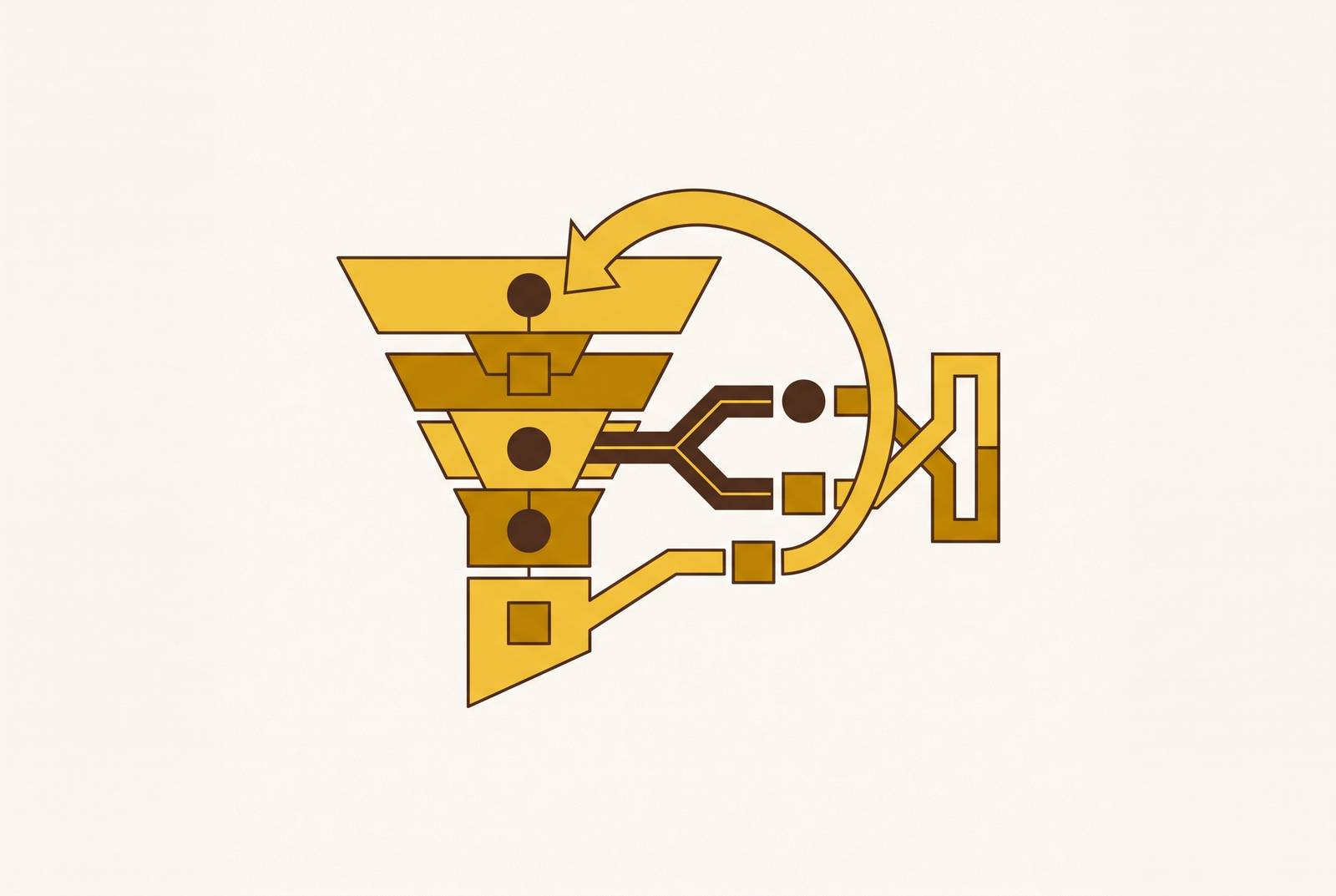
A reverse trial is its own onboarding architecture, and treating it as a dressed-up free trial or a freemium variant leads teams to design the wrong experiments around it. A free trial gives a user time-limited access to full or near-full features, and the account locks or expires once the clock runs out: the lever doing the work is urgency, a countdown the user feels pressing against them. Freemium runs on a different mechanism. There's no clock in freemium; a user gets permanent access to a limited feature set, and the thing that keeps them in the product is the endowment effect, the sunk investment of time and data they've already put into the tool they have.
A reverse trial borrows pieces of both and assembles something structurally distinct. Full premium access runs for a fixed window, typically 7 to 30 days, with no credit card required, and when that window closes the account doesn't lock, it downgrades automatically to a permanent free tier. That downgrade-not-lockout design changes what the user is weighing. A free trial asks the user to decide between paying and losing the product. A reverse trial asks the user to decide between paying and losing the best version of a product they already know how to use and already keep. That's a materially easier decision to walk away from. That is precisely why the mechanism has to work harder on the way in.
The psychological engine underneath a reverse trial is loss aversion, applied narrowly to specific premium capabilities rather than to generic access. The Good's 2026 analysis frames this as: a free trial activates loss aversion over access, a reverse trial activates loss aversion over the loss of specific premium capabilities, and freemium activates the endowment effect over accumulated investment. That distinction is the whole foundation for everything that follows in this piece. A reverse trial only works if the user actually experiences the premium feature they stand to lose. Without that experience, there's nothing concrete for loss aversion to grab onto, and the model collapses into a free trial with a softer landing.
How rare reverse trials still are
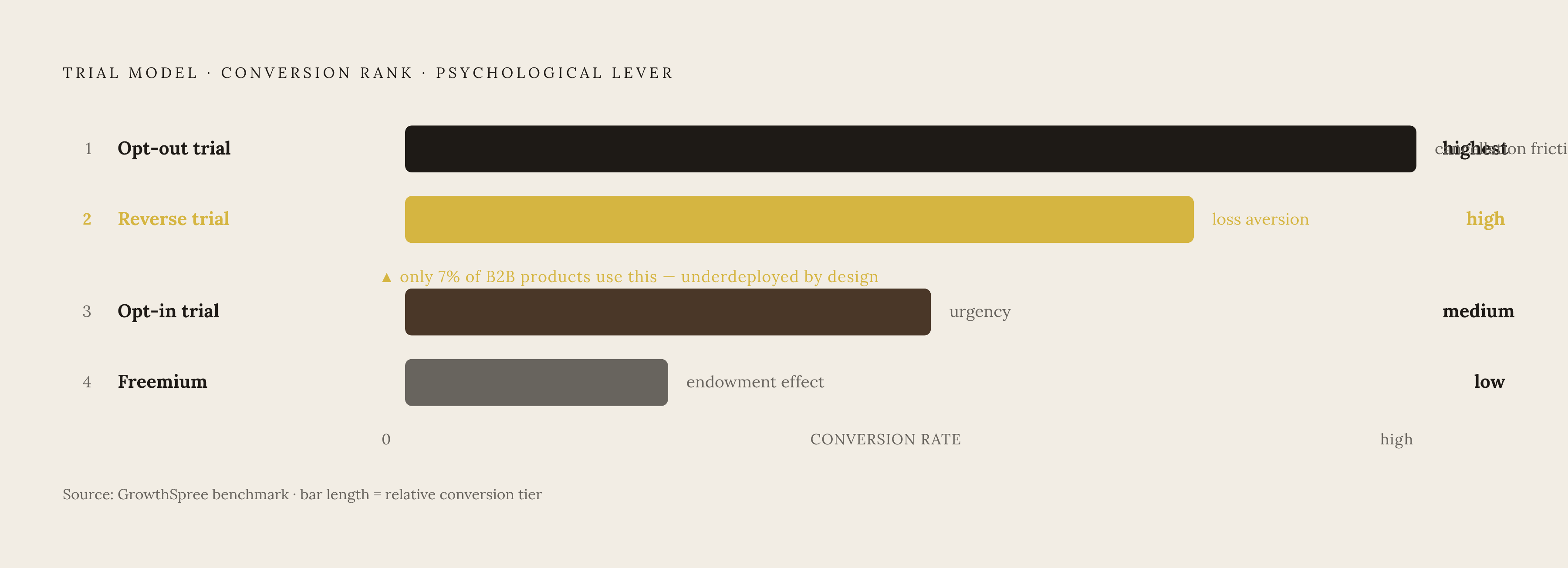
The gap between how well-understood the mechanics are and how rarely teams actually use them says something real about reverse trials. ChartMogul's conversion report, which surveyed 200 B2B software products, found free trials dominate as the primary entry point by a wide margin, while only 7% of products run a reverse trial as their main model. Some of that imbalance is just habit. The 14-day free trial has become the default setting for SaaS, and a large majority of the products in ChartMogul's study simply default to it rather than evaluate alternatives.
The more interesting question is why so few teams have moved toward a model that performs as well as a reverse trial appears to. Elena Verna, VP of Growth at Dropbox, reports that reverse trials lift freemium-to-premium conversion by a wide range, and that range is wide enough to suggest the variation comes from how well teams execute the model, not from the model's own structure. That's the editorial hinge the rest of this piece turns on: adoption is low, performance claims are high, and the distance between those two facts is explained by execution quality rather than by the architecture itself.
Part of the reason adoption stays low is structural. A reverse trial only works if there's a free tier at the far end of the downgrade that's genuinely usable, built to be useful rather than to look generous in a pricing page comparison. Teams without a credible free product to downgrade into simply can't run this model, because the entire psychological contract depends on the user keeping something real. Building that downgrade path on purpose, rather than bolting a free tier onto an existing trial flow, takes deliberate engineering work most teams haven't budgeted for.
The second barrier sits in onboarding design. A reverse trial's onboarding has to surface premium features early and specifically, because the model's entire mechanism depends on the user noticing what they'd lose. That's a different design brief than a standard onboarding flow built to orient a new user generally. Teams that skip this redesign and simply attach a downgrade event to their existing trial onboarding end up running a free trial with extra complexity.
What the conversion benchmarks show across trial types
Conversion data across trial mechanics shows a wide spread, and that spread is the story more than any single headline number is. GrowthSpree's benchmark found reverse trial median conversion runs higher than opt-in free trial median conversion, opt-in free trial median in turn runs well above freemium median, and opt-out trials requiring a credit card at signup lead every other mechanic measured. Read quickly, that reads like a ranking: opt-out trials on top, reverse trials next, free trials below that, freemium at the bottom. Read carefully, it's a description of four very different friction structures, each converting according to its own logic, not four competitors on the same track.
Userflow's September 2026 benchmarks make the more important point. For free trial products, the closest comparable mechanic, "Good" conversion is 4 to 6%, and "Great" conversion runs meaningfully higher than that; the headline figures attached to reverse trials depend heavily on vertical, average contract value, and how deep the onboarding goes. The spread within a single trial type is larger than the spread between trial types. A badly run reverse trial will underperform a well-run free trial, and a well-run free trial will underperform a well-run reverse trial, so the model itself explains less of the outcome than how carefully a team builds around it.
Credit card requirement remains the single largest structural lever at work across every trial mechanic. GrowthSpree's data shows opt-out conversion running well ahead of opt-in conversion; reverse trials typically launch without requiring a credit card, so they compete on activation depth rather than friction-to-cancel the way opt-out trials do. A reverse trial has to win on activation depth instead, since it's given up the one lever that does the most mechanical lifting elsewhere in the market. That's the argument this piece builds toward next: once credit card friction is off the table, the entire outcome rides on whether the user activates.
Why activation rate drives most of the conversion variance
The defining variable in how a reverse trial performs is whether the user experiences premium-tier value before the downgrade window closes, and almost everything else is secondary to that single fact. GrowthSpree's 2026 benchmark found activation rate accounts for most of the variation in trial conversion outcomes, with activated trials converting at dramatically higher rates than unactivated ones regardless of which trial mechanic is in use. Trials that don't activate in the first few days rarely activate later, so the pattern tends to be binary: early activation or close to zero conversion, with not much middle ground.
For a reverse trial specifically, activation can't be defined loosely. It has to be defined against a premium feature, something that only the paid tier provides and that the user will actually notice losing when the downgrade happens. Most conversion decisions land in the second half of the trial window, and early activation is what makes that late decision possible at all. GrowthSpree also describes an engagement cadence: an activation push in the early days, value-reinforcement through the middle stretch, and a conversion call-to-action in the final days, with teams that let engagement go quiet mid-trial underperforming as a result.
Databox's experience before it adopted a reverse trial shows what an unactivated trial looks like in practice. More than half of users eligible to start a 14-day trial meant to unlock key integrations simply weren't starting it, and the ones who did start were completing standard onboarding steps without ever reaching the integrations that would have made the product stick. They were active by the usual measure of "logged in and clicked around," but inactive by the measure that actually predicts retention. The Good's 2026 piece states the underlying principle: urgency without activation is just pressure, and a countdown clock does nothing for a user who hasn't yet had a genuine "this is for me" moment with the product. That stall, between generic onboarding and the specific feature that would have created the moment, is where the experiment design has to begin.
Defining the activation event a reverse trial experiment should be built around
A reverse trial experiment can only be measured once the activation event is defined before the experiment runs. Skip that step, and there's no way to tell whether a disappointing result came from a flawed model or from an onboarding flow that never gave the model a chance to work.
GrowthSpree's 2026 benchmark sets three criteria the activation event has to meet: it needs to be observable in product analytics, it needs to correlate with paid conversion at 4 to 8 times the rate seen among users who never activate, and it needs to be achievable within the first half of the trial window. For a reverse trial, that event should involve a premium feature specifically, one tied to what the account will lose at downgrade, rather than any generic product action that happens to be easy to log.
Userflow's 2026 benchmark piece draws a distinction that holds on its own terms: completion is not activation. Tracking whether a user finished an onboarding flow or clicked through a tutorial measures compliance with the tutorial, not whether the user reached the product action that actually predicts whether they'll stick around. A checklist with a high completion rate can sit right next to a low conversion rate if the checklist never pointed at the feature that matters.
GrowthSpree offers concrete examples of what a correctly scoped activation event looks like by product category. A project management tool might define it as a first task created and assigned to a teammate. An API-first devtool might define it as the first successful API call made from a production environment. A revenue analytics tool might define it as the first dashboard connected to a real, live data source rather than a sample dataset. Each example shares a structure: it's a specific, loggable action tied to the value the paid tier is actually selling.
Applied to named products, the same logic holds. Airtable's 14-day Team reverse trial would reasonably define its activation targets around advanced views, automations, or sync capabilities, the exact features an account loses when it downgrades. Toggl Track's 30-day reverse trial points at the premium workflow features that were central to the decision to move off a freemium structure users had been gaming.
What the window length decision controls
Trial window length is often treated as the first decision a team makes when building a reverse trial, but it's better understood as a decision that follows from time-to-value data rather than one set by convention. The window's job is to give users enough runway to reach the activation event, nothing more.
GrowthSpree's 2026 data shows the relationship between window length and conversion running in opposite directions depending on the mechanic. In opt-in trials, shorter windows convert better in part because urgency pushes activation forward. In opt-out trials, where a credit card is already on file, longer windows convert better because activation depth matters more than urgency once cancellation friction is doing the heavy lifting.
The experiment worth running is a measurement of time-to-activation-event across the current user cohort, followed by setting the window at that activation time plus a reasonable buffer for the conversion decision itself, rather than defaulting to whatever duration a competitor happens to use. Stretching the window doesn't repair a broken activation path. A 30-day trial in which no one activates in the first three days tends to produce roughly the same outcome as a 14-day trial under the same broken conditions.
Toggl Track's move to a reverse trial illustrates this cleanly. The underlying problem wasn't trial length at all; it was gaming behavior, users repeatedly creating new accounts to keep resetting a standard freemium plan. Switching to a reverse trial changed the structural incentive behind that behavior; the clock itself was never the problem. The lesson generalizes: before adjusting window length, confirm the problem is actually about time rather than about an incentive structure that no window length can fix.
The onboarding design changes a reverse trial requires that a standard trial does not
A standard free trial's onboarding goal is to get a new user oriented and using the product before time runs out, and premium features may or may not come up along the way. A reverse trial needs something more deliberate: the specific premium features a user will lose at downgrade have to surface as early as possible, because loss aversion needs a concrete thing to act on before it can do any work.
That requirement changes how the feature-exposure sequence has to be built. If premium capabilities sit buried several screens deep, or require setup steps a new user is unlikely to finish in the trial's early days, the reverse trial quietly degrades into a standard trial with a confusing downgrade tacked on at the end. The user never sees what they're meant to be afraid of losing, so the downgrade event, when it finally arrives, reads as an unexplained change rather than as a loss.
Databox's pre-reverse-trial experience is the clearest illustration of this failure mode in practice. Users were completing the initial onboarding flow and then stalling, never activating the core integrations that would have made the product worth keeping, which meant the standard flow was orienting people without ever pulling them toward the features that build retention.
A few failure patterns recur across teams attempting this redesign. Overwhelming a new user with every premium feature at once tends to kill activation rather than accelerate it, since there's no single clear action for the user to take. Building a feature tour that shows users what the product can do without ever getting them to actually do it produces the same completion-without-activation gap Userflow's research warns against. And pushing an upgrade prompt before a user has genuinely experienced the premium value being sold asks for a purchase decision before the loss aversion mechanism has anything real to work with, which is the one condition a reverse trial cannot survive and still function as designed.
Sources
- SaaS Onboarding Benchmarks 2026
- The SaaS Conversion Report: A new look at free-to-paid conversion
- B2B SaaS Trial-to-Paid Conversion Rate Benchmarks 2026
- Free Trial vs. Freemium vs. Reverse Trial: SaaS Trial Strategies & The Tradeoffs That Can Shape Your First 30 Days - The Good
- Reverse Trials: Why SaaS Is Ditching Freemium (2026)