Grandfathering Policy Design and Churn Risk in Pricing Changes
Choosing the right grandfathering model prevents churn when raising prices.

SaaS prices climbed 16.4% as of June 2026 across more than $75 billion in tracked software spend, nearly four times the 4.2% rise in US CPI over the same stretch. Every vendor riding that increase has to answer one question: what happens to the customers already on the books when the new price goes live? Most companies default to grandfathering, letting existing customers keep their old rate indefinitely, and that default is usually the wrong call. Grandfathering is a churn-management instrument with a real cost attached, and the model you pick deserves the same rigor as the price change itself.
What grandfathering is and the operational debt it quietly accumulates
Grandfathering means an existing customer keeps the rate or plan terms they signed up under, even after the company raises prices or restructures its plans for everyone new. It goes by legacy pricing in some board decks, a grandfather clause in others, and a large share of SaaS companies now use it as their primary method for handling price changes. That makes it the industry default, not some fringe accommodation reserved for early believers, and defaults deserve scrutiny precisely because nobody chose them on purpose.
The appeal is obvious in the short term. No customer complains, nobody cancels, support doesn't get flooded with angry tickets the week the new pricing page goes live. None of that calm is free, though. What disappears is invisible on any dashboard that tracks churn or complaints: it's the revenue those grandfathered customers would have paid at the new rate, every month, for as long as the policy stays in place. That's a subsidy, and subsidies compound quietly until someone finally adds them up.
Parseur's own pricing history makes the mechanism concrete. The company still bills a discontinued 1,000-credit plan at $9 a month, years after pulling it from the pricing page. The nearest equivalent plan available to new customers today runs $129 a month, which puts the legacy plan at a 93% discount, sustained indefinitely, on a tier nobody can even buy anymore. Parseur can carry that because it's bootstrapped and answers to no one but itself. Most companies drifting into the same position don't have that margin, and they rarely notice until the gap has already widened past the point of an easy fix.
The churn math that should precede any grandfathering commitment
Skipping the grandfathering conversation and forcing a migration instead turns the numbers against you fast. Forced migrations without any transition protection routinely trigger churn spikes in the 10% to 15% range, and acquiring a new customer costs five to seven times more than keeping an existing one. Bain & Company's research on retention shows that lifting customer retention by just 5% can increase profits by 25% to 95%. If churn prevention is treated as anything less than a profit multiplier, the math will correct that assumption.
Pricing this properly means building a break-even churn model before announcing anything. Calculate the gross revenue lift from the price change assuming zero churn, the best case, then stress-test that number against 5%, 10%, and 15% churn scenarios. Somewhere in that range sits the break-even churn rate, the exact point where cancellations wipe out whatever gain the increase was supposed to deliver. Announce a price change without running this math first, and you're not running a strategy, you're running a guess with a launch date attached.
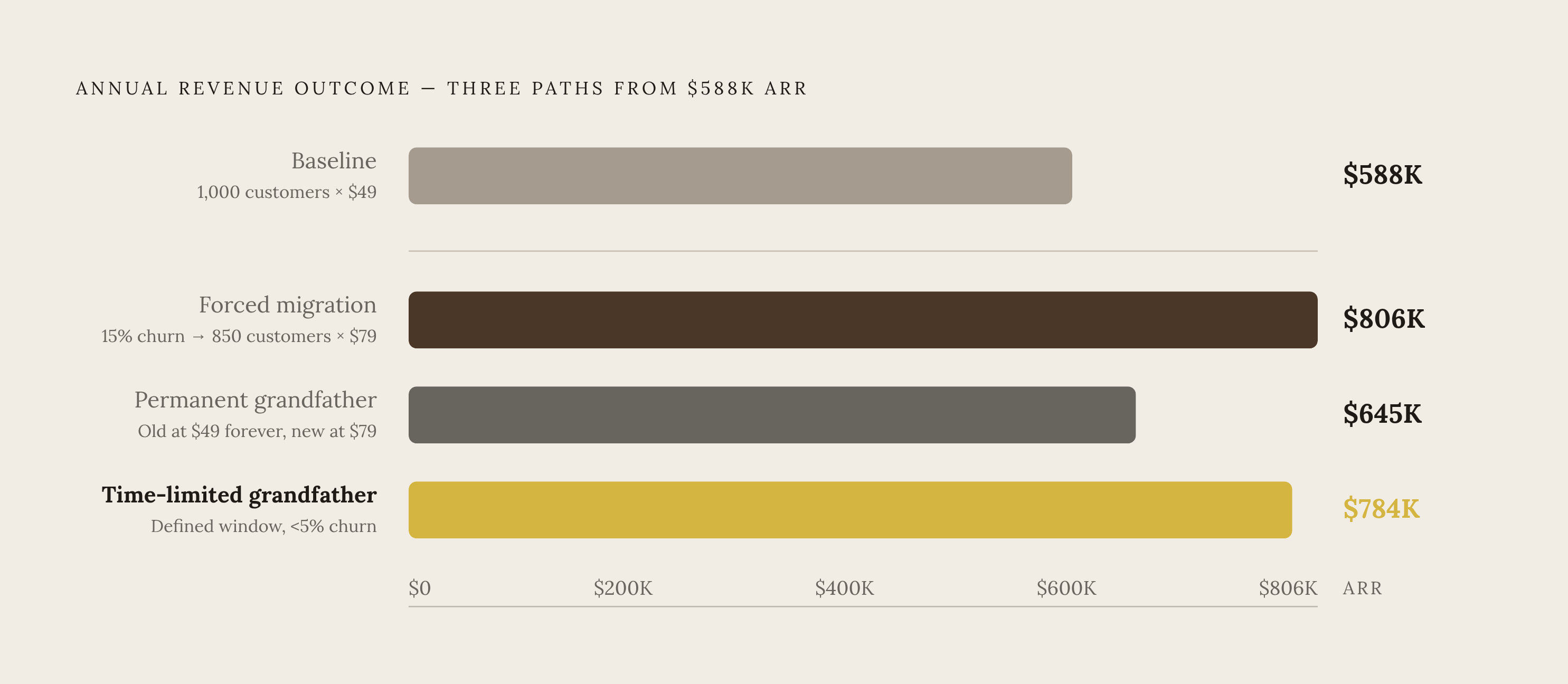
Solvimon ran a scenario that shows how much the choice of model actually moves the outcome. Start with 1,000 customers at $49 a month, $588,000 a year in recurring revenue. Forcing a migration to $79 a month absorbs a 15% churn hit and results in 850 customers generating $805,800 a year, a real gain bought with a customer base cut by more than a tenth. Permanent grandfathering, where existing customers keep $49 forever and only new signups pay $79, comes in lower than that even after counting new customer growth. A time-limited grandfather period that eventually migrates everyone, at a much lower churn rate than the forced switch, beats both. That's what happens when you capture most of the forced-migration revenue gain while sidestepping most of the forced-migration churn spike, and it's the reason time-limited grandfathering deserves to be... It's what happens when you capture most of the forced-migration revenue gain while sidestepping most of the forced-migration churn spike, and it's the reason time-limited grandfathering deserves to be the default answer, not permanent.
The four grandfathering models and what each one commits you to
Most companies don't choose a model through a strategic error. They choose one by never choosing at all, and the original pricing just stays in place by inertia. Deliberate selection, made up front, is the entire job here, and skipping it is itself a decision with consequences attached.
Permanent grandfathering holds original pricing indefinitely, with no sunset date. It fits small founding cohorts, beta testers, or bootstrapped companies with enough margin to absorb the subsidy on principle, which is what Parseur is doing with its $9 plan. Drift into it by inertia rather than choosing it on purpose, and a company can wake up years later with a meaningful share of revenue sitting on plans it discontinued long ago. It carries the widest revenue gap of any model and the hardest one to unwind, and it should be treated as a deliberate exception, never a fallback.
Time-limited grandfathering holds original pricing for a defined window, typically 12 to 24 months, before migrating customers to current pricing. It's the dominant pattern for good reason: it avoids the churn spike of an immediate forced switch while still guaranteeing pricing converges across the base eventually. Public examples from major SaaS vendors show how this plays out in practice. Billing infrastructure has to support scheduling a future, per-customer price change automatically, and this is exactly where a lot of legacy billing stacks fall apart.
Feature-gated grandfathering keeps existing features at the old price while gating any new capability behind new pricing tiers. Pairing a price increase with genuinely new, exclusive features makes gross retention run 26% higher than a price increase delivered alone. The model suits product-led companies shipping real new capability, because the increase feels earned rather than arbitrary. The tradeoff is a proliferation of tier variations that product and billing systems both have to track, entitlement by entitlement, and that tracking burden only grows with each release.
Executing forced migration without a churn spike
Grandfathering isn't always the answer, and treating it as the safe default in every case is a mistake. Forced migration is correct when the pricing model itself is changing structurally, when the legacy plan has become operationally unsustainable to support, or when the gap between legacy and current pricing has widened so far that the grandfathered cohort is distorting unit economics for the whole business.
The seat-to-usage transition is the structural trigger defining 2026. Gartner projects that 40% of enterprise applications will include AI agents by the end of the year, up from under 5% previously, and a seat count stops meaning anything once usage, not headcount, drives cost and value. Companies facing that shift shouldn't grandfather a seat-based rate forever. The pricing model itself has stopped matching what the product does, and no amount of transition courtesy changes that.
Executing the migration without detonating churn is a sequencing problem. New pricing should apply to new customers the moment it's announced, which creates urgency without touching a single existing account. Months 1 through 6 should go toward shipping visible product improvements that give the increase a reason to exist. When the 60-day notice reaches existing customers around Month 6, it should point to those specific improvements rather than arrive as a surprise line item on an invoice. Migration incentives, credits, vouchers, or a locked-in rate for anyone who upgrades early, turn a deadline into an offer instead of an ultimatum.
Communication discipline matters no matter which model gets chosen. Customers should hear about a change through email and an in-app notice before it ever shows up on an invoice, and the message should come from a founder or senior leader, never an automated billing notification. Frame it around value delivered: customers can tell whether a company earned an increase or is just passing along its own cost pressure.
The billing infrastructure requirements that most teams discover too late
Most grandfathering advice stops at picking a strategy and communicating it well. That's the easy half. Failures in the billing system, the finance workflows, and the product's entitlement architecture become visible usually months after the announcement went out clean.
Time-limited grandfathering needs a system that can schedule a future, per-customer price change and execute it automatically on the transition date, without someone manually updating records in a spreadsheet at 11pm before the cutover. Billing systems not designed for per-customer scheduling often struggle to handle this reliably. Feature-gated grandfathering needs entitlement logic that knows which cohort a customer belongs to and gates feature access accordingly, something a legacy flat-plan billing system was never built to track. Renewal-based grandfathering needs the system to correctly identify each customer's contract anniversary date, a genuine reconciliation problem in any architecture built around a single, universal pricing table. Any grandfathered plan that later adds a usage-based or credit-based overlay needs to support legacy subscription rates and consumption metering side by side, on the same invoice, at the same time.
There's a compliance dimension too, and it isn't optional. Ad-hoc price edits made directly inside a production billing environment violate basic governance practice and can create serious compliance exposure. Pricing configuration deserves the same rigor as software code: sandbox testing first, a deployment manager, documented change control before anything touches a live customer account.
Compare churn rates on legacy cohorts against churn rates on current-plan cohorts to see whether a grandfathering policy is actually working. Higher churn on the legacy side signals the grandfathering policy may not be delivering enough value to keep those customers engaged. Lower churn there confirms the policy is doing its job. Either way, that comparison should exist from day one, not get reconstructed after the fact when someone finally asks why retention slipped.
Choosing a grandfathering model as a deliberate revenue decision, not a default
Grandfathering policy is a revenue calculation with a retention variable attached. The variable to solve for is the break-even churn rate established earlier, and the model to choose is whichever one keeps actual churn below that line at the lowest operational cost to maintain.
The wrong sequence widens the revenue gap and makes the policy harder to unwind than any single choice within it would suggest on its own. Calculate the forgone revenue cost of each model across a 24-month horizon: permanent grandfathering, time-limited at 12 months, time-limited at 24 months, and forced migration. Stress-test each against 5%, 10%, and 15% churn scenarios to find the break-even point specific to that approach. Audit the billing infrastructure against whatever model gets chosen before making any promise to a customer, because a policy the system can't execute is just a liability with a delay built into it. Pair whatever migration window gets chosen with a shipped product improvement, since price increases paired with exclusive new features produce that 26% lift in gross retention over increases that arrive alone. Build cohort-level churn tracking in from day one, so the policy gets measured against actual results instead of declared once and forgotten.
Companies that never make an explicit choice end up with permanent grandfathering anyway, just without ever deciding to. Parseur can afford its $9 plan because of a specific structural advantage, being bootstrapped and answerable to no one but itself, that most companies simply don't have. Arriving at permanence by accident, without that advantage, is a different situation entirely, and a far more expensive one.
For products with a usage-based or AI pricing layer, the calculus picks up one more variable. A customer grandfathered onto a flat subscription rate who now consumes AI features billed on consumption needs a billing system that holds both structures at once, the legacy flat rate and the live usage meter, on the same account, without breaking reconciliation. Price that operational debt honestly before committing to it. It belongs in the model selection itself, in the scramble that follows once the invoices stop adding up.